All species › Passerines › Larks › Red Lark
Red Lark | Calendulauda burra
Rode leeuwerik | Alondra Roja
Red Lark is a large, heavy-billed lark found only in Bushmanland, in the north-west of South Africa. On the red sand ridges with tufts of dune grass it is as foxy-red as the sand beneath its feet; browner birds live on the gravel plains in between. With its small, fragmented range it is one of the most sought-after larks of the Karoo.

Voice
Sings from the top of a shrub or in a brief display flight: a few dry, sharp notes followed by a rolling, liquid trill, roughly chip-chip-churrrr-tseeu. The call is a short chip. Song is most intense in the early morning and after rain.
Recording: Gareth K. — CC BY-NC-SA 4.0 · shortened to the first 60 s, mono · xeno-canto
Identification
19 cm. A large, robust lark with a thick, horn-coloured bill and a rounded head. Dune birds are almost plain rufous above with at most faint streaking; birds of the gravel plains are duller brown and more clearly streaked on the back. The supercilium is pale buff and inconspicuous, the throat white. The breast is white to pale buff with coarse rufous to dark streaking, the belly white. The tail is fairly long and dark with rufous edges. The sexes are alike; juveniles show pale fringes to the upperpart feathers.
Confusion species
Karoo Lark Calendulauda albescens is very similar but smaller and finer-billed, with a striking white supercilium, a dark cheek patch and sharp black streaking on breast and flanks; it lives in Karoo shrubland south and west of Bushmanland. Sabota Lark Calendulauda sabota and Fawn-Colored Lark Calendulauda africanoides have a crisp white supercilium and live in wooded or bushy country. Large-Billed Lark Galerida magnirostris has a short crest and a yellow bill base. Dune Lark Calendulauda erythrochlamys of the Namib is smaller and slimmer; their ranges do not meet.
Habitat
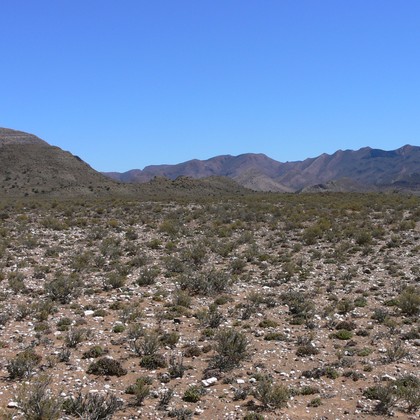
Red sand dunes and sandy plains with a sparse cover of dune grass (Stipagrostis) and low shrublets, and adjacent gravel and sand plains of the Nama Karoo. It forages on the ground for seeds and insects and runs fast between the grass tufts.
Where the bird is most at home, classified by the vegetation units of southern Africa.
Range and movements
Endemic to South Africa: Bushmanland in the Northern Cape, roughly from Aggeneys and Pofadder in the north to Brandvlei, Kenhardt and Van Wyksvlei in the south and east, south of the Orange River. Not in Namibia and nowhere else.
- Resident
- Passage (Mar–Apr, Oct–Nov)
- dark = core range, pale = thinly spread
How and when to look
Year-round, best early in the morning when males sing from shrub tops. Search the red dunes with dune grass west of Brandvlei and around Aggeneys. The heavy bill, barely streaked red back and its setting on red sand all but rule out Karoo Lark; with browner gravel-plain birds, look for the coarse, diffuse breast streaking and the lack of a crisp face pattern.
Conservation status
Vulnerable. The range is small and fragmented and numbers are declining. Overgrazing degrades the grass cover of the dunes, and mining, road building and drought linked to climate change are additional threats. The species occurs almost entirely on private farmland.
Scientific name
Calendulauda burra | (Bangs, 1930)
Bangs described the species in 1930 as Ammomanes burra; because it was later moved to another genus, the author and year stand in brackets. The genus Calendulauda was introduced in 1855 by Blyth. Calendulauda is a combination of two other lark names: Calendula and Alauda, the Latin word for 'lark'. burra comes from the Latin burrus, 'red' — for this lark's rufous plumage. The specimen the first description was based on came from not given in the source.