All species › Passerines › Larks › Dune Lark
Dune Lark | Calendulauda erythrochlamys
Roodrugleeuwerik | Alondra de las Dunas
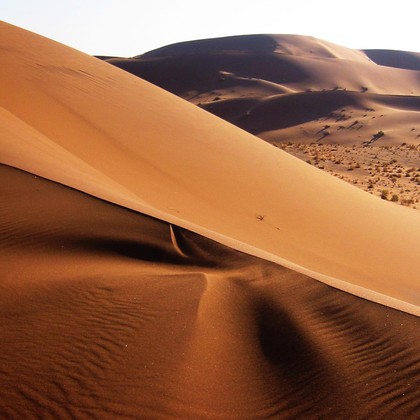
Dune Lark is the only bird truly at home in the Namib sand sea. It lives among tufts of dune grass at the foot and on the flanks of the dunes, never drinks and obtains all its moisture from insects and seeds. It occurs nowhere outside Namibia.

Voice
Sings from a dune crest, a shrublet or in a short display flight: a series of quick, dry notes accelerating into a rattling trill, roughly chip-chip-chip-chrrrrr. The call is a soft chip or chirp.
Recording: Keith Blomerley — CC BY-NC-SA 4.0 · converted to mono · xeno-canto
Identification
17–18 cm. A slim, long-tailed lark with a fairly long, slightly decurved, pinkish-horn bill. The upperparts are warm sandy to rufous with fine, faint dark streaking, stronger in southern birds. The supercilium is pale buff, the throat white. The breast is white to cream with fine rufous streaks that fade on the flanks; the belly is white. The tail is rufous with a dark centre. The sexes are alike. It walks fast and often, and when disturbed prefers to run rather than fly.
Confusion species
Barlow's Lark Calendulauda barlowi, which lives south of the sand sea around Lüderitz and Aus and along the lower Orange River, is greyer and more heavily streaked on back and breast; where the ranges meet, intermediates occur. Karoo Lark Calendulauda albescens is darker with a crisp face pattern and heavy black breast streaking, and lives further south. Gray's Lark Ammomanopsis grayi is much paler, virtually unstreaked and lives on gravel plains, not in the dunes. Red Lark Calendulauda burra is larger and heavy-billed and occurs only in Bushmanland.
Habitat
Vegetated dune bases, interdune valleys and dune slopes with tufts of Stipagrostis grass and scattered shrublets in the Namib Desert. It avoids bare shifting sand and the open gravel plains. It forages on the ground for insects and seeds, often around grass tufts where the wind collects seed.
Where the bird is most at home, classified by the vegetation units of southern Africa.
Range and movements
Endemic to Namibia: the Namib sand sea, from the Kuiseb River near Walvis Bay and Gobabeb south via Sossusvlei to the Lüderitz area. It does not occur in South Africa.
- Resident
- Summer visitor (c. Oct–Mar)
- Winter visitor (c. Apr–Sep)
- Passage (Mar–Apr, Oct–Nov)
- dark = core range, pale = thinly spread
How and when to look
Year-round; best in the first hour after sunrise, before the sand heats up. Good sites are the dunes along the Kuiseb at Rooibank and Gobabeb, and the vegetated dune bases at Sossusvlei and Sesriem. Walk slowly along the grass tufts and look for tracks in the sand; the bird often runs ahead of you. South of the sand sea, allow for Barlow's Lark and intermediates.
Conservation status
Not threatened. The range is small but lies largely within the Namib-Naukluft Park and other protected areas, and the desert habitat is under little pressure. The population is considered stable.
Scientific name
Calendulauda erythrochlamys | (Strickland, 1853)
Strickland described the species in 1853 as Alauda erythrochlamys; because it was later moved to another genus, the author and year stand in brackets. The genus Calendulauda was introduced in 1855 by Blyth. Calendulauda is a combination of two other lark names: Calendula and Alauda, the Latin word for 'lark'. erythrochlamys comes from the Greek eruthros, 'red', and chlamys, 'cloak' — for the rufous upperparts. The specimen the first description was based on came from coastal belt near Walvis Bay, Namibia.