All species › Passerines › Thrushes › Karoo Thrush
Karoo Thrush | Turdus smithi
Karoolijster | Zorzal del Karoo
The Karoo Thrush is the grey, orange-billed Turdus thrush of the dry interior of South Africa, where it lives in gardens, orchards and along tree-lined rivers. It was long regarded as a subspecies of Olive Thrush and replaces that species in the west and the interior.

Voice
The song is a variable series of clear whistled phrases and chattering notes, less rich than that of Olive Thrush, often given before sunrise from a tree or roof. The call is a thin tseep and a hard chuk; in alarm a high, rattling chak-chak-chak.
Recording: JJSUN — CC BY-NC-SA 4.0 · shortened to the first 60 s, mono · xeno-canto
Identification
22–24 cm. A greyish thrush: upperparts dark grey-brown, breast and flanks plain grey to grey-brown, with only a limited pale orange-brown wash on the centre of the lower belly. The throat is pale grey with dark streaks. The bill is entirely bright orange and the eye-ring orange; the legs orange-brown. The sexes are alike. Juveniles are browner with pale spots on the back and dark spots below.
Confusion species
Olive Thrush (Turdus olivaceus) is more olive-brown, with warm orange flanks and belly and often a dark culmen; in the Eastern Cape, the Free State and around Gauteng the two meet and hybridise, so not every bird can be named. Kurrichane Thrush (Turdus libonyana) has black malar stripes, orange flanks and a white belly, and lives in woodland. Groundscraper Thrush (Turdus litsitsirupa) has heavily spotted white underparts.
Habitat
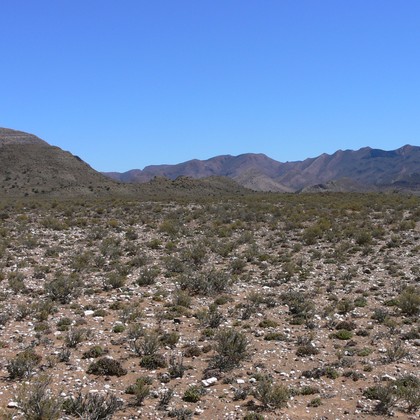
Trees along rivers and dry watercourses in the Karoo and Highveld, and above all planted trees: gardens, parks, farmyards, orchards, windbreaks and cemeteries in towns and villages. Forages on lawns and under shrubs for worms, insects and snails, and eats fruit. It has benefited greatly from tree planting in the arid interior.
Where the bird is most at home, classified by the vegetation units of southern Africa.


Range and movements
Endemic to southern Africa. Widespread in South Africa in the Western Cape (except the far south), the Northern Cape, the Karoo, the Free State, North West and Gauteng, and in Lesotho, southern Namibia (north to about Windhoek) and southern Botswana. Resident. The species does not occur outside the region.
- Resident
- Summer visitor (c. Oct–Mar)
- Winter visitor (c. Apr–Sep)
- dark = core range, pale = thinly spread
How and when to look
In almost any Karoo town or farm with a garden and trees, such as Graaff-Reinet, Beaufort West or Springbok, it can be found on the lawn in the early morning. To compare the two species, look carefully at flank colour and bill in the Free State or around Johannesburg.
Conservation status
Not threatened. Common, with a range that has expanded thanks to tree planting in towns and on farms. Hybridisation with Olive Thrush in the contact zone is known but is not a threat.
Scientific name
Turdus smithi | Bonaparte, 1850
Bonaparte described the species in 1850 and placed it straight away in the genus where it still stands. The genus Turdus was introduced in 1758 by Linnaeus. Turdus is the ordinary Latin word for 'thrush'. smithi honours the Scottish army surgeon and zoologist Andrew Smith (1797–1872), a pioneer of southern African zoology. The specimen the first description was based on came from southern Africa (not further specified).