All species › Passerines › Thrushes › Abyssinian Thrush
Abyssinian Thrush | Turdus abyssinicus
Afrikaanse berglijster | Zorzal Abisinio
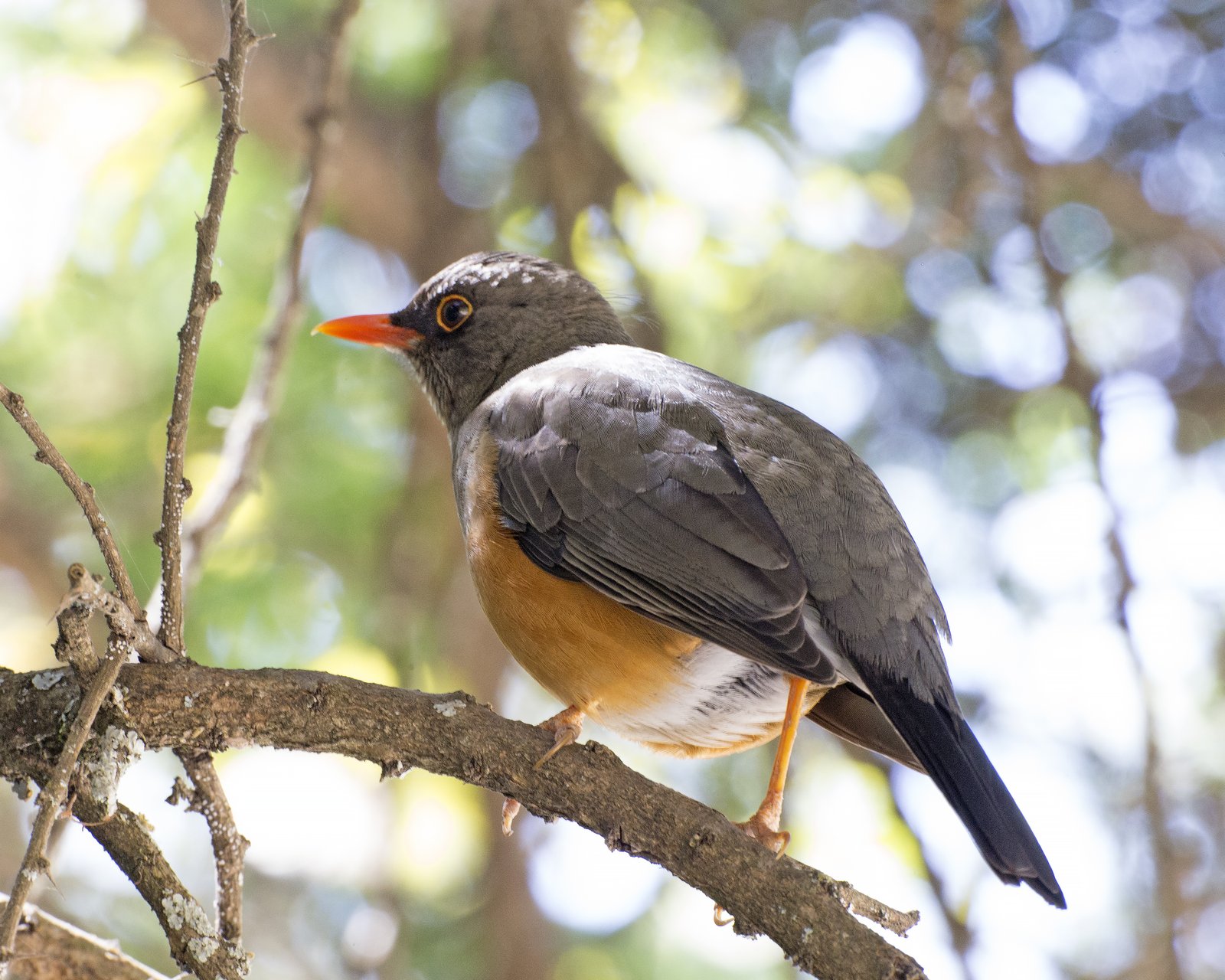
The Abyssinian Thrush is the dark, orange-billed Turdus thrush of the East African mountain forests. In the region it reaches its southern limit on the plateaus of northern Malawi and north-eastern Zambia, where it is the only large thrush of the montane forest.
Voice
The song is a leisurely, varied series of clear whistled phrases and chattering notes, often from a high branch at the forest edge at dusk. The call is a thin, high tseep and a harder chuk; the alarm a rattling chak-chak.
Recording: Simon Gillings — CC BY-NC-SA 4.0 · converted to mono · xeno-canto
Identification
21–23 cm. Upperparts dark olive-brown to slaty brown, the head often slightly greyer. The throat is pale grey with dense dark streaks; the breast grey-brown, the flanks and centre of the belly warm rufous-orange, the undertail coverts white with dark spots. The bill and narrow eye-ring are bright orange, the legs orange-brown. The sexes are alike. Juveniles are browner with pale spots on the back and dark spots on breast and flanks. The higher up the mountain, the darker the birds.
Confusion species
Olive Thrush (Turdus olivaceus) is very similar and was formerly lumped with it; in the region the difference is mainly geographical: Olive Thrush lives in South Africa and, depending on the taxonomy, on Mulanje and in the Eastern Highlands of Zimbabwe and Mozambique, not on Nyika. African Thrush (Turdus pelios) is paler grey-brown with a yellow bill and hardly any orange on the flanks, and lives in lowland forest. Kurrichane Thrush (Turdus libonyana) has black malar stripes and a white belly. Orange Ground Thrush (Geokichla gurneyi) has an orange throat and breast and white wing bars.
Habitat
Montane evergreen forest, forest edges, ravine thickets and montane grassland with scrub, up to over 2000 m; also around camps and in gardens on the plateaus. Forages on the ground in clearings and on lawns for worms and insects, and eats fruit. Nests in a tree fork or on a branch close to the trunk.
Where the bird is most at home, classified by the vegetation units of southern Africa.

Range and movements
In the region only on the plateaus of northern Malawi (Nyika, Viphya, Misuku) and adjacent north-eastern Zambia (the Zambian side of Nyika, the Mafinga Hills). Some taxonomies also include the thrushes of Mulanje and the Eastern Highlands of Zimbabwe and Mozambique in this species. Beyond, from Tanzania and Kenya through Uganda and eastern DR Congo to Ethiopia and South Sudan.
- Resident
- dark = core range, pale = thinly spread
How and when to look
On the Nyika Plateau it is easy to see around Chelinda and in the Zovochipolo forest patches, often feeding in clearings near the lodges in the early morning. Listen for the leisurely whistled song at the forest edge at sunset.
Conservation status
Not threatened. Common in its montane habitat. In the region the population is small and tied to forest remnants on the plateaus; fire and clearing are the main threats.
Scientific name
Turdus abyssinicus | Gmelin, 1789
Gmelin described the species in 1789 and placed it straight away in the genus where it still stands. The genus Turdus was introduced in 1758 by Linnaeus. Turdus is the ordinary Latin word for 'thrush'. abyssinicus means 'of Abyssinia', the old name for Ethiopia, where the first specimen came from. The specimen the first description was based on came from Ethiopia (not further specified).