All species › Passerines › African Warblers › Lemon-Bellied Crombec
Lemon-Bellied Crombec | Sylvietta denti
Geelbuikkrombek | Crombec Ventrilimón
Lemon-Bellied Crombec is one of the smallest forest birds in the region: an almost tailless little ball with a grey head, an olive-green back and a lemon-yellow belly. A species of the Central African rainforest, it occurs in the region only in northern and north-western Angola, where it travels with mixed flocks through the canopy of moist forest.

Voice
A high, thin, rapid series of a few notes, often rising and falling, such as 'tsi-tsi-tsuwee-tsuwee', repeated at short intervals. The contact call is a soft, thin 'tsip'. In the dense canopy it is heard far more often than seen.
Recording: Niall Perrins — CC BY-NC-SA 4.0 · xeno-canto
Identification
About 8 cm. Crown and hindneck grey, mantle, rump and wing edgings olive-green. The face, throat and breast are warm rufous-buff to cinnamon, contrasting fairly sharply with the lemon-yellow belly and undertail coverts that give the species its name. The tail is very short, as in all crombecs, so the bird looks cut off at the rear. The bill is fine, pointed and dark; legs pinkish-brown. The sexes are alike; juveniles are duller, with a paler yellow belly.
Confusion species
Green Crombec Sylvietta virens is the only other crombec living in the same forest in northern Angola and thus the main pitfall: it has a brown rather than grey head, a brownish breast and a dirty-white belly with no yellow. Red-Capped Crombec Sylvietta ruficapilla has a rufous crown or rufous cheeks, a white throat and an ash-grey back without green, and lives in miombo rather than rainforest. Long-Billed Crombec Sylvietta rufescens is larger and grey above, with a clearly longer, decurved bill, a dark eye-stripe and wholly cinnamon underparts; it is a bird of dry woodland. Red-Faced Crombec Sylvietta whytii has a grey back and uniform rufous-buff underparts and occurs only in the east of the region, far from the range of Lemon-Bellied Crombec. Green Hylia Hylia prasina is larger, with a longer tail and a yellow supercilium.
Habitat
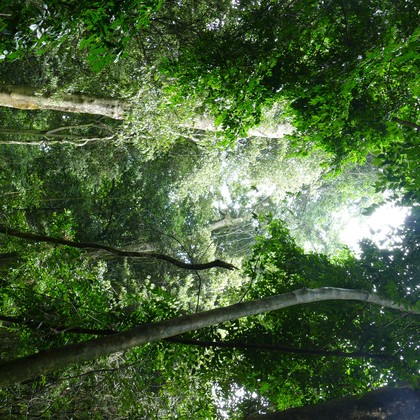
Moist lowland and escarpment forest, especially edges, clearings and the upper canopy, also old secondary forest and tangles rich in lianas. It forages restlessly through foliage and along thin branches in the middle and upper strata, often in mixed flocks, gleaning small insects and spiders from leaves and twigs.
Where the bird is most at home, classified by the vegetation units of southern Africa.
Range and movements
A rainforest species of Central and West Africa that is well established in the region in northern and north-western Angola, rather than a mere vagrant at the edge. Recent records come from the Luanda area and Kumbira Forest in Cuanza Sul (both 2024), and an old museum specimen from 1958 was taken at Dundo in Lunda, so the species is known from several Angolan provinces. Beyond the region, from Sierra Leone and Guinea through West Africa (subspecies hardyi) and from Nigeria and Cameroon through Gabon and Congo to eastern DR Congo and western Uganda (nominate denti).
How and when to look
The best site in the region is Kumbira Forest near Conda in Cuanza Sul, where it moves through the canopy with mixed flocks. Listen for the high, undulating series and scan the treetops for a tiny, tailless bird. A glimpse of the yellow belly separates it at once from Green Crombec, which can occur in the same places.
Conservation status
Not threatened; patchy and sparse across its large range, but not rare. Clearance of moist forest for farming and timber reduces its habitat, including in Angola, where the escarpment forests of Cuanza Sul are under heavy pressure. Its status in Angola is poorly known.
Scientific name
Sylvietta denti | Ogilvie-Grant, 1906
Ogilvie-Grant described the species in 1906 as Sylviella denti; because it was later moved to another genus, the author and year stand in brackets. The genus Sylvietta was introduced in 1839 by De Lafresnaye. Sylvietta is a diminutive of Sylvia (warbler), after the French sylviette, 'little warbler' — for the tiny, almost tailless crombecs. denti honours the British collector Richard Edward Dent, a member of the British Museum Ruwenzori expedition of 1905–1906, which gathered the birds from which Ogilvie-Grant described this species. The specimen the first description was based on came from 10 miles northwest of Fort Beni, West Ruwenzori, Congo Free State; altitude 3,000 feet.