All species › Passerines › African Warblers › Long-Billed Crombec
Long-Billed Crombec | Sylvietta rufescens
Kaapse krombek | Crombec Piquilargo
Long-Billed Crombec is one of the best-known small birds of the dry woodland of southern Africa: a grey and cinnamon ball with no visible tail and a long, slightly decurved bill. It creeps along branches like a treecreeper and announces itself with a penetrating, repeated tree-reet.

Voice
A loud, penetrating and often repeated tree-reet, tree-reet or tirrit-tirrit-tirrit, sometimes accelerating into a rolling series. While foraging it gives a dry tsik or trrt. The song is heard all year and for many birders is the first sign that a crombec is nearby.
Recording: Paul Driver — CC BY-NC-SA 4.0 · converted to mono · xeno-canto
Identification
10–12 cm. Upperparts grey to grey-brown, the wings browner. A pale creamy supercilium above a dark eye-stripe. Throat pale buff, the rest of the underparts warm cinnamon to buff-brown, deepest on the flanks and undertail. The tail is so short that the bird looks almost tailless. The bill is long, thin and slightly decurved, dark with a paler base. Legs pinkish-brown, eye light brown. Birds from the east (Mozambique, lowveld) are paler below than those from the west.
Confusion species
Red-Faced Crombec Sylvietta whytii, in the north-east, has a shorter, straight bill, a rufous face with no dark eye-stripe and uniform rufous-buff underparts. Red-Capped Crombec Sylvietta ruficapilla of Angola and Zambia has red on the crown or cheeks, a white throat and a shorter bill. Yellow-Bellied Eremomela Eremomela icteropygialis has a distinct tail, a greyish breast and a yellow belly. Cape Penduline Tit Anthoscopus minutus is smaller, with a short conical bill and a yellow belly.
Habitat
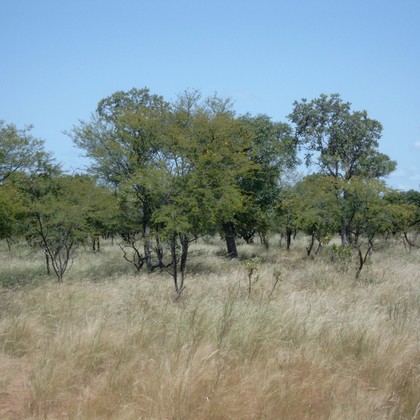
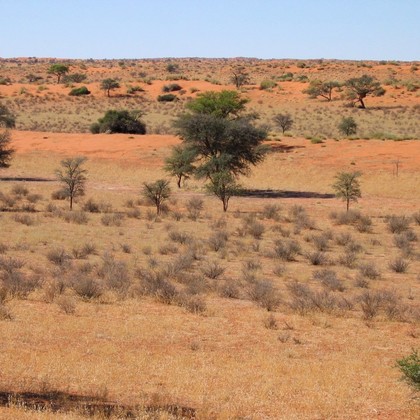
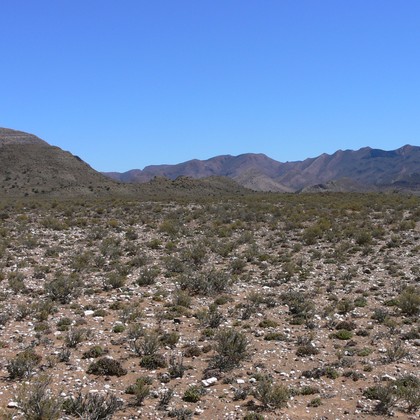
Dry savanna and thornveld, Kalahari thornveld, mopane and mixed woodland, Karoo scrub, along dry watercourses and on wooded hills; also fynbos margins. It is absent from dense forest and open, treeless grassland. It forages low to mid-height in bushes and trees, creeping along trunks and branches and picking insects from bark crevices and leaves. The nest is a hanging purse of grass and cobweb.
Where the bird is most at home, classified by the vegetation units of southern Africa.
Range and movements
Widespread: almost all of Namibia, Botswana, Zimbabwe and southern and western Mozambique, much of South Africa (not on the treeless highveld or in the high Drakensberg), Eswatini and the lowest parts of Lesotho, as well as southern and western Zambia, southern and central Angola and southern Malawi. Beyond, to south-eastern DR Congo and south-western Tanzania.
- Resident
- Summer visitor (c. Oct–Mar)
- Winter visitor (c. Apr–Sep)
- Passage (Mar–Apr, Oct–Nov)
- dark = core range, pale = thinly spread
How and when to look
Easy to find year-round in almost any dry reserve, from Kruger and Pilanesberg to Etosha and the Kgalagadi. Follow the loud tree-reet and look for a small bird creeping along branches or flying briefly from bush to bush; the long bill and lack of a tail are obvious at once. In the north-east of the region always check for Red-Faced Crombec.
Conservation status
Not threatened; common and widespread. The species also does well in disturbed and overgrazed scrub and has no known major threats.
Scientific name
Sylvietta rufescens | (Vieillot, 1817)
Vieillot described the species in 1817 as Dicaeum rufescens; because it was later moved to another genus, the author and year stand in brackets. The genus Sylvietta was introduced in 1839 by De Lafresnaye. Sylvietta is a diminutive of Sylvia (warbler), after the French sylviette, 'little warbler' — for the tiny, almost tailless crombecs. rufescens is Latin for 'reddish', from rufus, 'rufous' — for the buffy-rufous underparts. The specimen the first description was based on came from Olifants River, Western Cape, South Africa (after Levaillant).