All species › Flamingos › Flamingos › Lesser Flamingo
Lesser Flamingo | Phoeniconaias minor
Kleine flamingo | Flamenco Enano
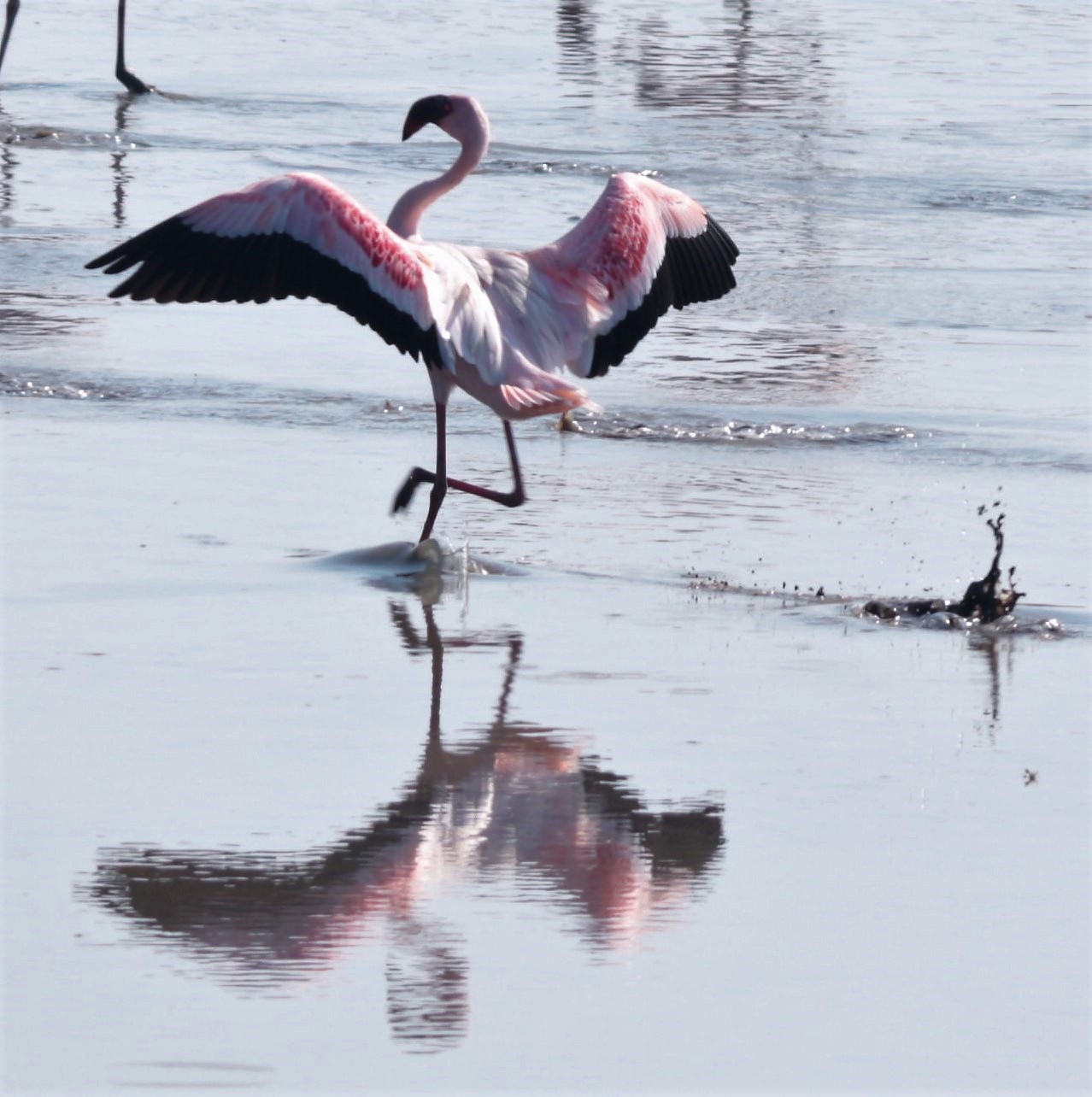
The Lesser Flamingo is the smallest of the flamingos and is known by its dark red bill, which looks black at a distance. It filters blue-green algae from brackish and alkaline waters and sometimes gathers in tens of thousands on shallow pans.
Voice
A high murmuring kwirrik and a goose-like honking. A large flock produces a continuous murmur that carries across the pan. In flight a nasal kwak, taken up in chorus by the whole formation.
Recording: Boyancé — CC BY-NC-SA 4.0 · converted to mono · xeno-canto
Identification
About 80 to 105 cm long with a wingspan around a metre and a weight of 1200 to 2700 grams, clearly smaller and more compact than the Greater Flamingo. The plumage is a deeper pink, the wing coverts crimson and the flight feathers black. The bill is dark crimson with a black tip and looks uniformly dark at range; the legs are red. Sexes alike, the male larger. Juveniles are grey-brown. It feeds with the head upside down, swishing the bill tip just below the surface while walking or swimming.
Confusion species
Greater Flamingo (Phoenicopterus roseus) is far larger and much paler, almost white, with a pink bill tipped black and paler legs. The two often stand in the same flock; size and above all bill colour separate them at any distance. The Greater also feeds in deeper water and submerges its head further.
Habitat
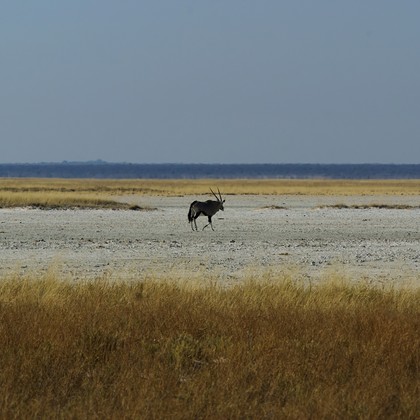
Shallow alkaline and saline pans, coastal lagoons, saltworks and estuaries. The diet consists almost entirely of blue-green algae (Arthrospira) and diatoms, sieved from the water by fine lamellae inside the bill.
Where the bird is most at home, classified by the vegetation units of southern Africa.
Range and movements
In southern Africa the only regular breeding sites are Etosha Pan in Namibia and the Makgadikgadi pans, especially Sua Pan, in Botswana; a colony also breeds on a purpose-built island at Kamfers Dam near Kimberley. Outside the breeding season birds range across the whole region and occupy Walvis Bay, Sandwich Harbour, the Orange River mouth, Langebaan lagoon and the saltworks along the south and east coasts. Beyond the region the species occurs in the East African rift lakes, in West Africa, and in India and Pakistan.
- Resident
- Summer visitor (c. Oct–Mar)
- Winter visitor (c. Apr–Sep)
- Passage (Mar–Apr, Oct–Nov)
- dark = core range, pale = thinly spread
How and when to look
After good rains, usually from January to April, Etosha Pan and the Makgadikgadi pans fill and tens of thousands of birds gather there; in dry years nothing happens at all. Outside that window, coastal lagoons and saltworks are reliable all year. In a mixed flock, always check bill colour first. Early and late in the day the light is best and the birds stand closer to the shore.
Conservation status
Near Threatened. The species breeds at a handful of sites, so a single disturbed or failed season affects a large share of the population. Soda ash and salt extraction at Sua Pan, water abstraction, collisions with power lines, for which Kamfers Dam is known, disturbance of breeding colonies and botulism outbreaks are the main pressures. The key pans fall under international wetland conventions.
Scientific name
Phoeniconaias minor | (Geoffroy Saint-Hilaire, 1798)
Geoffroy Saint-Hilaire described the species in 1798 as Phoenicopterus minor; because it was later moved to another genus, the author and year stand in brackets. The genus Phoeniconaias was introduced in 1869 by Gray. Phoeniconaias comes from the Greek phoinix, 'crimson', and naias, 'water nymph' — a 'crimson water nymph', for the pink colour and the bird's tie to water. minor is Latin for 'smaller', distinguishing it from the larger, more widespread flamingo. The specimen the first description was based on came from Senegal.