All species › Flamingos › Flamingos › Greater Flamingo
Greater Flamingo | Phoenicopterus roseus
Flamingo | Flamenco Común
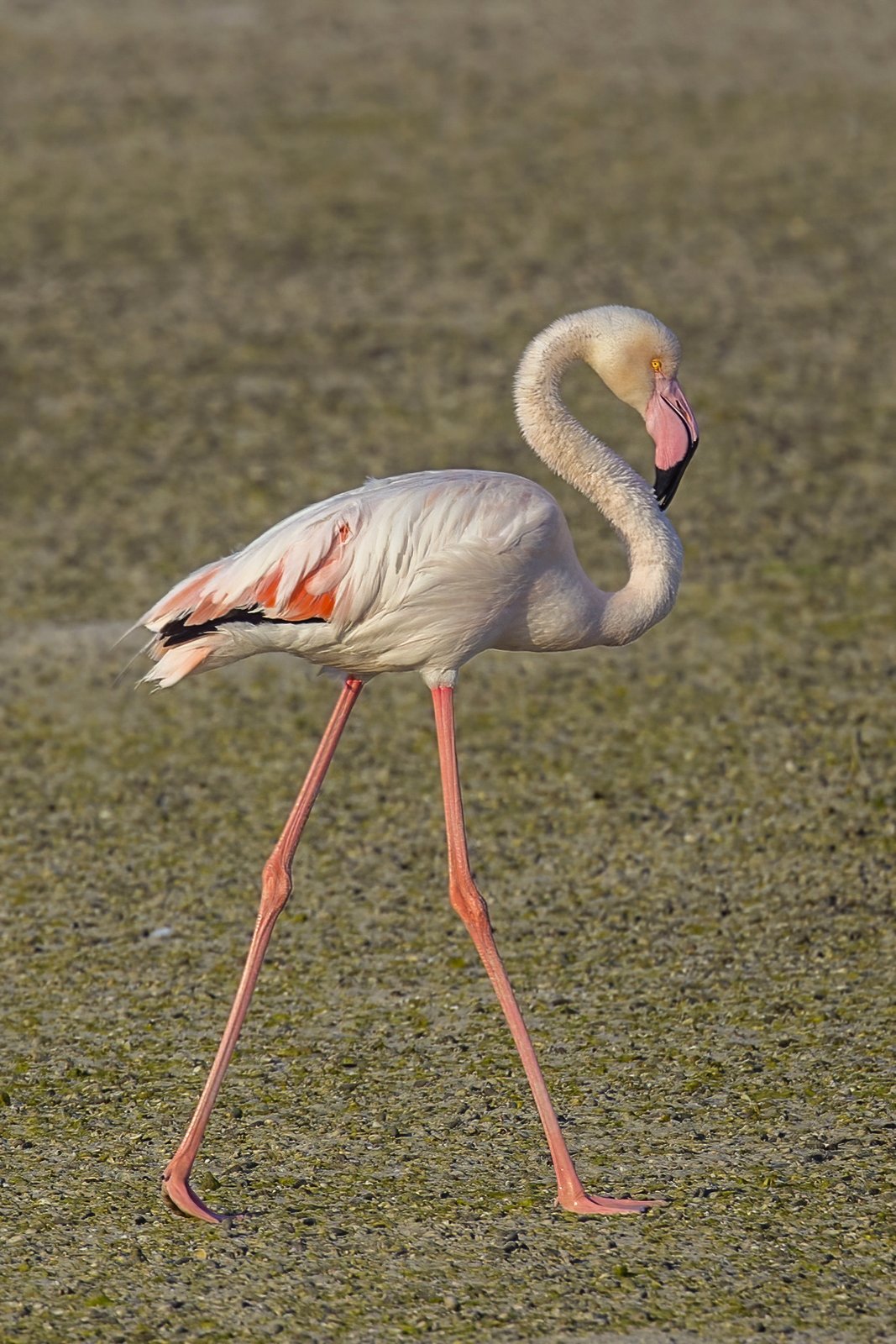
The Greater Flamingo is the larger and paler of southern Africa's two flamingos, a tall, almost white bird with a pink bill and crimson wings. It feeds on invertebrates in shallow saline and brackish water and often stands in mixed flocks with Lesser Flamingos.
Voice
A goose-like, two-syllable honking, ka-hank, lower and fuller than that of Lesser Flamingo. A feeding flock produces a continuous gabbling and grunting; in flight the birds call almost constantly.
Recording: BİLGEHAN ERGAN — CC BY-NC-SA 4.0 · converted to mono · xeno-canto
Identification
About 120 to 145 cm long, with a very long neck and legs. The plumage is white washed with pink; the upperwing coverts are crimson and the flight feathers black, giving a striking red-and-black wing pattern, especially in flight. The bill is pale pink with a sharply demarcated black tip, the eye is yellow and the legs are pink. The sexes are alike, the male clearly larger. Juveniles are grey-brown with a grey bill and dark legs, and become white and pink only after several years. It flies in lines and V-formations with neck and legs outstretched.
Confusion species
Lesser Flamingo (Phoeniconaias minor) is much smaller and deeper pink, with a dark red bill that looks black at a distance and lacks a contrasting tip. In a mixed flock the Greater Flamingo stands out by its height and paleness. Young Greaters are larger and longer-billed than young Lessers. American Flamingo (Phoenicopterus ruber) of the Caribbean is deep orange-pink and does not occur in the wild in the region.
Habitat
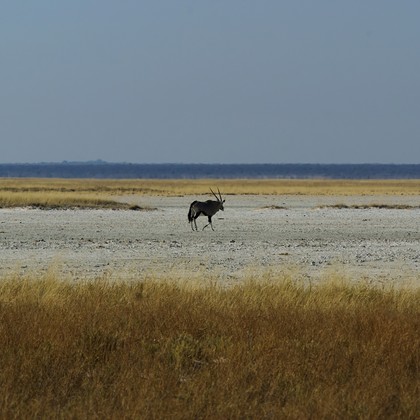
Shallow salt pans, brackish lakes, coastal lagoons, estuaries, saltworks and sewage ponds, sometimes large dams inland. It feeds head-down in slightly deeper water than Lesser Flamingo, sieving brine shrimps, insect larvae, small molluscs and organic mud from the bottom, often trampling in small circles as it goes.
Where the bird is most at home, classified by the vegetation units of southern Africa.

Range and movements
Breeds in wet years on Etosha Pan in Namibia and Sua Pan in the Makgadikgadi in Botswana. Outside the breeding season it is spread across the whole region: along the Namibian coast at Walvis Bay and Sandwich Harbour, the Orange River mouth, the Western Cape with Langebaan Lagoon and the Cape Flats, the Eastern Cape estuaries, Lake St Lucia in KwaZulu-Natal, the coast of Mozambique and the Angolan coast near Luanda and at Baía dos Tigres; inland on pans and dams of the Highveld and in Botswana, and scarce in Zimbabwe, Zambia and Malawi. Beyond the region across much of Africa, southern Europe, the Middle East and southern Asia.
- Resident
- Summer visitor (c. Oct–Mar)
- Winter visitor (c. Apr–Sep)
- Passage (Mar–Apr, Oct–Nov)
- dark = core range, pale = thinly spread
How and when to look
Walvis Bay is the most reliable site: hundreds to thousands of birds stand on the lagoon all year, often right beside the promenade. In South Africa, Strandfontein near Cape Town, Langebaan Lagoon and the West Coast saltpans are good. After a wet summer a visit to Etosha or the Makgadikgadi Pans pays off, as large breeding colonies may form.
Conservation status
Not threatened and numerous worldwide. In southern Africa breeding success depends on irregular rainfall at a few pans, so years without young are common. Disturbance of breeding colonies, salt and soda extraction, water abstraction and collisions with power lines are local problems.
Scientific name
Phoenicopterus roseus | Pallas, 1811
Pallas described the species in 1811 and placed it straight away in the genus where it still stands. The genus Phoenicopterus was introduced in 1758 by Linnaeus. Phoenicopterus is Greek, from phoinix 'crimson' and pteron 'feather', thus 'red-feathered'. roseus is Latin for 'rose-coloured', after the pale pink plumage. The specimen the first description was based on came from the Ural River.