All species › Gamebirds › Pheasants and partridges › Chukar Partridge
Chukar Partridge | Alectoris chukar
Aziatische steenpatrijs | Perdiz Chukar
The Chukar Partridge is an introduced gamebird that in southern Africa occurs only on Robben Island in Table Bay. The population descends from six birds confiscated by customs at the port of Cape Town in 1964 and released on the island.

Voice
A rhythmic series that grows louder, chuk-chuk-chuk-chukar-chukar, which gives the species its name, and a sharp pitchi-pitchi when disturbed. It calls mostly in the morning from a raised spot.
Recording: Stanislas Wroza — CC BY-NC-SA 4.0 · converted to mono · xeno-canto
Identification
About 33 cm, compact, with a short rounded tail. The upperparts and breast are soft blue-grey to sandy brown, and the creamy-white throat is framed by a black band running from the forehead through the eye to the breast. The pale flanks carry bold black and chestnut bars. The bill, eye-ring and legs are coral red. The sexes are alike; the male is slightly larger and has a blunt spur. In flight the rufous outer tail feathers stand out.
Confusion species
No other partridge or francolin occurs on Robben Island; the Helmeted Guineafowl that also lives there is much larger and dark with white spots. On the mainland, which the species has not reached, the Cape Spurfowl differs in its dark, finely marked plumage without a black throat frame or barred flanks.
Habitat
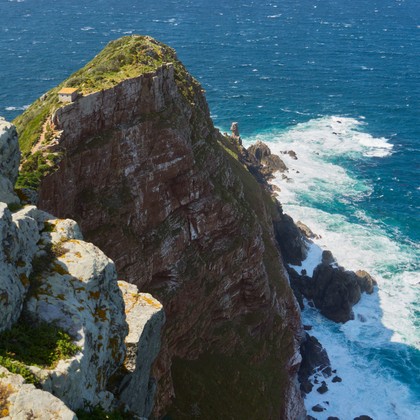
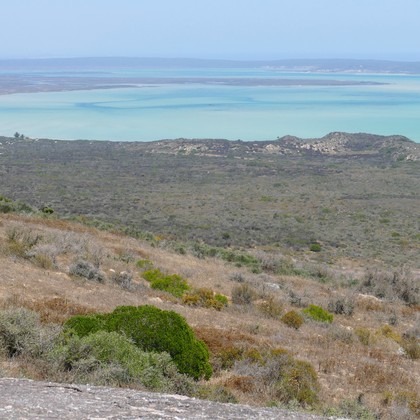
On Robben Island, open low strandveld scrub with sandy and rocky patches, small lawns around the buildings and the edges of the quarry. It forages on the ground for seeds, young shoots, leaves and insects. In its native range it is a bird of dry rocky mountain slopes and semi-desert.
Where the bird is most at home, classified by the vegetation units of southern Africa.
Range and movements
Within the region only on Robben Island (South Africa), about 7 km offshore from Cape Town; the birds have not crossed to the mainland. Native from south-eastern Europe through Turkey, the Middle East and Central Asia to northern China; introduced in North America, Hawaii and New Zealand.
- Resident
- Passage (Mar–Apr, Oct–Nov)
- dark = core range, pale = thinly spread
How and when to look
Seen only from the tour bus on a visit to Robben Island, by ferry from the V&A Waterfront. Watch the roadsides and the area around the quarry for small groups running quietly away; have the camera ready, as the bus stops only briefly.
Conservation status
Not globally threatened. The island population numbered a few hundred birds around 2018 but has fluctuated strongly; in the mid-2000s feral cats reduced it to a few dozen. As an alien species it has no meaningful protection in South Africa.
Scientific name
Alectoris chukar | (Gray, 1830)
Gray described the species in 1830 as Perdix Chukar; because it was later moved to another genus, the author and year stand in brackets. The genus Alectoris was introduced in 1829 by Kaup. Alectoris is Greek, from alektoris 'farmyard hen', from alektōr 'cockerel'. chukar imitates the call, by way of Hindi chakor; the word already occurs in Sanskrit. The specimen the first description was based on came from Srinagar, Kumaon.