All species › Parrots › Old World parakeets › Lilian's Lovebird
Lilian's Lovebird | Agapornis lilianae
Nyasa-agapornis | Inseparable del Nyasa
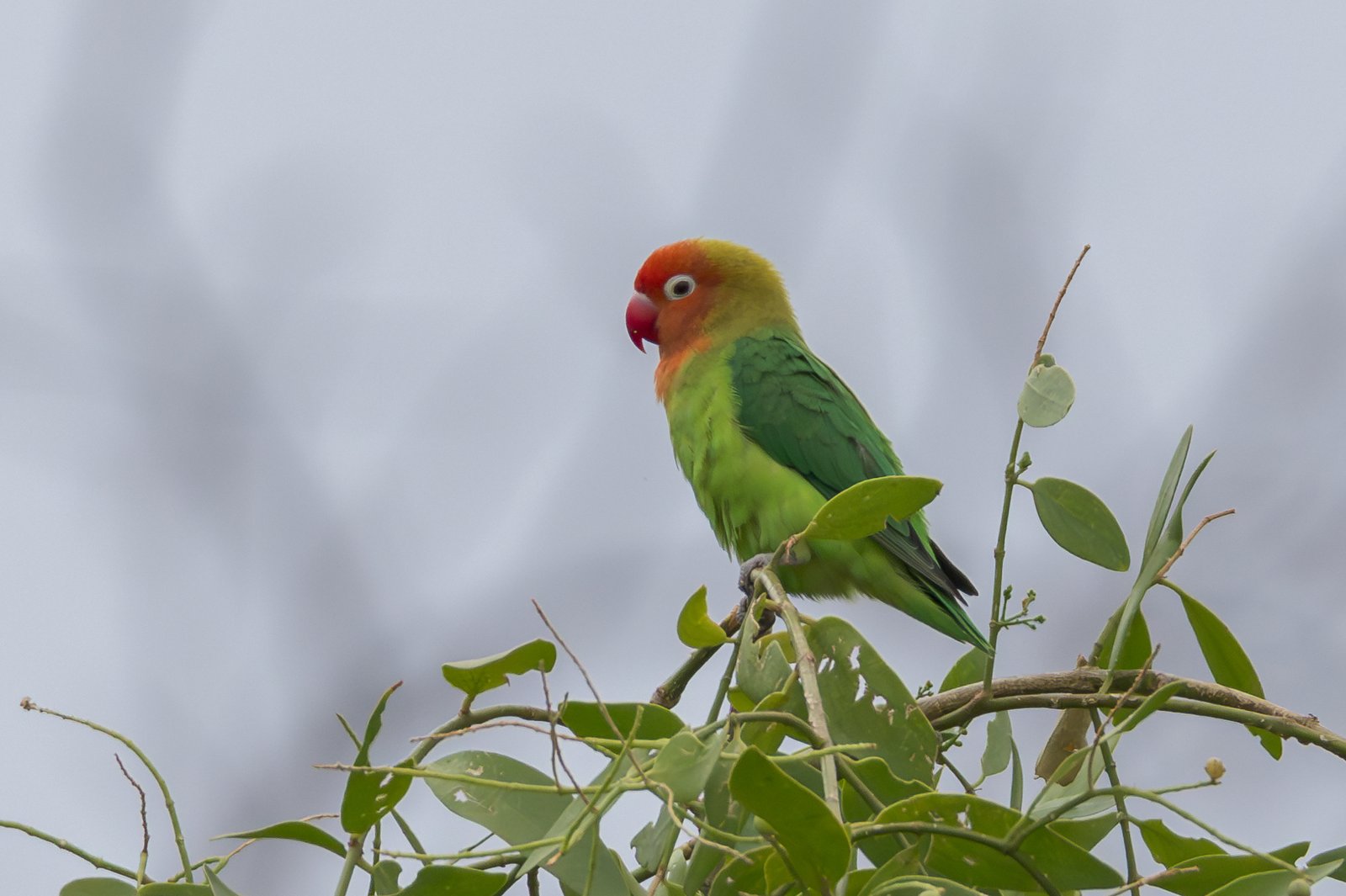
Lilian's Lovebird is a small green lovebird with an orange-red face and a conspicuous white eye-ring, tied to the mopane woodland of the middle Zambezi and Luangwa. It lives in busy, fast-flying flocks that come to water one or more times every day.
Voice
A high, rapid twittering, tsee-tsee-tsee, with sharp single calls in flight. Flocks perched in a drinking tree make a continuous, penetrating din.
Recording: Magnus Wadstein — CC BY-NC-SA 4.0 · converted to mono · xeno-canto
Identification
13–14 cm, small and compact, with a short tail. The forehead and forecrown are orange-red, grading into salmon-pink on the throat and cheeks; the hindcrown is green with a yellowish tinge. The rest of the body is grass-green, the rump slightly paler green (not blue). The bill is bright red and a broad bare white ring surrounds the eye. In flight the orange and black basal pattern of the tail feathers may show. The sexes are alike; juveniles are duller, with a dark mark on the bill.
Confusion species
Black-Cheeked Lovebird (Agapornis nigrigenis) has a brownish-black face, an orange throat patch and a brownish crown; the two are separated by the Victoria Falls and the broad middle section of the Zambezi, although hybrids are known from captivity. Rosy-Faced Lovebird (Agapornis roseicollis) of the west is larger, with a blue rump and no white eye-ring. Other escaped lovebirds occur in towns.
Habitat
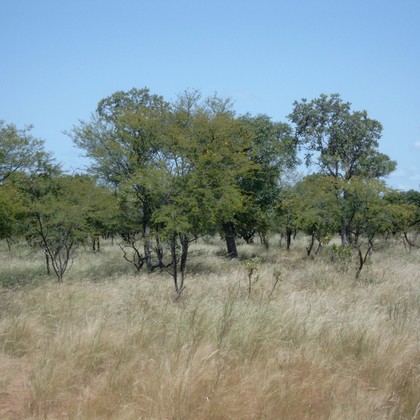
Mopane and acacia woodland on river terraces, usually within a few kilometres of permanent water. It feeds mainly on grass and herb seeds, both on the ground and in the vegetation, and also visits millet and sorghum fields. It nests in tree holes, often in mopane or baobab, and lines the nest with strips of bark carried in the bill.
Where the bird is most at home, classified by the vegetation units of southern Africa.


Range and movements
In the region restricted to the valleys of the middle Zambezi and the Luangwa: the Zambian bank of the Zambezi and the Luangwa Valley, northern Zimbabwe (Mana Pools, Chewore), western Mozambique in Tete, and southern Malawi in the Shire Valley and Liwonde National Park. Beyond the region only in southern Tanzania around the Selous Game Reserve.
- Resident
- Winter visitor (c. Apr–Sep)
- dark = core range, pale = thinly spread
How and when to look
Mana Pools, the Luangwa Valley and Liwonde are the best sites; go in the morning to a water's edge where mopane grows down to the bank and wait for the flocks to drop in to drink. Their green plumage makes them vanish in the foliage; follow the calls.
Conservation status
Near Threatened; the range is small and fragmented, and the species depends heavily on permanent water. Formerly trapped in numbers for the cage-bird trade. Ongoing clearance of mopane and the drying of tributaries are the main threats; in the large national parks it is still common.
Scientific name
Agapornis lilianae | Shelley, 1894
Shelley described the species in 1894 and placed it straight away in the genus where it still stands. The genus Agapornis was introduced in 1836 by Selby. Agapornis comes from the Greek agapē, 'love', and ornis, 'bird' — for the close bond between the members of a pair. lilianae honours Lilian Elizabeth Lutley Sclater (1863–1957), daughter of the English ornithologist Philip Lutley Sclater. The specimen the first description was based on came from Liwonde, Shire valley, Malawi.