All species › Parrots › Old World parakeets › Rosy-Faced Lovebird
Rosy-Faced Lovebird | Agapornis roseicollis
Perzikkopagapornis | Inseparable de Namibia
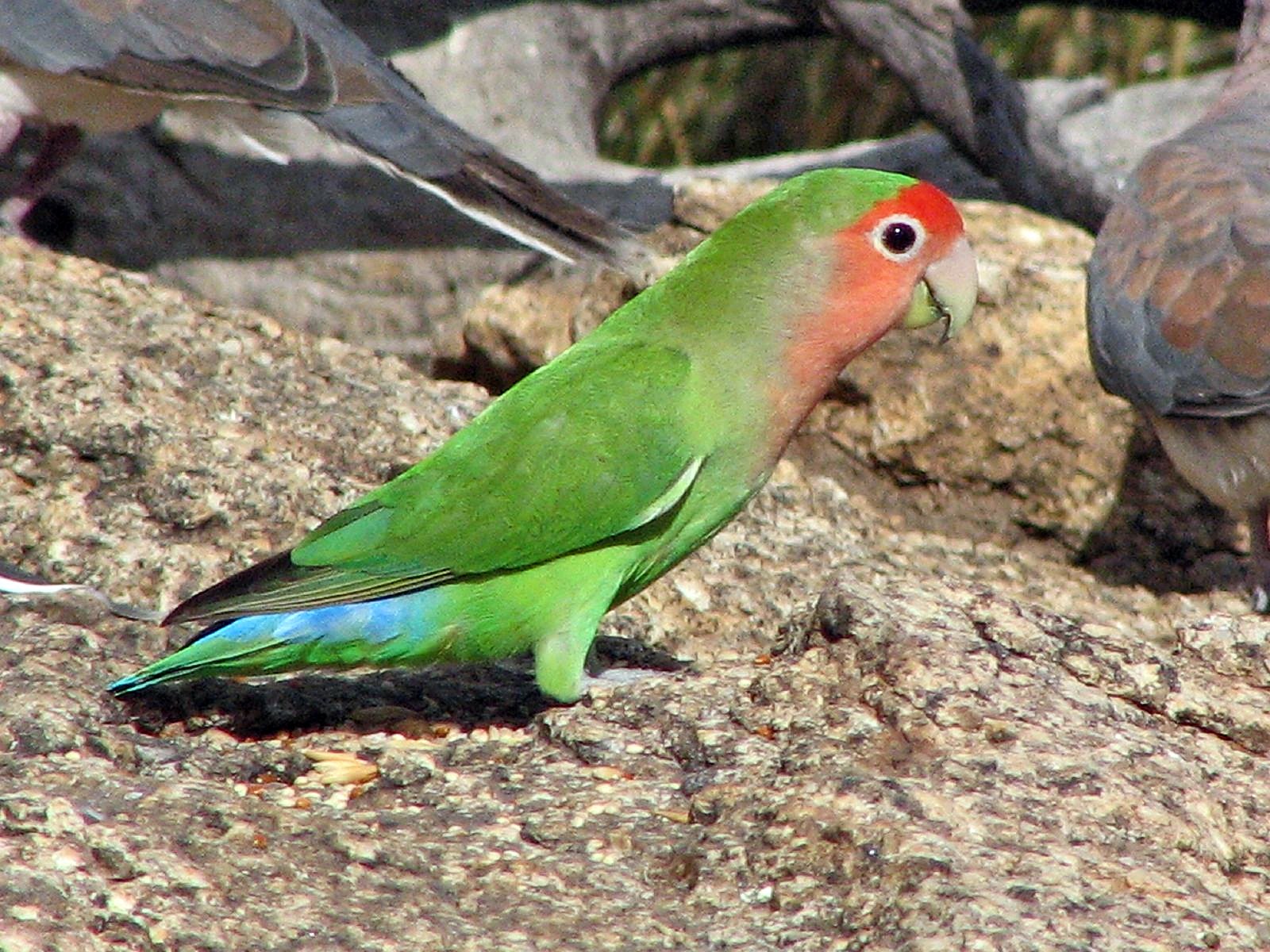
The Rosy-Faced Lovebird is a small, stocky parrot with a pink face and a bright blue rump, the only lovebird of the arid west. Small flocks fly screeching between rocky hills and waterholes, and the species likes to breed in the chambers of the huge communal nests of the Sociable Weaver.
Voice
A high screech, shreek or tsheek, rapidly repeated in flight and on landing. Flocks keep up a continuous strident chatter in trees or on rocks.
Recording: African Bioacoustics Community — CC BY-NC-SA 4.0 · converted to mono · xeno-canto
Identification
17–18 cm, with a short rounded tail. The body is grass-green, the forehead deep pink and the face and throat paler peach-pink. The rump and uppertail coverts are bright sky-blue, conspicuous in flight. The tail feathers have a red-and-black basal pattern, visible only when the tail is spread. The bill is horn to greyish-yellow; there is no white eye-ring. The sexes are alike. Juveniles have a duller, greyish-pink face and a dark base to the bill.
Confusion species
No other lovebird overlaps in the arid west. Rüppell's Parrot (Poicephalus rueppellii), found in the same area, is larger and greyish-brown with a blue rump and belly, lacking pink on the face. Escaped cage birds of other lovebirds, such as Lilian's Lovebird (Agapornis lilianae) with its orange-red face and white eye-ring, occur in towns, as do yellow and blue colour mutants of this species.
Habitat
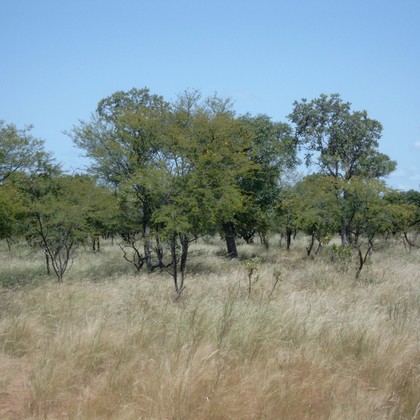
Dry, hilly and rocky savanna and semi-desert, always within flying distance of water: river beds, springs, stock troughs and dams. It eats grass and herb seeds and visits grain fields. It nests in rock crevices, under the eaves of buildings and above all in the nest chambers of Sociable Weaver (Philetairus socius) and White-Browed Sparrow-Weaver (Plocepasser mahali). The female carries nest material tucked between her rump feathers.
Where the bird is most at home, classified by the vegetation units of southern Africa.


Range and movements
Most numerous in western and central Namibia, from the Orange River to the Kaokoveld, and further in south-western Angola. In South Africa restricted to the north-west of the Northern Cape, along the Orange River and in the Richtersveld. The range is virtually confined to these three countries; feral populations exist outside Africa, including in Arizona.
- Resident
- Summer visitor (c. Oct–Mar)
- Winter visitor (c. Apr–Sep)
- Passage (Mar–Apr, Oct–Nov)
- dark = core range, pale = thinly spread
How and when to look
Wait in the morning at a waterhole or stock trough in rocky country; flocks tend to arrive along the same route each time. In Windhoek and other Namibian towns they can also be seen in gardens and parks. Check large Sociable Weaver nests for lovebirds flying in and out.
Conservation status
Not threatened; common over most of its range. Locally trapped for the cage-bird trade, but captive breeding is so extensive that demand for wild birds is limited. It benefits from artificial watering points on farms.
Scientific name
Agapornis roseicollis | (Vieillot, 1818)
Vieillot described the species in 1818 as Psittacus roseicollis; because it was later moved to another genus, the author and year stand in brackets. The genus Agapornis was introduced in 1836 by Selby. Agapornis comes from the Greek agapē, 'love', and ornis, 'bird' — for the close bond between the members of a pair. roseicollis is Latin for 'rosy-necked', from roseus, 'rosy', and collum, 'neck'. The specimen the first description was based on came from interior of the Cape, South Africa.