All species › Parrots › Old World parakeets › Red-Headed Lovebird
Red-Headed Lovebird | Agapornis pullarius
Roodmaskeragapornis | Inseparable Carirrojo
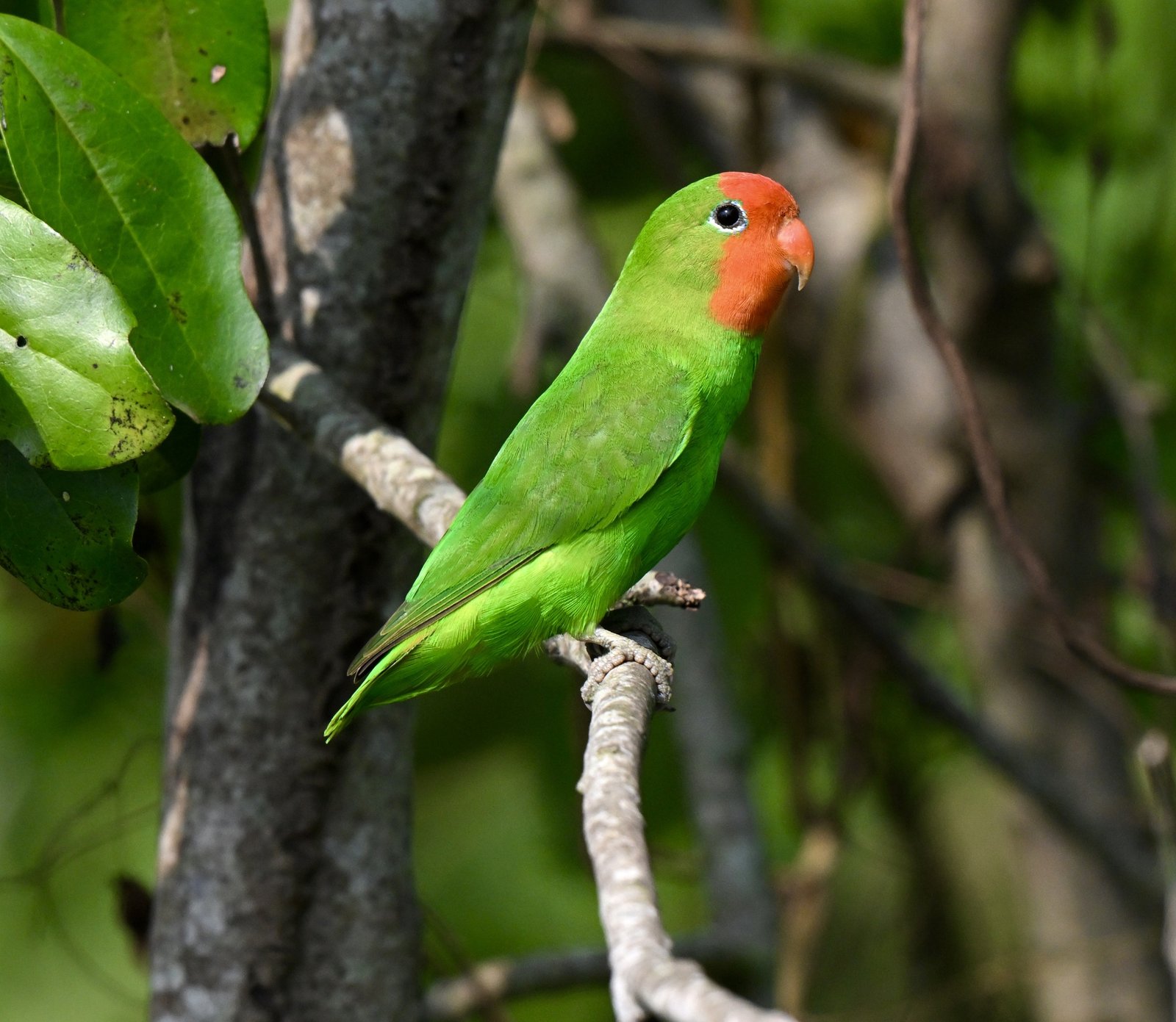
The Red-Headed Lovebird is a small green lovebird with an orange-red face and a blue rump, a species of moist savanna and forest edge that within our region occurs only in northern Angola. It is less noisy and less tied to water than the lovebirds of the Zambezi basin, and it breeds in termite nests.
Voice
A high, thin twittering, si-si-si, softer than that of other lovebirds; in flight short, piercing calls. Small flocks often keep up a continuous quiet chirping while feeding.
Recording: selvino — CC BY-NC-SA 3.0 · converted to mono · xeno-canto
Identification
13–15 cm, with a short tail. The male has an orange-red forehead, face and throat, a grass-green body and a bright sky-blue rump; the underwing coverts are black, conspicuous in flight. The female has an orange-yellow face and green underwing coverts. The bill is red in the male and orange-red in the female. There is no white eye-ring; the eye-ring is narrow and bluish. When spread, the tail feathers show a red and black basal band. Juveniles have a yellowish face.
Confusion species
No other lovebird overlaps in northern Angola. Lilian's Lovebird (Agapornis lilianae) also has an orange-red face, but a broad white eye-ring and a green rump, and lives far to the east. Rosy-Faced Lovebird (Agapornis roseicollis) of south-western Angola is larger, with a pink face and no black under the wing. Escaped cage birds are the main source of confusion elsewhere.
Habitat
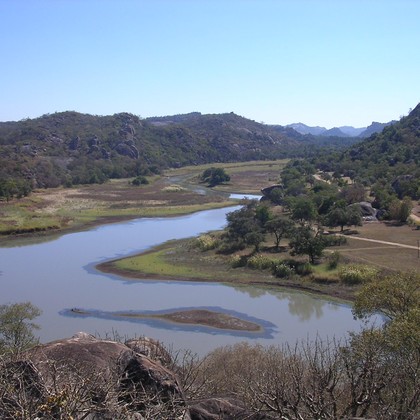
Moist savanna with scattered trees, grassland at forest edges, gallery forest along rivers and open country with secondary growth and cultivation. It forages mainly on the ground and in tall grass for seeds, and also eats figs and other fruit. It digs a nest tunnel into active arboreal termite nests and sometimes into terrestrial termite mounds, where the termites seal the nest chamber off from the outside.
Where the bird is most at home, classified by the vegetation units of southern Africa.

Range and movements
In the region only in northern and north-western Angola, south to about Cuanza Sul and Malanje, in the belt of moist savanna and forest edge. Beyond the region across a broad band of West and Central Africa, from Sierra Leone and Guinea east to South Sudan, Ethiopia, Uganda and north-western Tanzania.
How and when to look
In Angola search along forest edges and in grassland with termite nests in the trees, and watch for small flocks flying low and fast over the grass. The species is shyer and quieter than other lovebirds and is often noticed only when a small flock flushes from tall grass.
Conservation status
Not threatened and locally common over its large range, though thinly spread and inconspicuous. Many were caught for the cage-bird trade, but the species does poorly in captivity because it breeds in termite nests, which makes trapping unrewarding. Little is known about numbers in Angola.
Scientific name
Agapornis pullarius | (Linnaeus, 1758)
Linnaeus described the species in 1758 as Psittacus pullarius; because it was later moved to another genus, the author and year stand in brackets. The genus Agapornis was introduced in 1836 by Selby. Agapornis comes from the Greek agapē, 'love', and ornis, 'bird' — for the close bond between the members of a pair. pullarius is Latin for 'of young birds, chicks', from pullus, 'chick'. The specimen the first description was based on came from Ghana (designated; originally, in error, ‘Asia, Ethiopia’).