All species › Pelicans, herons and ibises › Herons and bitterns › Little Bittern
Little Bittern | Botaurus minutus
Woudaapje | Avetorillo Común
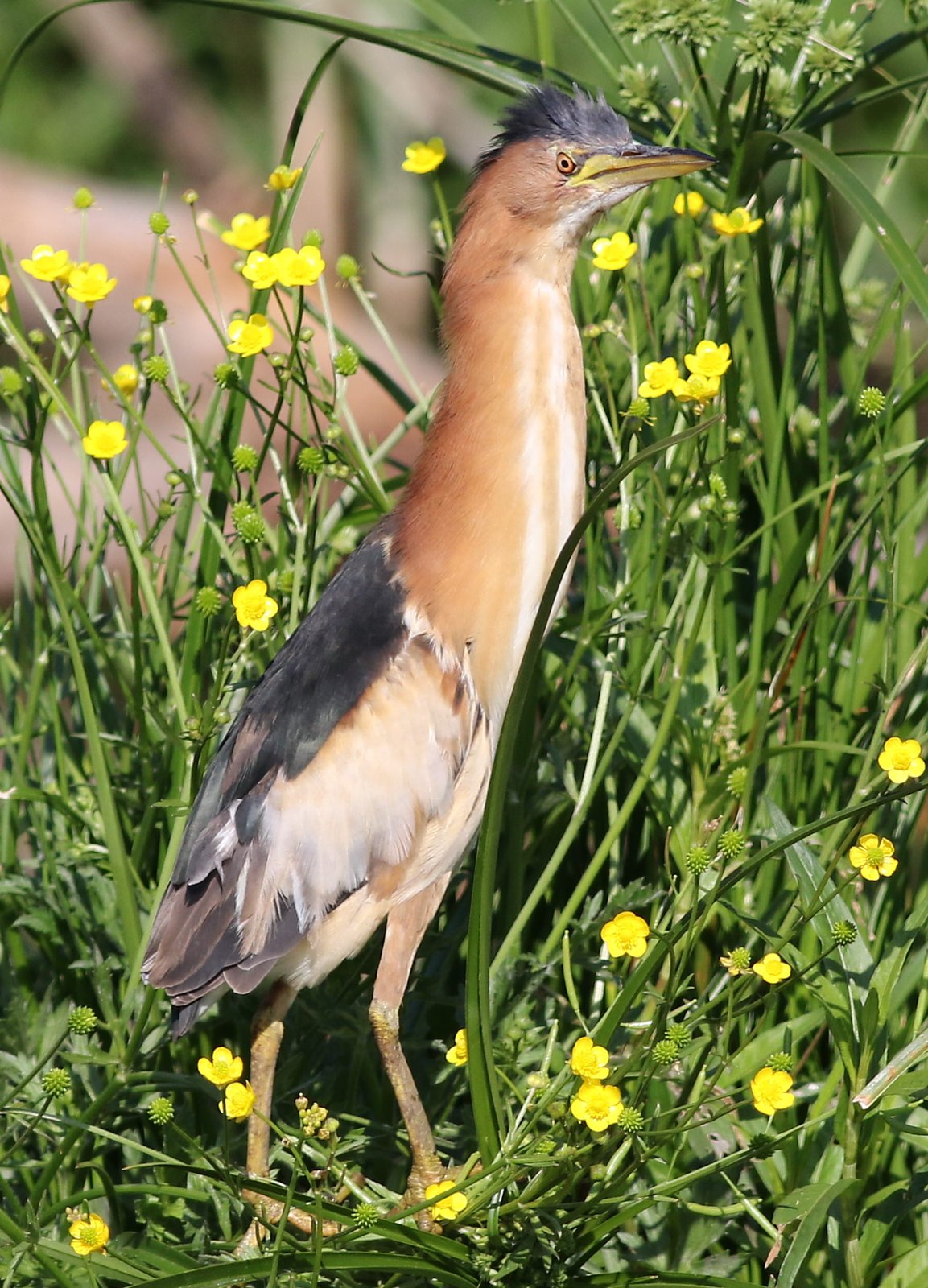
The Little Bittern is the smallest heron in the region, a shy reedbed bird that usually draws attention only when it flies low and briefly over the reeds, showing its pale wing panel. Two forms occur: the resident payesii and the Eurasian nominate form as a non-breeding visitor.
Voice
In the breeding season the male gives a low barking wooh or rao at intervals of a few seconds, often repeated for hours, also at night. When flushed or in flight a short, hoarse kek or kwer.
No recording with a suitable Creative Commons licence is available for this species yet.
Identification
33–38 cm, wingspan 49 to 58 cm. The male has a black crown, black back and tail and a large cream to ochre-buff wing panel that stands out sharply against the black flight feathers; neck and underparts are warm buff. In the African form payesii the sides of head and neck are chestnut, in the Eurasian form more greyish-buff. The female is browner, with a brown, lightly streaked back, a duller wing panel and a streaked foreneck. Juveniles are heavily streaked, including on the wing panel. The bill is yellow, the legs greenish-yellow. It flies with fast shallow wingbeats, usually only a short distance.
Confusion species
The Dwarf Bittern Botaurus sturmii has plain slate-grey upperparts without a wing panel, heavy streaks below and orange-yellow legs. The Striated Heron Butorides striata is grey with a black cap and no pale wing panel. The Squacco Heron Ardeola ralloides is larger, ochre-brown and shows all-white wings in flight.
Habitat
Reedbeds, bulrush stands and papyrus along lakes, rivers, dams and vleis, also small reed fringes at sewage works and in urban areas. It clambers deftly among the stems, taking small fish, frogs and insects. The nest is a small platform of reed leaves among the stems just above the water.
Where the bird is most at home, classified by the vegetation units of southern Africa.

Range and movements
Over most of the region where reedbeds exist: in South Africa widespread in the Western Cape, the eastern provinces and on the highveld, scarce in the Karoo; also Lesotho, Eswatini, Zimbabwe, Botswana (mainly the Okavango), northern Namibia, Zambia, Malawi, Mozambique and Angola. Absent from the dry western interior. Eurasian visitors are found mainly in the north and east of the region. Beyond the region it breeds in Europe, western and central Asia, sub-Saharan Africa and Madagascar.
- Resident
- Summer visitor (c. Oct–Mar)
- Passage (Mar–Apr, Oct–Nov)
- dark = core range, pale = thinly spread
How and when to look
Wait at sunrise at a spot with an open view over a reedbed and watch for a small buff bird flying low with a pale wing panel. In the summer months the male's barking is the best clue to its presence.
Conservation status
Not threatened and fairly common in the region. It benefits from small reedbeds at dams and sewage works, but suffers locally from the cutting and burning of reeds and the draining of vleis.
Scientific name
Botaurus minutus | (Linnaeus, 1766)
Linnaeus described the species in 1766 as Ardea minuta; because it was later moved to another genus, the author and year stand in brackets. The genus Botaurus was introduced in 1819 by Stephens. Botaurus is Medieval Latin for a bittern; the word combines Latin bos 'ox' with taurus 'bull', after the booming call (compare butire 'to boom'). minutus is Latin for 'small': this is the smallest heron in Europe. The specimen the first description was based on came from Switzerland.