All species › Cranes, rails and allies › Rails and crakes › Little Crake
Little Crake | Zapornia parva
Klein waterhoen | Polluela Bastarda
The Little Crake breeds in Europe and western Asia and winters mainly in the Sahel and East Africa. Southern Africa lies at the very edge of its winter range and the species is a great rarity here.
Voice
Largely silent in winter quarters. At times a sharp kek or a dry rattle. The accelerating and fading series of croaking notes, kwek-kwek-kwek-kwek-kr-r-r, is well known on the breeding grounds.
Recording: Lars Edenius — CC BY-NC-SA 4.0 · shortened to the first 60 s, mono · xeno-canto
Identification
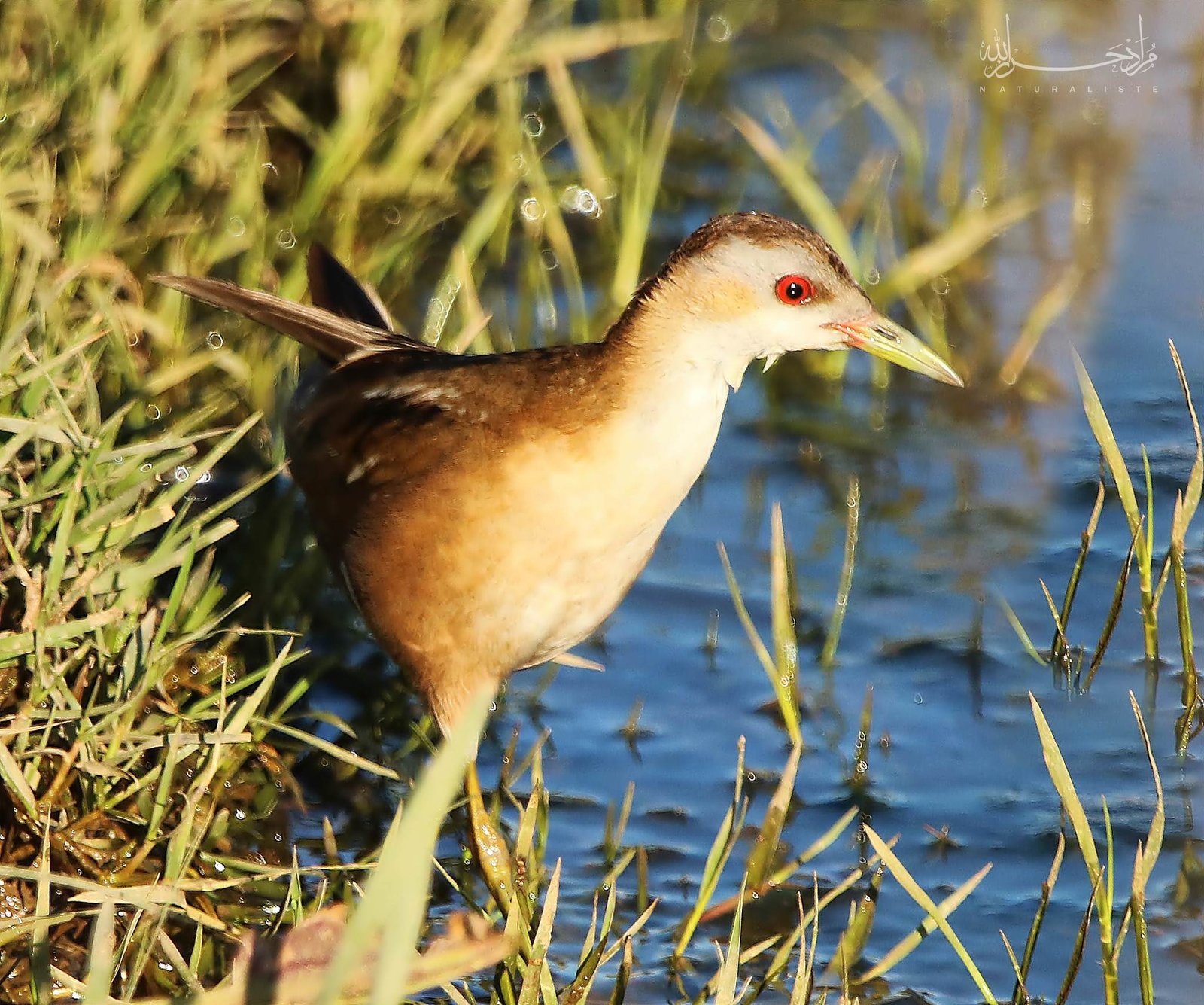
About 18 cm, slim, with relatively long wings and a long tail; the primaries project well beyond the tertials. The bill is greenish yellow with a small red base and the legs are green. The male has a blue-grey face and underparts with only faint white barring at the rear of the flanks, and olive-brown upperparts with black streaks and a few white spots. The female has a pale buff to ochre breast, a white throat and a grey face. Juveniles are whitish below with barred flanks.
Confusion species
Baillon's Crake (Zapornia pusilla) is smaller and more compact, with a short primary projection, more boldly black-and-white barred flanks, many white spots and lines on the back, a bill without a red base and flesh-coloured legs. The Spotted Crake (Porzana porzana) is larger and densely spotted white on the head and breast, with a buff undertail. The Striped Crake (Aenigmatolimnas marginalis) has white longitudinal streaks on the back and a rufous undertail.
Habitat
Marshes with floating vegetation and dense reeds or bulrushes over deeper water, lake margins and sewage ponds. It often walks over floating leaves and swims short distances. It eats aquatic insects, larvae, snails and seeds.
Where the bird is most at home, classified by the vegetation units of southern Africa.

Range and movements
A few records in Zambia, including at Ndola, and a handful of not always confirmed reports further south. It breeds from Europe to Central Asia and winters mainly in the Sahel, the Nile valley, East Africa and South Asia.
How and when to look
Not a bird to look for deliberately. A bird walking over floating leaves, with long primaries and a red bill base, deserves a good photograph; report any sighting to the national rarities committee. Confusion with Baillon's Crake, which breeds here, is the main pitfall.
Conservation status
Not globally threatened; the European population has declined locally with the loss of marshes. In southern Africa an exceptional vagrant.
Scientific name
Zapornia parva | (Scopoli, 1769) (GBIF: Porzana parva)
Scopoli described the species in 1769 as Rallus parvus; because it was later moved to another genus, the author and year stand in brackets. The genus Zapornia was introduced in 1816 by Leach. Zapornia is a near-anagram of Porzana, the genus of the French ornithologist Louis-Pierre Vieillot. parva is Latin for 'small', after the modest size of this little crake. The specimen the first description was based on came from Carniola, Slovenia.