All species › Waders, gulls and terns › Gulls and terns › Little Gull
Little Gull | Hydrocoloeus minutus
Dwergmeeuw | Gaviota Enana
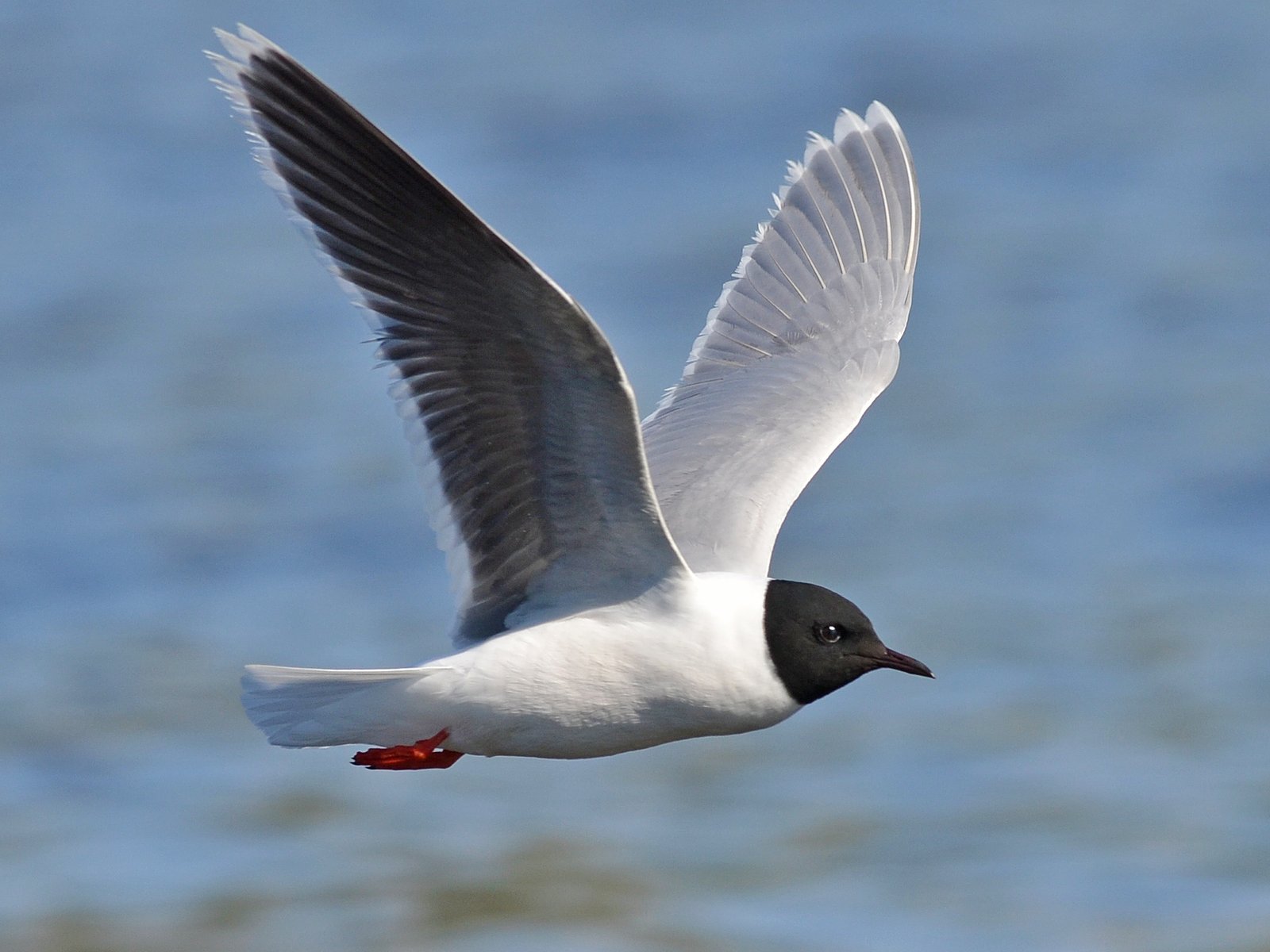
The Little Gull is the smallest gull in the world, with a flight that recalls a marsh tern more than a gull. It breeds in northern Europe and Asia and winters mainly in Europe; southern Africa lies far outside its normal range, and there are only a few records in the region.
Voice
Almost always silent in the region. Elsewhere a nasal, repeated kek-kek-kek or kaa-kaa, higher and softer than in Black-Headed Gull.
Recording: Stanislas Wroza — CC BY-NC-SA 4.0 · shortened to the first 60 s, mono · xeno-canto
Identification
25–27 cm. Adults in all plumages have strikingly dark, almost black underwings with a white trailing edge, and pale grey upperwings with rounded white wingtips without black. In non-breeding plumage, the one to be expected in the region, the head is white with a dark crown and a dark ear spot; in breeding plumage a full black hood without a white eye-ring. The bill is small and dark, the legs red. Immatures have a sharp black W-pattern across the upperwings, a dark crown and a narrow black tail band. The flight is light and agile, with dips to the water surface.
Confusion species
Black-Headed Gull Chroicocephalus ridibundus is larger, with a white leading edge to the wing, black wingtips and a red bill. Sabine's Gull Xema sabini also shows a W-like wing pattern in juvenile plumage, but as a triangular pattern of brown, white and black, and has a forked tail. White-Winged Tern Chlidonias leucopterus and Black Tern Chlidonias niger feed in the same way, but have a tern's bill and a dark cap or crown reaching the cheek.
Habitat
Coastal lagoons, estuaries, salt pans and sewage works, sometimes large freshwater lakes. Like a marsh tern it picks insects and small invertebrates from the water surface in flight, and also feeds along the tideline.
Where the bird is most at home, classified by the vegetation units of southern Africa.


Range and movements
In the region a handful of accepted records, mainly on the coast of South Africa, usually among Grey-Headed Gulls, Hartlaub's Gulls or marsh terns. It breeds from the Baltic states and Finland to eastern Siberia, and in small numbers in North America; it winters mainly at sea in Europe, around the Mediterranean and the Caspian, rarely to West Africa.
How and when to look
Check flocks of White-Winged Terns and small gulls at sewage works and in lagoons for a small gull with dark underwings. The chance is highest in the southern summer. A flight photograph of the underwing is decisive.
Conservation status
Not globally threatened; the population has increased in western Europe in recent decades. Of no conservation significance in southern Africa.
Scientific name
Hydrocoloeus minutus | (Pallas, 1776)
Pallas described the species in 1776 as Larus minutus; because it was later moved to another genus, the author and year stand in brackets. The genus Hydrocoloeus was introduced in 1829 by Kaup. Hydrocoloeus is Greek, from hudor 'water' and koloios 'jackdaw': 'water jackdaw'. minutus is Latin for 'small'; this is the smallest gull in the world. The specimen the first description was based on came from Berezovo, Siberia.