All species › Passerines › Grasshopper warblers › Little Rush Warbler
Little Rush Warbler | Bradypterus baboecala
Moerasstruikzanger | Zarzalero Charlatán
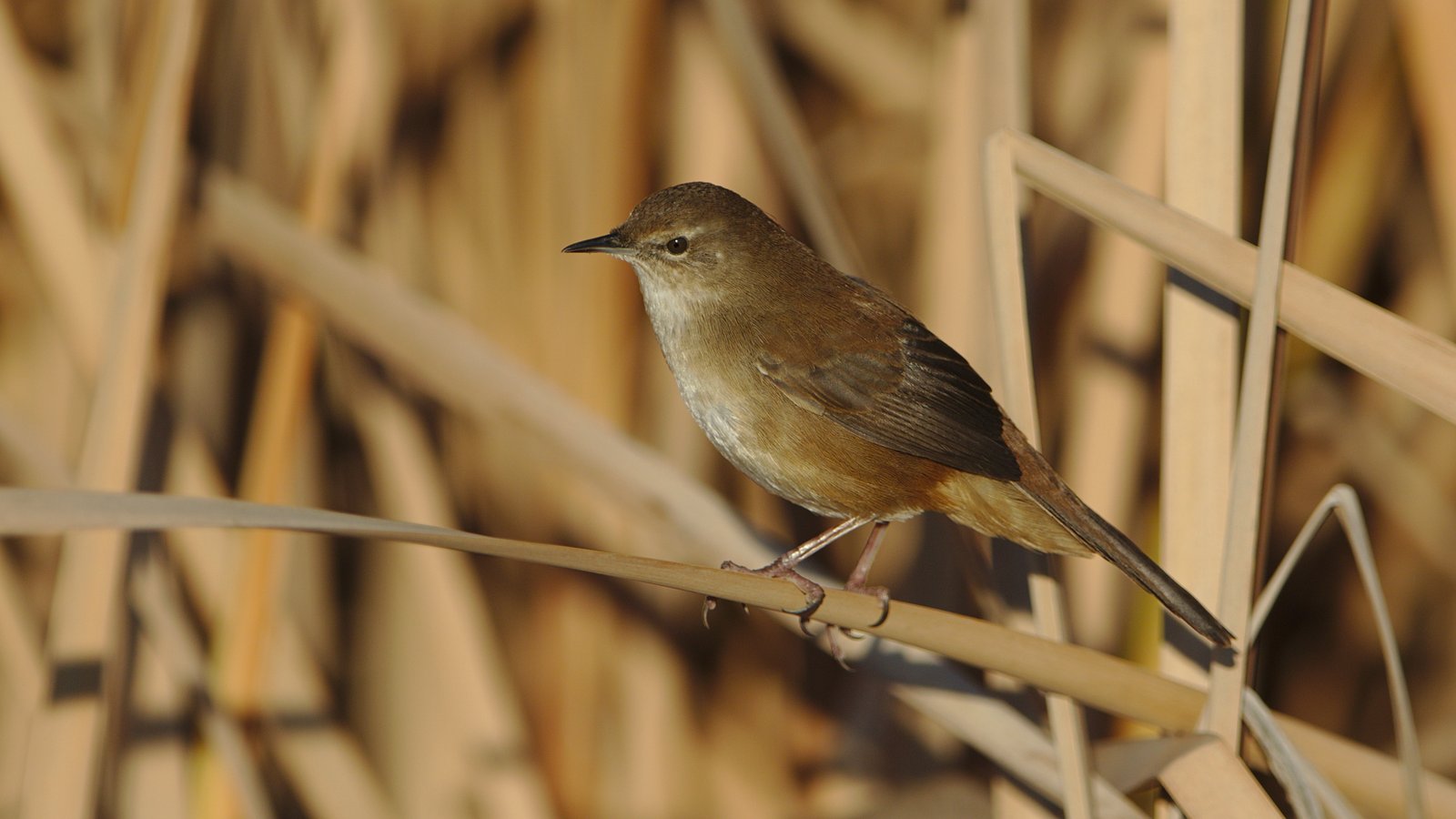
The Little Rush Warbler is a dark brown, secretive warbler of reeds, bulrushes and tall sedges, heard far more often than seen. Its stuttering, accelerating song, often accompanied by wing-snapping, is one of the characteristic sounds of wetlands in the east and south of the region.
Voice
The song is a series of dry, stuttering notes that speed up and fade into a rattle: trrp-trrp-trp-trp-tptptptp. The male sings from cover or in a short display flight over the reeds, snapping his wings (frrrt-frrrt). Calls include a hard chik and a rasping chrrr in alarm. It sings throughout the year, most at dawn and dusk.
Recording: African Bioacoustics Community — CC BY-NC-SA 4.0 · converted to mono · xeno-canto
Identification
16–18 cm. Upperparts uniform dark warm brown, unstreaked. A narrow, indistinct pale supercilium; throat off-white with fine dark speckling on the lower throat and upper breast, often barely visible in the field. Breast and flanks buffy brown, centre of belly paler; undertail coverts brown with paler tips. The tail is broad, strongly graduated and rounded, and is often fanned in flight; the wings are short and round. Bill dark, legs pinkish-brown. The sexes are alike; juveniles are more olive, with a yellowish wash below. It flies low and briefly over the reeds with the tail drooped and spread, dropping straight back into cover.
Confusion species
In this group, voice, habitat and behaviour decide the identification. The Lesser Swamp Warbler Acrocephalus gracilirostris is paler, with a flat head, long bill and narrow tail, climbs openly up reed stems and sings a rich, liquid song. The Knysna Warbler Bradypterus sylvaticus and Barratt's Warbler Bradypterus barratti are very similar, but live in forest undergrowth, forest edges and montane bracken, not in reeds. The Cinnamon Bracken Warbler Bradypterus cinnamomeus is warm cinnamon-brown and lives in montane bracken and scrub in the north. The River Warbler Locustella fluviatilis is a Palearctic passage migrant (mainly December–March) with a streaked throat, long white-tipped undertail coverts and a monotonous, insect-like reeling song. In papyrus in northern Zambia the White-Winged Swamp Warbler Bradypterus carpalis occurs; it is larger, heavily streaked on the breast and has a white bend of the wing.
Habitat
Dense reedbeds, bulrushes, tall sedges, rushes and rank grass along vleis, dams, rivers, streams and lagoons, from sea level high into the mountains; also in small wet patches along ditches. It forages low in the vegetation and on the mud for insects and other small invertebrates.
Where the bird is most at home, classified by the vegetation units of southern Africa.

Range and movements
Widespread in the east and south of the region: in South Africa in the Western Cape (coastal wetlands from the Cape Peninsula eastwards), Eastern Cape, KwaZulu-Natal, the Highveld and the north-east, and in Lesotho and Eswatini; in Zimbabwe, Mozambique, Malawi and Zambia, in northern Botswana (Okavango Delta, Chobe and Linyanti), in north-eastern Namibia (Kavango and Zambezi Region) and in Angola. Absent from the arid western half (Karoo, Kalahari, Namib). Beyond the region it occurs in East and Central Africa north to Ethiopia, with scattered populations in West Africa.
- Resident
- Summer visitor (c. Oct–Mar)
- Winter visitor (c. Apr–Sep)
- Passage (Mar–Apr, Oct–Nov)
- dark = core range, pale = thinly spread
How and when to look
Present all year in almost any sizeable reed marsh in the east, such as Marievale (Gauteng), Wakkerstroom or the Strandfontein sewage works near Cape Town. At dawn, listen for the accelerating rattle and the wing-snapping, then watch the reed edge: the bird sometimes shows briefly at the base of a stem or flies a short way low over the reeds.
Conservation status
Not threatened and common in suitable wetlands. Habitat is lost locally through drainage, overgrazing of margins and the annual burning of reedbeds.
Scientific name
Bradypterus baboecala | (Vieillot, 1817)
Vieillot described the species in 1817 as Sylvia baboecala; because it was later moved to another genus, the author and year stand in brackets. The genus Bradypterus was introduced in 1837 by Swainson. Bradypterus comes from the Greek bradus, 'slow', and -pteros, '-winged' — for the short, rounded wings and weak flight. baboecala is a diminutive of the Greek babax, 'chatterer' (from babazō, 'to babble'), after Levaillant's name 'la Caqueteuse' ('the Chatterer', 1802) for this species. The specimen the first description was based on came from Knysna area, South Africa.