All species › Birds of prey › Hawks, eagles and kites › Little Sparrowhawk
Little Sparrowhawk | Tachyspiza minulla
Oost-Afrikaanse dwergsperwer | Gavilán Chico
The Little Sparrowhawk is the smallest hawk in the region, barely larger than a thrush. It lives hidden in riverine forest, forest edges and clumps of trees and hunts small birds, especially passerines, and insects with short, fast dashes. Despite its size it sometimes takes birds as large as a dove.
Voice
A high, rapid kee-kee-kee-kee or tu-tu-tu-tu, mainly around the nest; also a sharp, short alarm keek.
No recording with a suitable Creative Commons licence is available for this species yet.
Identification
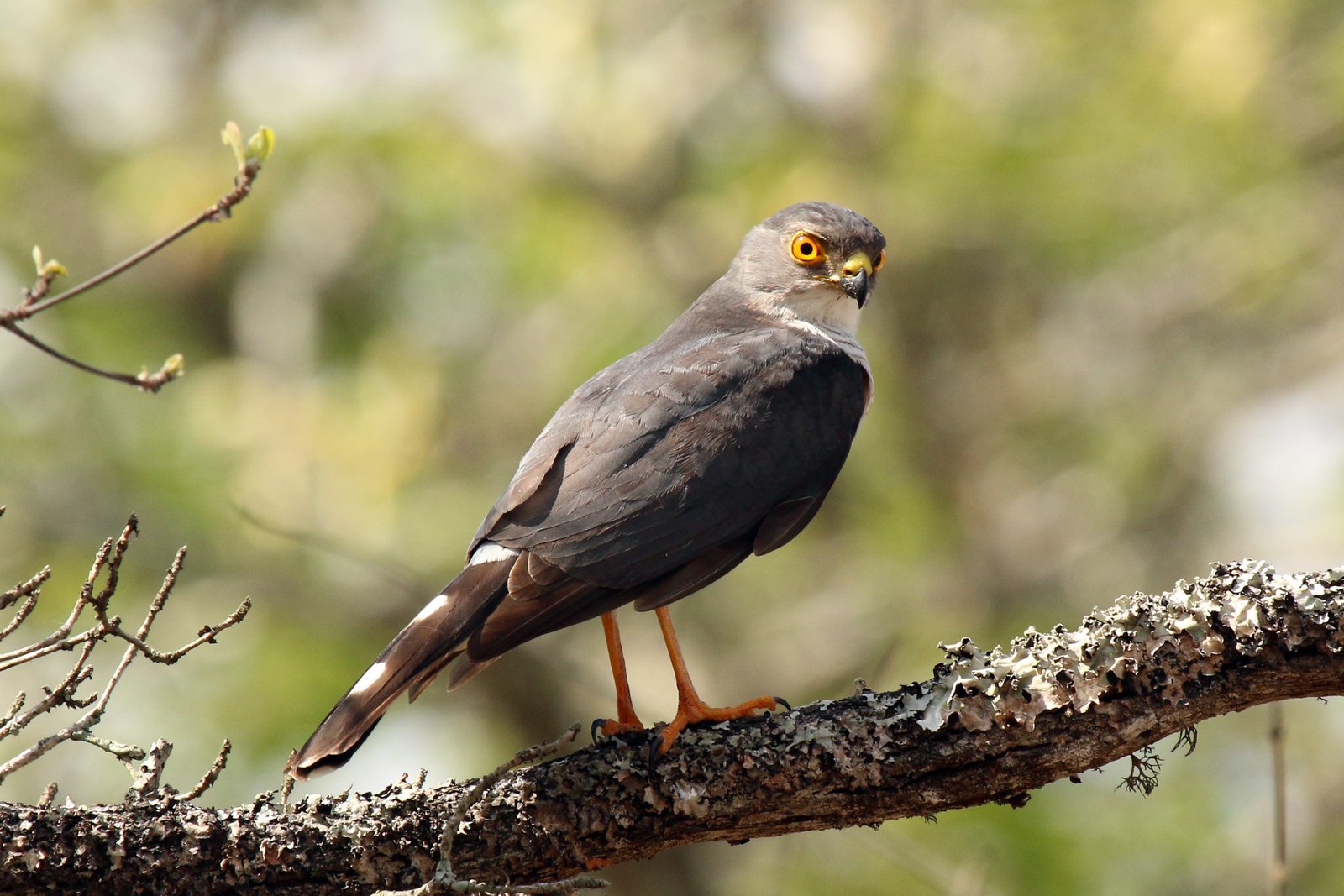
23–27 cm, wingspan 39–52 cm. The male is dark slate-grey above, white below with fine rufous barring on the breast and flanks. Characteristic are a narrow white rump band and two (sometimes three) clear white spots in the centre of the black, banded tail, which show especially in flight. Eyes, cere and legs are yellow. The female is larger and browner above. Juveniles are brown above and white to cream below with large brown drops on the breast and flanks; they too show the white tail spots.
Confusion species
Gabar Goshawk Micronisus gabar is larger, has a grey throat and breast, a red cere and red legs and no white tail spots. Shikra Tachyspiza badia is larger and paler grey, without a white rump and with a red eye. Ovambo Sparrowhawk Accipiter ovampensis is larger, barred grey across all the underparts and has white shaft streaks on the tail rather than round spots. The male African Goshawk Aerospiza tachiro is much larger, with a darker tail and no white rump band.
Habitat
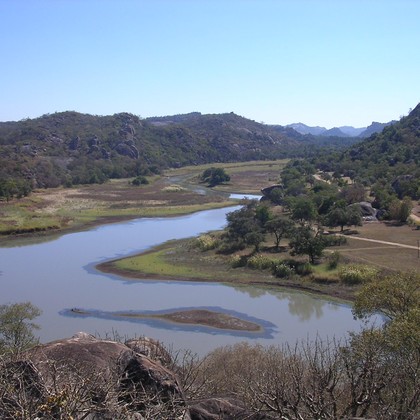
Riverine forest, forest edges, dense clumps of trees in woodland, coastal forest and exotic plantations of eucalyptus and pine, also large suburban gardens. It sits quietly in the foliage and attacks small birds that pass by or feed on the ground. The nest is a small stick platform, often high in a eucalyptus or another tall tree.
Where the bird is most at home, classified by the vegetation units of southern Africa.


Range and movements
In the east and north of the region: in South Africa from the Western Cape (locally) along the Garden Route, the Eastern Cape and KwaZulu-Natal to Mpumalanga, Gauteng, Limpopo and North West, then Eswatini, Zimbabwe, Mozambique, Malawi, Zambia, Angola, northern and eastern Botswana and north-eastern Namibia. Absent from the arid west. Beyond the region it occurs in East Africa to Ethiopia and Somalia.
- Resident
- Summer visitor (c. Oct–Mar)
- Winter visitor (c. Apr–Sep)
- Passage (Mar–Apr, Oct–Nov)
- dark = core range, pale = thinly spread
How and when to look
This species is easily overlooked. In riverine forest and eucalyptus stands, watch for a small hawk dashing low between the trees that shows the white rump band and two white tail spots as it flies off. In the breeding season, September–December, the high calling at the nest gives it away.
Conservation status
Not threatened; fairly common but unobtrusive. It benefits from planted eucalyptus and garden trees, which have extended its range inland in South Africa. It is sensitive to pesticides through its prey.
Scientific name
Tachyspiza minulla | (Daudin, 1800)
Daudin described the species in 1800 as Falco minullus; because it was later moved to another genus, the author and year stand in brackets. The genus Tachyspiza was introduced in 1844 by Kaup. Tachyspiza is Greek, from takhus 'fast' and spizias 'hawk'. minulla is Latin for 'very small, tiny' — the species is one of the smallest sparrowhawks. The specimen the first description was based on came from the Gamtoos River, Cape Province.