All species › Passerines › Wagtails and pipits › Long-Billed Pipit
Long-Billed Pipit | Anthus similis
Langsnavelpieper | Bisbita Piquilargo
The Long-Billed Pipit in its current, narrow sense is a pipit ranging from East Africa to India, which occurs in the region only in the Angolan highlands. The birds of South Africa, Namibia and adjacent countries that carry this name in older guides now belong to Nicholson's Pipit.

Voice
The song resembles that of Nicholson's Pipit: a slow series of loud, measured chirping notes with pauses, chrip ... chuwee ... chrip, from a rock or treetop or in a display flight. The call is a sharp chip or a nasal chwee.
Recording: Stanislas Wroza — CC BY-NC-SA 4.0 · converted to mono · xeno-canto
Identification
17 to 20 cm, a large, slender pipit with a long bill and long tail. The upperparts are warm greyish brown with faint dark streaking on mantle and crown; the supercilium is pale buff, the malar stripe narrow and dark. The underparts are buff to cinnamon-buff, with fine, faint streaks on the breast. The median wing coverts have dark centres with buff fringes. The bill base is yellowish to pink. The outer tail feathers are buff. The posture is horizontal, with frequent tail-wagging. The sexes are alike; Angolan birds are relatively dark and warm-toned.
Confusion species
Nicholson's Pipit (Anthus nicholsoni) is almost identical and can be separated only by range and subspecific features; in south-western Angola the two may approach each other. Wood Pipit (Anthus nyassae) is smaller, shorter-billed, more clearly streaked on the mantle and lives in miombo. Long-Legged Pipit (Anthus pallidiventris) of north-western Angola is stockier, longer-legged and lives on short lowland grassland. Buffy Pipit (Anthus vaalensis) has a plain back and lives on flat, bare grassland.
Habitat
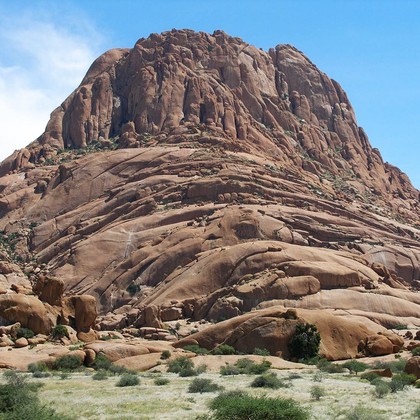
Rocky and stony mountain slopes with grass, scattered bushes and trees, edges of montane forest and open, stony places in the highlands. It forages on the ground for insects and likes to perch on boulders and in trees.
Where the bird is most at home, classified by the vegetation units of southern Africa.

Range and movements
Within the region only in the highlands of western Angola, including the Mount Moco area. Older records under this name elsewhere in the region, including in databases, almost always refer to Nicholson's Pipit or Wood Pipit. Beyond the region from the eastern Democratic Republic of the Congo, Rwanda and Burundi through East Africa and Ethiopia to the mountains of the Sahel, and further from the Middle East to India and Myanmar.
- Resident
- dark = core range, pale = thinly spread
How and when to look
In the region this is a species for visitors to the Angolan highlands: search the rocky, grazed slopes above the forest line around Mount Moco. Treat records outside Angola critically: elsewhere in southern Africa the bird is Nicholson's Pipit. When in doubt, record the song.
Conservation status
Not threatened. Overall a widespread species with a very large range. The small Angolan population is poorly known; the highlands around Mount Moco are under pressure from fire, grazing and cultivation.
Scientific name
Anthus similis | (Jerdon, 1840)
Jerdon described the species in 1840 as Agrodoma similis; because it was later moved to another genus, the author and year stand in brackets. The genus Anthus was introduced in 1805 by Bechstein. Anthus is the Latin word for a small bird of grasslands mentioned by Pliny the Elder. similis is Latin for 'like, resembling'; which other pipit the bird is said to resemble is not stated in the description. The specimen the first description was based on came from Jalna, India.