All species › Passerines › Wagtails and pipits › Buffy Pipit
Buffy Pipit | Anthus vaalensis
Vaalrivierpieper | Bisbita del Vaal
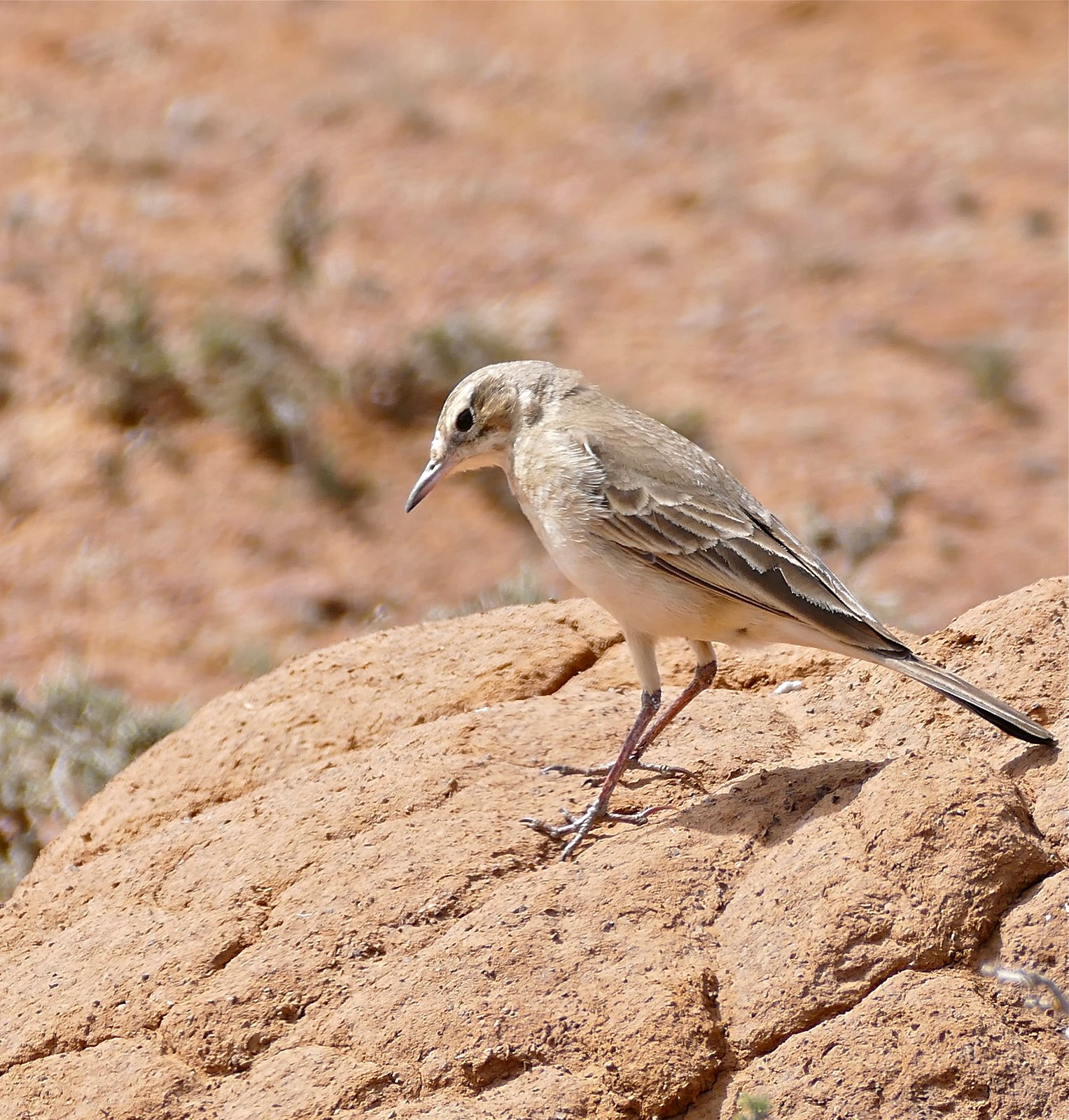
The Buffy Pipit is a large, pale and weakly marked pipit of dry, bare grassland. It stands conspicuously upright, often wags its tail emphatically, and together with the Plain-Backed Pipit forms the most frequently confused pipit pair in the region.
Voice
The call is a dry sheep or chissik, slightly fuller than that of African Pipit. The song is a series of measured two-part phrases, chree-trrit ... chree-trrit, from a termite mound, post or bush or in a short, low display flight.
Recording: Tony Archer — CC BY-NC-SA 4.0 · converted to mono · xeno-canto
Identification
18 to 19 cm, a large, long-legged pipit with a fairly stout bill. The upperparts are plain sandy brown with at most faint streaking on the crown; the mantle looks unstreaked. The supercilium is pale buff and fairly short, the malar stripe weak. The underparts are warm buff, strongest on flanks and lower belly; the breast shows only a few faint, short spots. The lower mandible has a pinkish base. The outer tail feathers are buff, not white. The sexes are alike; juveniles have pale fringes above and a slightly more spotted breast.
Confusion species
Plain-Backed Pipit (Anthus leucophrys) is darker and colder brown, less buff below, with a clearer malar stripe, a slightly more spotted breast and a yellow bill base; it more often chooses damper short grassland in the east. Nicholson's Pipit (Anthus nicholsoni) has a longer bill, a faintly streaked mantle and lives on rocky, vegetated slopes. African Pipit (Anthus cinnamomeus) is smaller, clearly streaked on mantle and breast and has white outer tail feathers. Mountain Pipit (Anthus hoeschi) is more heavily streaked. On sight they are very similar: combine posture, tail-wagging, bill base, habitat and song.
Habitat
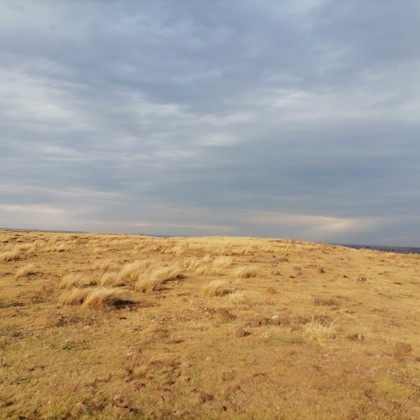
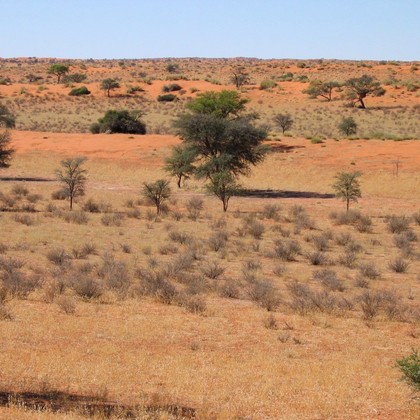
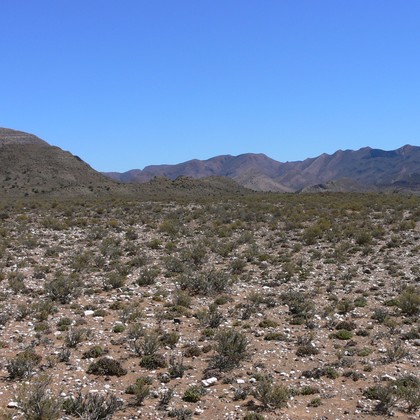
Dry, short and sparse grassland on sandy or bare ground, overgrazed pastures, pan margins, fallow fields and open patches in Kalahari thornveld and dry savanna. It avoids tall grass. It forages by walking and in short dashes for insects, and after each dash stands upright with a wagging tail.
Where the bird is most at home, classified by the vegetation units of southern Africa.
Range and movements
Widespread in the region: the interior of South Africa (Highveld, Free State, North West, Northern Cape and Limpopo), Lesotho, Eswatini, almost all of Botswana, Namibia except the Namib, Zimbabwe, southern and western Zambia, southern and central Angola and locally Malawi and Mozambique. Beyond the region scattered north to Tanzania, Kenya and the southern Democratic Republic of the Congo.
- Resident
- Summer visitor (c. Oct–Mar)
- Winter visitor (c. Apr–Sep)
- Passage (Mar–Apr, Oct–Nov)
- dark = core range, pale = thinly spread
How and when to look
Look for it on bare, overgrazed veld and around pans in the dry west, for example in the Kalahari and on the Highveld in winter. It shows well on a termite mound or post: note the plain back, the buffy underparts and the emphatic tail-wagging. A plain pipit in the damp eastern grasslands is more likely a Plain-Backed Pipit.
Conservation status
Not threatened. Common and widespread in the dry interior, with no evidence of a marked decline. Locally it benefits from grazing that keeps the grass short, but it disappears where grassland is ploughed.
Scientific name
Anthus vaalensis | Shelley, 1900
Shelley described the species in 1900 and placed it straight away in the genus where it still stands. The genus Anthus was introduced in 1805 by Bechstein. Anthus is the Latin word for a small bird of grasslands mentioned by Pliny the Elder. vaalensis refers to the Vaal River in South Africa. The specimen the first description was based on came from Newcastle, KwaZulu-Natal, South Africa.