All species › Passerines › Wagtails and pipits › Wood Pipit
Wood Pipit | Anthus nyassae
Bospieper | Bisbita de Nyasa
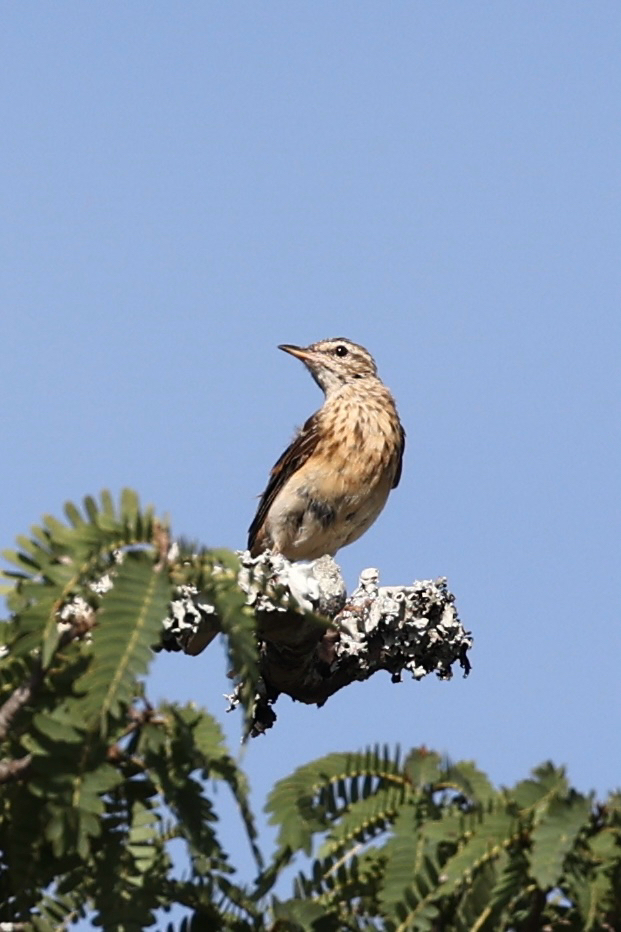
The Wood Pipit is the only pipit in the region that lives in closed woodland: it walks over the bare, leaf-strewn floor of miombo and other broadleaved woodland and flies up to a branch when disturbed. It was formerly treated as a subspecies of Long-Billed Pipit.
Voice
The song is a slow series of loud, measured phrases, chree ... churree ... chrip, similar to that of Nicholson's Pipit but slightly higher and faster, from a high branch in the canopy. The call is a soft chip or sheep.
Recording: Dries Van de Loock — CC BY-NC-SA 4.0 · converted to mono · xeno-canto
Identification
16 to 18 cm, a medium-sized pipit with a fairly long bill. The upperparts are warm brown with distinct dark streaking on mantle and crown. The supercilium is conspicuously white to pale buff and long; the lores and eye-stripe are dark, the malar stripe distinct. The underparts are buffy white, with a band of fine dark streaks on the breast. The wing coverts and tertials have conspicuous rusty-buff fringes. The outer tail feathers are pale buff to dull white. The sexes are alike; juveniles are more heavily spotted.
Confusion species
Nicholson's Pipit (Anthus nicholsoni) is larger and longer-billed, less streaked and lives on open, rocky slopes, not in woodland. Long-Billed Pipit (Anthus similis) of the Angolan highlands is likewise larger and more plainly marked. Tree Pipit (Anthus trivialis), a summer visitor, also perches in trees but is smaller, has a short, fine bill, heavily streaked breast and flanks and a thin teez call. Bushveld Pipit (Anthus caffer) is smaller, shorter-tailed and heavily streaked on the breast.
Habitat
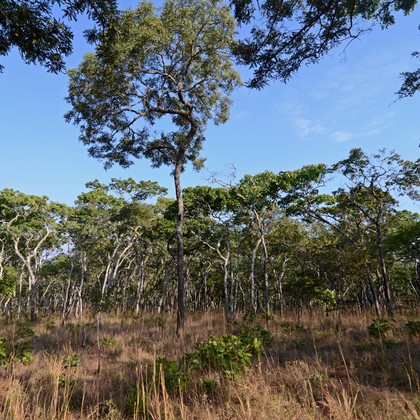
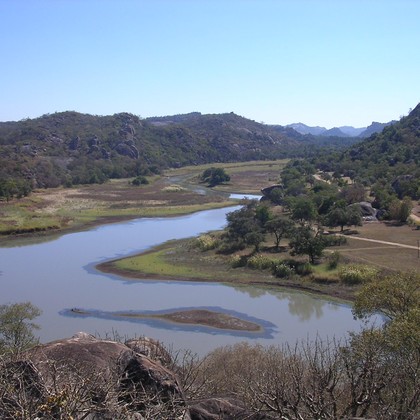
Miombo and other dry broadleaved woodland, including Baikiaea woodland on sand in the west, often on slopes with a sparsely vegetated, stony or leaf-covered floor and in recently burnt patches. It forages on the ground for insects and when disturbed flies up to a branch, where it sits still.
Where the bird is most at home, classified by the vegetation units of southern Africa.
Range and movements
Within the region in the miombo belt: Angola, Zambia, Malawi, northern and central Mozambique, Zimbabwe (mainly the central plateau and the north), locally north-eastern Namibia and northern Botswana; in South Africa only as a rare vagrant. Beyond the region in the southern Democratic Republic of the Congo and in Tanzania.
- Resident
- dark = core range, pale = thinly spread
How and when to look
Walk quietly through open miombo with a bare floor, for example on the central plateau of Zimbabwe or in Zambia, and watch for a pipit that flushes ahead of you and lands on a low branch. It is the only pipit that behaves like this in woodland; only Tree Pipit does so in summer too, but it is smaller and heavily streaked on the flanks.
Conservation status
Not threatened. Fairly common in suitable woodland, with a large range. The main threat is the continuing clearance of miombo for charcoal and agriculture, which fragments the habitat.
Scientific name
Anthus nyassae | Neumann, 1906
Neumann described the species in 1906 and placed it straight away in the genus where it still stands. The genus Anthus was introduced in 1805 by Bechstein. Anthus is the Latin word for a small bird of grasslands mentioned by Pliny the Elder. nyassae refers to Nyasa, the old name of Lake Malawi and the surrounding region. The specimen the first description was based on came from between Sangesi and Songea, southern Tanzania.