All species › Passerines › Wagtails and pipits › Long-Legged Pipit
Long-Legged Pipit | Anthus pallidiventris
Langpootpieper | Bisbita Patilargo
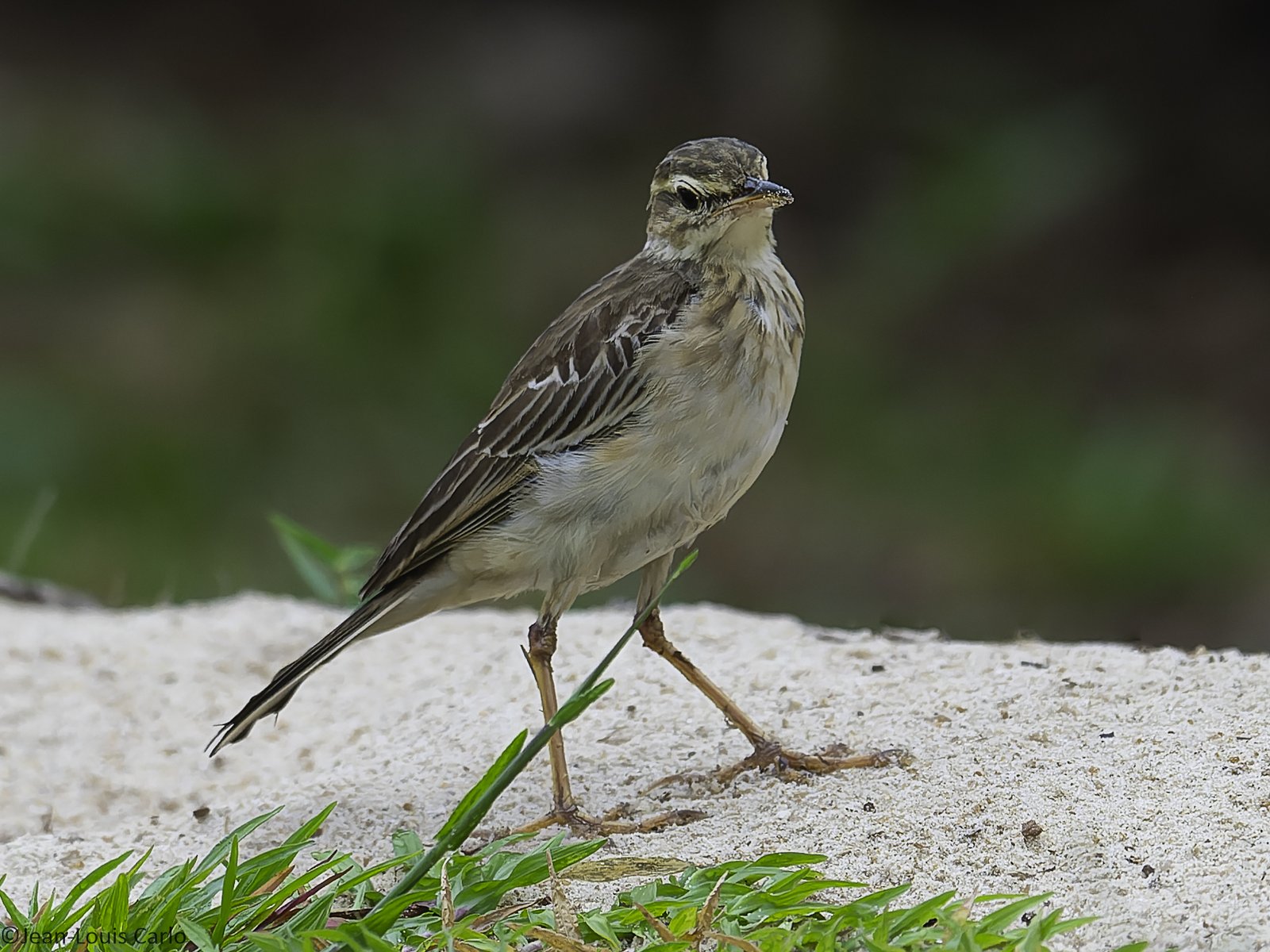
The Long-Legged Pipit is a bulky, upright pipit of the Central African coastal plain and lowlands, which occurs in the region only in north-western Angola. The long, pale legs and heavy bill give it a distinctive, almost thrush-like build.
Voice
The song is a simple, repeated series of loud, rasping notes, chree-chrup ... chree-chrup, from a termite mound, post or bush. The call is a short, sparrow-like chip.
Recording: julien Birard — CC BY-NC-SA 4.0 · converted to mono · xeno-canto
Identification
17 to 18 cm, a heavy pipit with a long, stout bill and strikingly long, pale flesh-coloured legs. The upperparts are fairly plain greyish brown with at most faint streaking on crown and mantle. The supercilium is pale and short, the malar stripe narrow. The underparts are pale, often almost white on the belly, with a few faint brown streaks on the buffy breast. The outer tail feathers are dull white to buff. It stands very upright and runs fast over short grass. The sexes are alike; juveniles are more spotted on the breast.
Confusion species
Plain-Backed Pipit (Anthus leucophrys) occurs in the same part of Angola; it is slightly smaller, shorter-legged and shorter-billed, darker brown above and warmer buff below, with a yellow bill base. African Pipit (Anthus cinnamomeus) is smaller, clearly streaked on mantle and breast and has white tail sides. Buffy Pipit (Anthus vaalensis) is buffier below and lives on drier ground further south. Long-Billed Pipit (Anthus similis) lives on rocky slopes in the highlands. Note the long legs, the pale belly and the lowland habitat.
Habitat
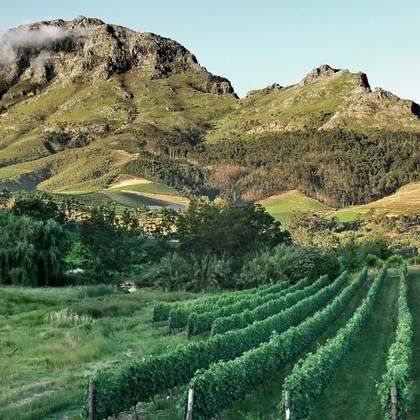
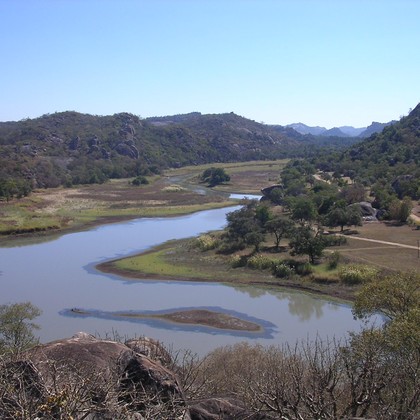
Short grass in open patches of the forest–savanna mosaic, pastures, airfields, lawns, road verges, fields and fallow ground, also in villages and along the coast. It forages by walking and running on the ground for insects and likes to perch on termite mounds and posts.
Where the bird is most at home, classified by the vegetation units of southern Africa.
Range and movements
Within the region only in north-western Angola, from Cabinda and the coastal plain around Luanda inland to the slopes of the western escarpment. Beyond the region from Gabon and Equatorial Guinea through Congo-Brazzaville to the western Democratic Republic of the Congo.
- Resident
- dark = core range, pale = thinly spread
How and when to look
A species found in the region only in north-western Angola, but there often close to habitation: check airfields, lawns and closely grazed pastures around Luanda and in Cabinda. The large pipit standing tall on a termite mound with a pale belly is characteristic.
Conservation status
Not threatened. Locally common within a fairly restricted range. It benefits from deforestation and from open, short-grass ground around villages and airfields; there is no evidence of decline.
Scientific name
Anthus pallidiventris | Sharpe, 1885
Sharpe described the species in 1885 and placed it straight away in the genus where it still stands. The genus Anthus was introduced in 1805 by Bechstein. Anthus is the Latin word for a small bird of grasslands mentioned by Pliny the Elder. pallidiventris comes from the Latin pallidus, 'pale', and venter, 'belly' — 'pale-bellied'. The specimen the first description was based on came from Gabon.