All species › Passerines › Wagtails and pipits › Plain-Backed Pipit
Plain-Backed Pipit | Anthus leucophrys
Bruinrugpieper | Bisbita Liso
The Plain-Backed Pipit is a large, dark and almost unmarked pipit of short grassland, often near water or on freshly burnt veld. Together with the Buffy Pipit it forms the most difficult pair among the region's plain pipits.

Voice
The call is a sharp chissik, often on take-off. The song is a simple, repeated two-part phrase, chrip-churup or tree-trup, from a clod, termite mound or post, sometimes in a short display flight.
Recording: julien Birard — CC BY-NC-SA 4.0 · converted to mono · xeno-canto
Identification
17 to 18 cm, a sturdy pipit with a plain, dark earth-brown back lacking obvious streaks. The supercilium is pale and extends behind the eye; the malar stripe is dark and fairly distinct. The underparts are dirty white to pale buff, less warm than in Buffy Pipit, with a band of faint dark spots on the upper breast. The lower mandible has a yellow base. The legs are yellowish to flesh-coloured. The outer tail feathers are buff. The sexes are alike; juveniles have pale fringes above and a more spotted breast.
Confusion species
Buffy Pipit (Anthus vaalensis) is paler sandy brown and warmer buff below, has a weaker malar stripe, a pinkish bill base and stands even more upright; it chooses drier, barer ground in the west. African Pipit (Anthus cinnamomeus) is smaller, with a clearly streaked mantle, a heavily streaked breast and white outer tail feathers. Nicholson's Pipit (Anthus nicholsoni) has a longer bill and lives on rocky slopes. Wood Pipit (Anthus nyassae) lives in woodland and is warmer coloured with a streaked mantle. Note bill base, breast markings, habitat and song.
Habitat
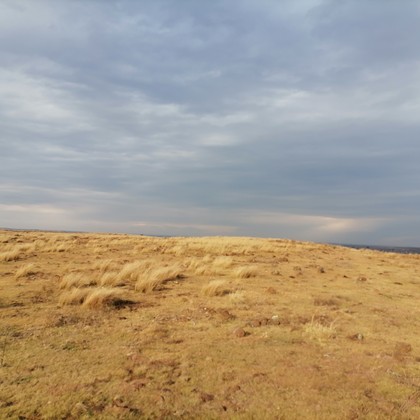
Short grassland, preferably on damp or heavy soils, vlei margins, burnt veld, pastures, airfields and field edges, from the coast to the highlands. It appears quickly on freshly burnt veld. It forages by walking on the ground, wagging its tail regularly, for insects and other invertebrates.
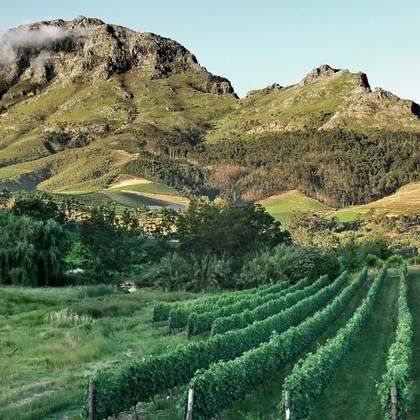
Where the bird is most at home, classified by the vegetation units of southern Africa.

Range and movements
Within the region mainly in the east and north: Eastern Cape, KwaZulu-Natal, Mpumalanga, Limpopo and the eastern Highveld in South Africa, Eswatini, western Lesotho, Zimbabwe, Mozambique, Malawi, Zambia, Angola, northern Botswana and north-eastern Namibia. Beyond the region widespread in sub-Saharan Africa, from Senegal to Ethiopia and Kenya.
- Resident
- Summer visitor (c. Oct–Mar)
- Winter visitor (c. Apr–Sep)
- Passage (Mar–Apr, Oct–Nov)
- dark = core range, pale = thinly spread
How and when to look
Look for it on closely grazed or freshly burnt grassland in the eastern highlands, for example around Wakkerstroom and in the Drakensberg foothills. Check the bill base at close range: yellow points to this species, pink to Buffy Pipit. In the breeding season, from September to December, it sings persistently from clods and termite mounds.
Conservation status
Not threatened. Common in suitable grassland and spread over a very large range. It benefits from grazing and burning that keep the grass short, and declines where grassland is lost to forestry plantations and intensive agriculture.
Scientific name
Anthus leucophrys | Vieillot, 1818
Vieillot described the species in 1818 and placed it straight away in the genus where it still stands. The genus Anthus was introduced in 1805 by Bechstein. Anthus is the Latin word for a small bird of grasslands mentioned by Pliny the Elder. leucophrys comes from the Greek leukos, 'white', and ophrus, 'eyebrow' — for the pale eyebrow. The specimen the first description was based on came from Cape of Good Hope.