All species › Passerines › Wagtails and pipits › African Pipit
African Pipit | Anthus cinnamomeus
Kaneelpieper | Bisbita Africano
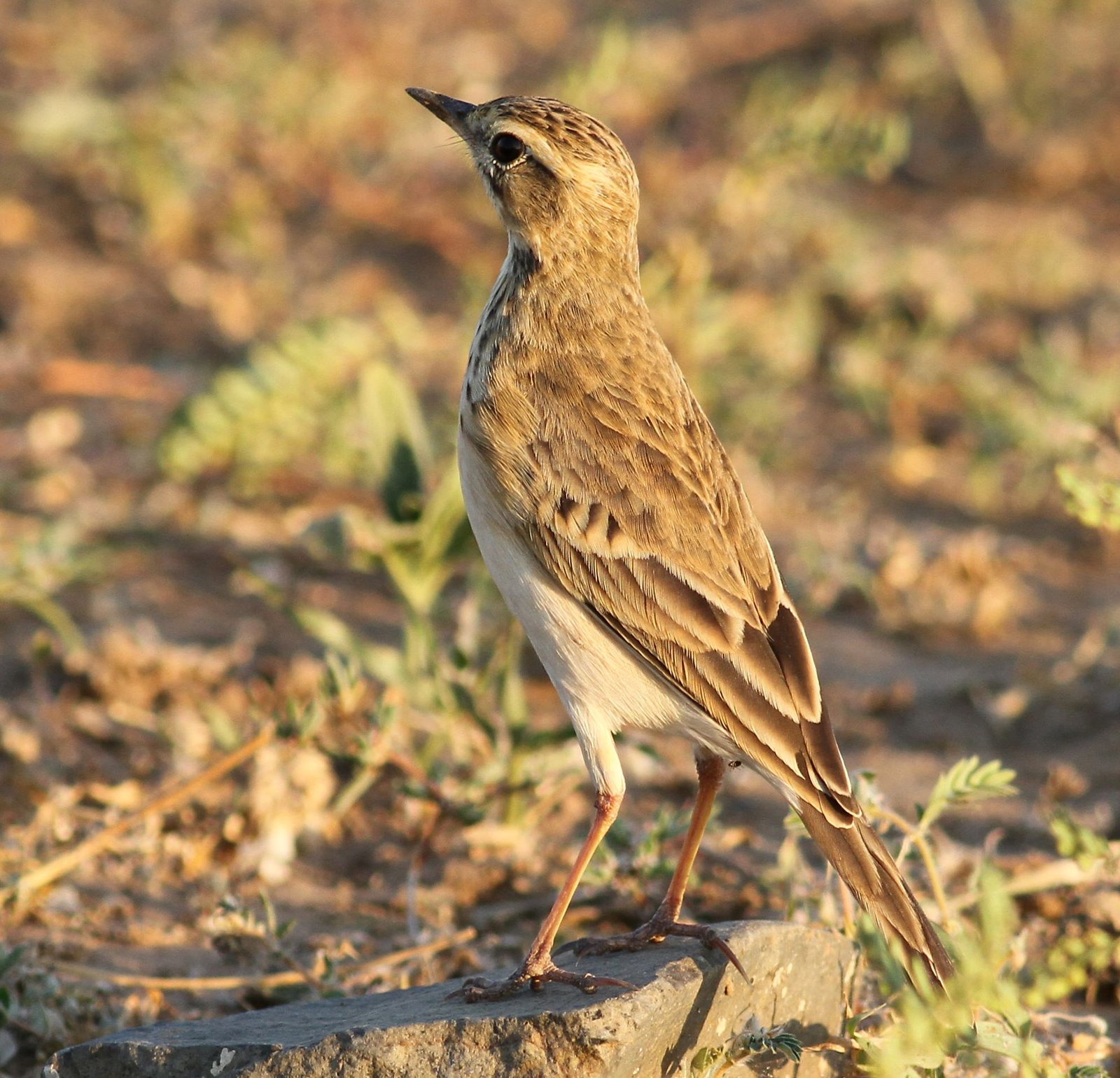
The African Pipit is the common, heavily streaked pipit of short grassland across almost the entire region, and thus the yardstick against which every other pipit is measured. In summer it draws attention with its display flight, circling in undulating loops high over the veld.
Voice
The call on take-off is a sharp chissik. The song is a series of repeated, scratchy chirps, trrit-trrit-trrit, delivered in an undulating display flight high over the territory or from a termite mound or clod, after which the bird plunges steeply to the ground.
Recording: Dawie de Swardt — CC BY-NC-SA 4.0 · converted to mono · xeno-canto
Identification
16 to 18 cm, a medium-sized, slender pipit. The upperparts are brown with distinct dark streaking on mantle and crown; the median wing coverts have sharply defined dark centres. A pale supercilium and a dark malar stripe frame the cheek. The breast is warm buff with a band of short, sharp dark streaks; belly and flanks are paler and unstreaked. The bill is slender, with a yellow base to the lower mandible; the legs are pale pink. The outer tail feathers are white and easy to see in flight. The sexes are alike; juveniles are darker and scaly above.
Confusion species
Buffy Pipit (Anthus vaalensis) and Plain-Backed Pipit (Anthus leucophrys) are larger, have an almost unstreaked back, weakly marked breast and buff rather than white outer tail feathers. Nicholson's Pipit (Anthus nicholsoni) is larger and longer-billed, with faint breast markings, and lives on rocky slopes. Richard's Pipit (Anthus richardi) is a rare vagrant, larger and longer-legged. Mountain Pipit (Anthus hoeschi) is very similar but more heavily streaked below, has buff outer tail feathers and a pink rather than yellow bill base; it breeds only in the high mountains of Lesotho and the Drakensberg. Look for the combination of streaked mantle, white tail sides and the call.
Habitat
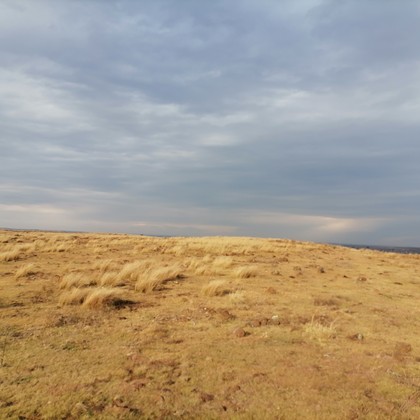
Short, open grassland, burnt veld, pastures, field margins, airfields, sports fields and road verges, from sea level high into the mountains; it avoids dense scrub and woodland. It forages by walking on the ground for insects, spiders and small seeds. The cup-shaped nest is on the ground, hidden at the base of a grass tuft.
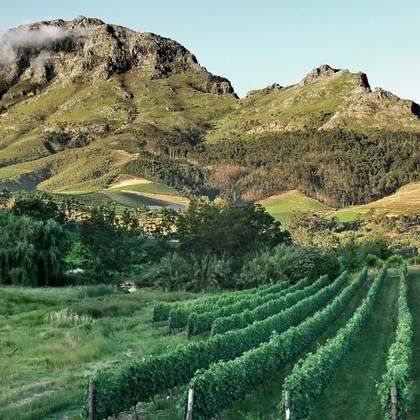
Where the bird is most at home, classified by the vegetation units of southern Africa.

Range and movements
Common in almost the entire region, from Angola, Zambia and Malawi to the Cape, but scarce or absent in the bare Namib and the driest parts of the Northern Cape and Botswana. Beyond the region across much of sub-Saharan Africa, from Senegal and Ethiopia southwards, and in the south-western Arabian Peninsula.
- Resident
- Summer visitor (c. Oct–Mar)
- Winter visitor (c. Apr–Sep)
- Passage (Mar–Apr, Oct–Nov)
- dark = core range, pale = thinly spread
How and when to look
Start with this species when learning pipits: walk over short grass or freshly burnt veld and wait for a bird to flush and call chissik. Then look for the white tail sides and streaked mantle. In summer, from September to February, the display flight gives away the territories. If a pipit has a plain back, you are probably dealing with one of the larger species.
Conservation status
Not threatened. One of the most numerous songbirds of open country in the region, with a large range and stable numbers. It benefits from grazing, burning and the maintenance of open grassland, and disappears where grassland is converted to dense plantations or fields without margins.
Scientific name
Anthus cinnamomeus | Rüppell, 1840
Rüppell described the species in 1840 and placed it straight away in the genus where it still stands. The genus Anthus was introduced in 1805 by Bechstein. Anthus is the Latin word for a small bird of grasslands mentioned by Pliny the Elder. cinnamomeus is Latin for 'cinnamon-coloured' — for the warm brown tone of the plumage. The specimen the first description was based on came from Simien Mountains, Ethiopia.