All species › Passerines › Wagtails and pipits › Striped Pipit
Striped Pipit | Anthus lineiventris
Gestreepte pieper | Bisbita Rayado
The Striped Pipit is the largest and most heavily streaked pipit of the region, an inhabitant of wooded, rocky slopes. It is heard more often than seen: the loud, thrush-like song rings out across the gorge from a boulder or a bare branch.

Voice
The song is loud, rich and melodious, more thrush-like than pipit-like: a series of repeated whistles, chree-chree-choo-cheep, delivered from a rock or branch, sometimes in flight. The call is a short chep.
Recording: Lars Lachmann — CC BY-NC-SA 4.0 · converted to mono · xeno-canto
Identification
A large, heavy pipit of 17 to 18 cm with a stout bill. The upperparts are olive-brown with dark streaks; the edges of the wing coverts and flight feathers are yellowish-green, forming an olive-yellow wing panel. The white supercilium is clear and the throat white with a dark malar stripe. Breast and flanks carry dense black streaks that continue well onto the belly, the best feature. The outer tail feathers are white. The sexes are alike; juveniles are warmer brown. It walks among rocks and flies into a tree when disturbed.
Confusion species
The Long-Billed Pipit (Anthus similis) has only faint breast streaking, an unstreaked belly and buff outer tail feathers. The African Rock Pipit (Anthus crenatus) is almost unstreaked and lives on bare rocky slopes in open grassland. The Wood Pipit (Anthus nyassae) of miombo woodland is more lightly streaked on the breast, with no streaks on the belly. No other pipit combines heavy breast and belly streaking with the yellowish-green wing panel.
Habitat
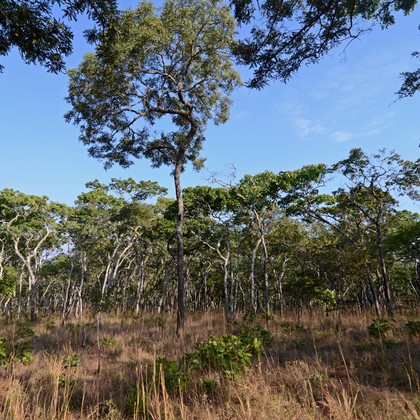
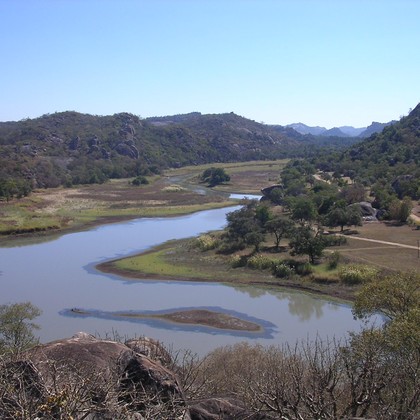
Steep rocky hills, koppies and gorges with open woodland, especially miombo, but also mixed broadleaf woodland, montane forest edges and plantations of alien trees. It forages among rocks, in sparse vegetation and along road verges for grasshoppers, other insects and ticks. The nest is on the ground, hidden under a tuft or rock, on level ground or a low bank.
Where the bird is most at home, classified by the vegetation units of southern Africa.

Range and movements
North-eastern South Africa (Limpopo, Mpumalanga, Gauteng and North West, south into KwaZulu-Natal), Eswatini, the far south-east of Botswana, much of Zimbabwe, Mozambique, Malawi, Zambia and Angola. Beyond the region to Tanzania, southern Kenya and southern DR Congo.
- Resident
- Summer visitor (c. Oct–Mar)
- Winter visitor (c. Apr–Sep)
- Passage (Mar–Apr, Oct–Nov)
- dark = core range, pale = thinly spread
How and when to look
Look for it on wooded rocky slopes such as the Magaliesberg, the Waterberg or the Matobo Hills. Early in the breeding season (September–December) listen for the loud song echoing through the gorge, then find the singer on a projecting rock or dead branch. Outside the breeding season it is quieter and best found by walking slowly along rocky woodland edges.
Conservation status
Not threatened. A widespread and locally common species of rugged, rocky terrain that is little threatened by agriculture.
Scientific name
Anthus lineiventris | Sundevall, 1850
Sundevall described the species in 1850 and placed it straight away in the genus where it still stands. The genus Anthus was introduced in 1805 by Bechstein. Anthus is the Latin word for a small bird of grasslands mentioned by Pliny the Elder. lineiventris comes from the Latin linea, 'line', and venter, 'belly' — for the streaked underparts. The specimen the first description was based on came from Mohapoani Berg, Limpopo River region.