All species › Passerines › Wagtails and pipits › African Rock Pipit
African Rock Pipit | Anthus crenatus
Kopjespieper | Bisbita Roquero
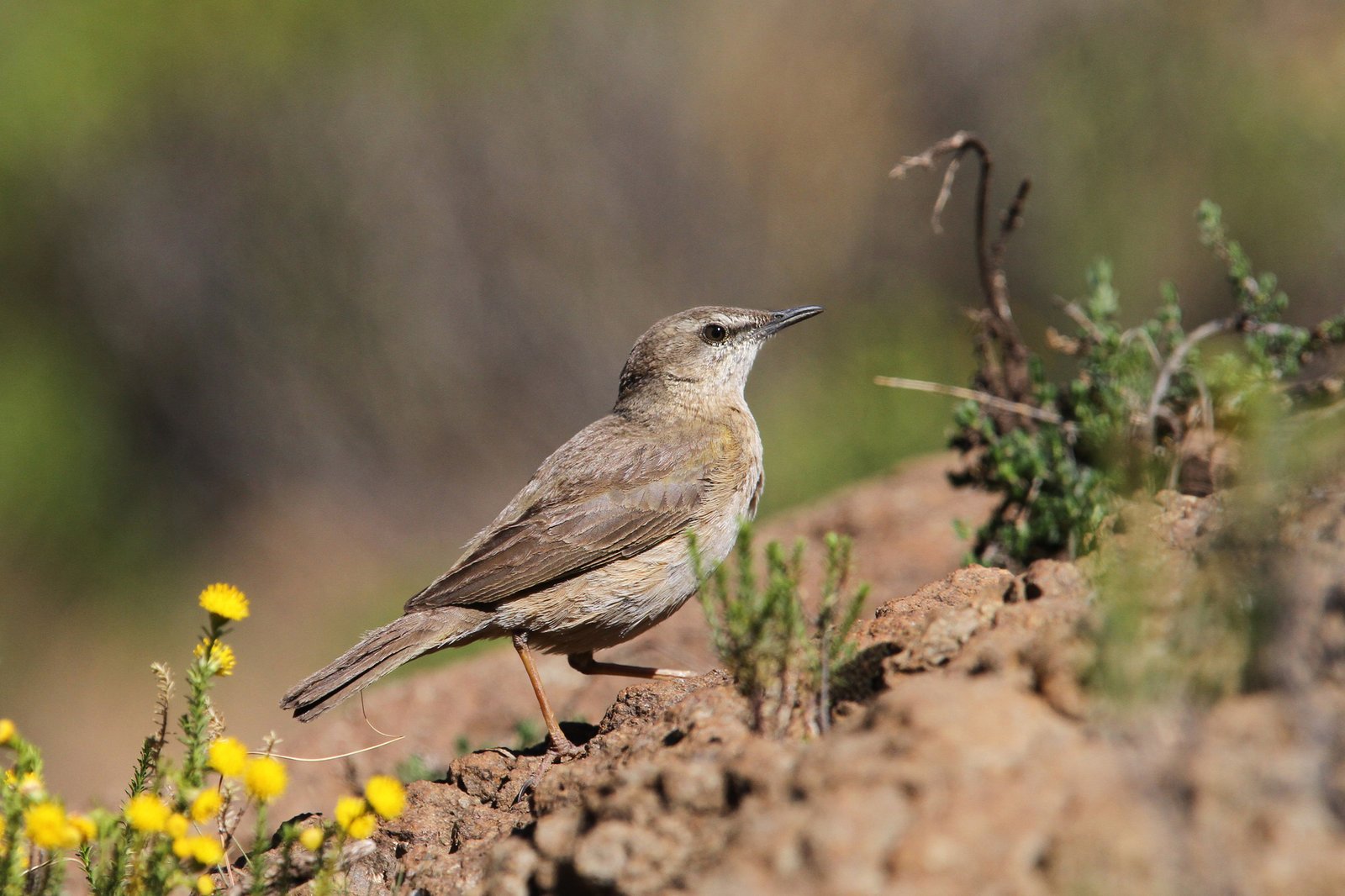
The African Rock Pipit is a compact, almost unstreaked pipit of steep grassy rocky slopes, endemic to South Africa and Lesotho. Of all the region's pipits it is the easiest to identify by ear: a thin whistle followed by a rolling trill, sung with the head thrown back.
Voice
The song is unique: a high thin whistle followed by a rolling, descending trill, tseeee-tcherrrrr, repeated after a pause from a boulder. It sings mainly in the early morning and in overcast weather, and can then be heard at long range. The call is a short chip.
Recording: Dawie de Swardt — CC BY-NC-SA 4.0 · shortened to the first 60 s, mono · xeno-canto
Identification
A compact, sturdy pipit of 17 to 18 cm with a relatively short tail and a strong bill. The upperparts are plain greyish-brown with no clear streaks; the breast is pale brownish-grey with at most faint streaking. The best field feature is the yellowish-green to olive-yellow panel formed by the edges of the greater coverts and secondaries. The pale supercilium is short and the throat white. The outer tail feathers are buff, not white. The sexes are alike. It perches upright on a boulder and sings with the bill raised and the throat quivering.
Confusion species
The Long-Billed Pipit (Anthus similis) is slimmer, longer-tailed and streaked on the back, lacks the yellowish-green wing panel and has a monotonous song built from separate notes. The Buffy Pipit (Anthus vaalensis) lives in flat short grassland and pumps its tail markedly. The Striped Pipit (Anthus lineiventris) is heavily streaked on breast and belly and lives on wooded slopes.
Habitat
Steep grassy and rocky slopes of mountains, koppies, valleys and gorges, from about 600 to 3,000 m, often on slopes with scattered boulders and few shrubs. It forages on the ground among the rocks for insects. The nest is on the ground, hidden under a grass tuft or against a rock.
Where the bird is most at home, classified by the vegetation units of southern Africa.


Range and movements
Endemic to South Africa and Lesotho: the Great Escarpment of the Eastern Cape, the Karoo mountains, the Drakensberg and the Free State highlands, also inland KwaZulu-Natal and southern Mpumalanga, and west into the mountains of the Western and Northern Cape. It does not occur outside this area.
- Resident
- Summer visitor (c. Oct–Mar)
- dark = core range, pale = thinly spread
How and when to look
Search sunny, windless mornings on rocky grassland slopes, for example along the Sani Pass, in Golden Gate or on the passes through the Karoo mountains. Listen for the characteristic whistle and trill and then scan the boulder the bird is singing from. When it sits still its cryptic plumage is easily overlooked.
Conservation status
Near Threatened on the global Red List (2024) owing to its limited range and the expected loss of habitat through climate change. A regional reassessment in 2025, however, estimated the population to be far larger than previously thought and found stable trends, so the species is now regarded as Least Concern in South Africa. Wind farms on ridges and bush encroachment are local risks.
Scientific name
Anthus crenatus | Finsch & Hartlaub, 1870
Finsch & Hartlaub described the species in 1870 and placed it straight away in the genus where it still stands. The genus Anthus was introduced in 1805 by Bechstein. Anthus is the Latin word for a small bird of grasslands mentioned by Pliny the Elder. crenatus is Latin for 'notched, crenate', from crena, 'notch'; exactly what feature the name refers to is unclear. The specimen the first description was based on came from near Cape Town, South Africa.