All species › Passerines › Wagtails and pipits › Short-Tailed Pipit
Short-Tailed Pipit | Anthus brachyurus
Kortstaartpieper | Bisbita Colicorto
The Short-Tailed Pipit is the smallest pipit of the region, a dark, heavily streaked bird with a stubby tail that recalls a cisticola more than a pipit. A scarce and poorly known species of short grassland on hills, it flushes from underfoot and drops back into the grass after a short flight.

Voice
The song is a buzzing, insect-like zzrt-zzreet, given in a high circling song flight or from a grass tuft. The call on take-off is a short, soft tsip.
Recording: Dries Van de Loock — CC BY-NC-SA 4.0 · converted to mono · xeno-canto
Identification
A tiny pipit of 11 to 12 cm with a strikingly short, narrow tail and a fine bill. The upperparts are dark brown with heavy black streaks and pale edges; the underparts are buff with dense, sharp black streaks across the whole breast and flanks. The outer tail feathers are white, sometimes hard to see in the short tail. The supercilium is narrow and pale. The sexes are alike. It flushes low and fast with a whirring flight and drops back into the grass after ten to thirty metres.
Confusion species
The Bushveld Pipit (Anthus caffer) is slightly larger, has a longer tail and less dense streaking below, and flies into a tree in savanna when flushed. Cisticolas such as the Zitting Cisticola (Cisticola juncidis) and the Wing-Snapping Cisticola (Cisticola ayresii) share the habitat but have an unstreaked breast, a finer bill and a tail with dark subterminal spots. The African Pipit (Anthus cinnamomeus) is much larger and long-tailed.
Habitat
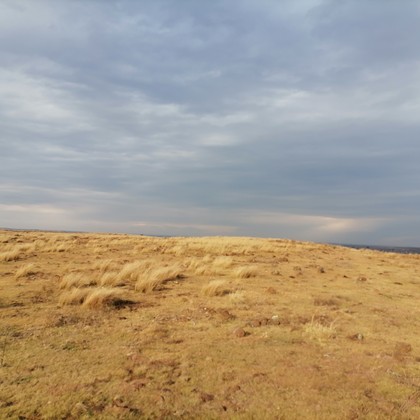
In the breeding season fairly short grassland on hills and slopes, often with scattered rocks, in highland and montane grassland. Outside the breeding season also seasonally flooded grassland and dambos. It forages on the ground for insects, larvae and seeds. The nest is a small, deep cup of grass, well hidden in a dense grass tuft.
Where the bird is most at home, classified by the vegetation units of southern Africa.


Range and movements
In South Africa and Eswatini a scarce and local breeding summer visitor to hilly grassland in Mpumalanga and northern KwaZulu-Natal; outside the breeding season there are records from the flooded grasslands near Beira in Mozambique. Also local in Zambia and Angola. Beyond the region in a series of scattered populations from Gabon and DR Congo to Uganda and Tanzania.
- Summer visitor (c. Oct–Mar)
- Winter visitor (c. Apr–Sep)
- dark = core range, pale = thinly spread
How and when to look
Search short, hilly grassland in the highlands of Mpumalanga and northern KwaZulu-Natal in November–January. Listen for the buzzing song flight, then walk slowly through the grass: the bird rises low and fast and soon drops again. With any small, heavily streaked 'cisticola' that flushes, check for white tail edges.
Conservation status
Not threatened. In South Africa it is regionally regarded as Vulnerable owing to loss of grassland to overgrazing, coal mining, afforestation and agriculture. In the rest of its range it is poorly known.
Scientific name
Anthus brachyurus | Sundevall, 1850
Sundevall described the species in 1850 and placed it straight away in the genus where it still stands. The genus Anthus was introduced in 1805 by Bechstein. Anthus is the Latin word for a small bird of grasslands mentioned by Pliny the Elder. brachyurus comes from the Greek brakhus, 'short', and oura, 'tail' — for the strikingly short tail. The specimen the first description was based on came from near Durban, South Africa.