All species › Passerines › Wagtails and pipits › Bushveld Pipit
Bushveld Pipit | Anthus caffer
Savannepieper | Bisbita Cafre
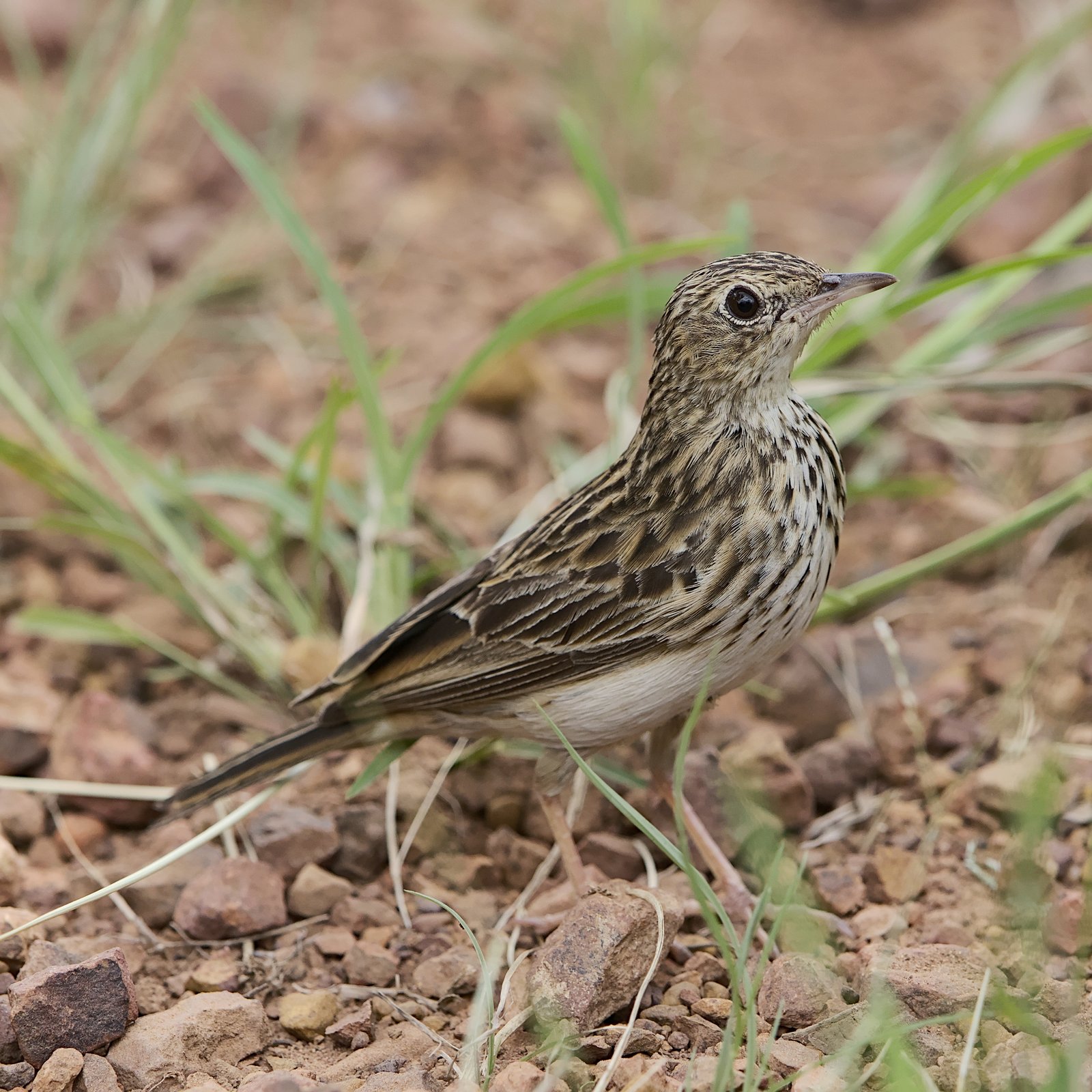
The Bushveld Pipit is a small, streaked pipit of open woodland that, when disturbed, does not crouch in the grass but flies up to a branch. An inconspicuous species usually noticed only by its thin call, after which the bird sits quietly and upright on a low branch.
Voice
The song is a repeated, rasping zrrrt-zeet or zree-zree-zree, sung from a branch or in a short song flight over the woodland. The call on take-off is a thin tseep.
Recording: Niall Perrins — CC BY-NC-SA 4.0 · converted to mono · xeno-canto
Identification
A small, compact pipit of 13 to 14 cm with a fairly short tail and a fine bill. The upperparts are warm brown with clear dark streaks; the underparts are buffy-white with dense, sharp black streaks on the breast that become finer on the flanks. The face is fairly plain, with a pale eye-ring and a short pale supercilium. The outer tail feathers are white and the legs pink. The sexes are alike. It walks on the ground in shady spots under trees and wags its tail slightly.
Confusion species
The Tree Pipit (Anthus trivialis) is larger, with a longer tail, a more olive back and heavier breast streaks that change sharply into finely streaked flanks; it is a summer visitor and calls a hoarse speez. The Short-Tailed Pipit (Anthus brachyurus) is even smaller and darker, has an even shorter tail and lives in open treeless grassland. The Wood Pipit (Anthus nyassae) is much larger, with a long tail and a heavier bill.
Habitat
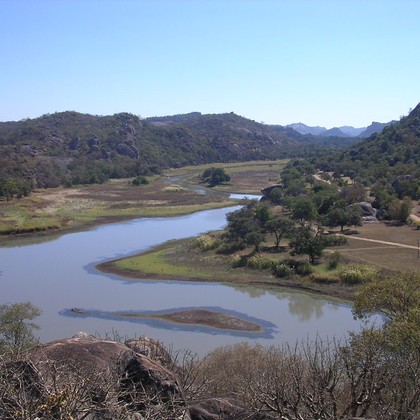
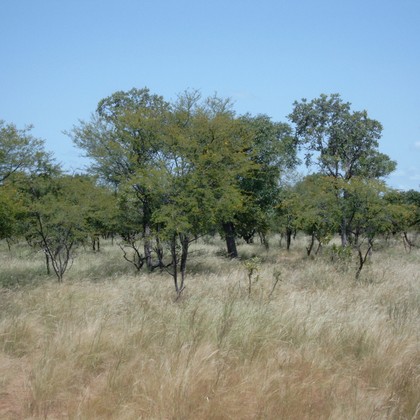
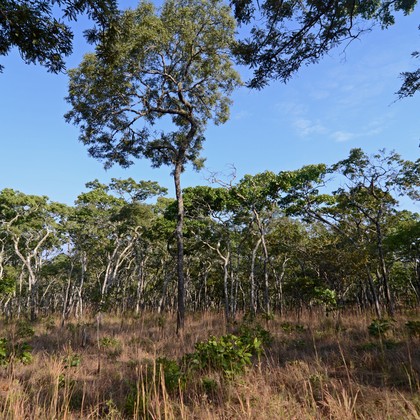
Open woodland with sparse undergrowth, especially mixed broadleaf woodland, acacia savanna and the edges of miombo, often where there is bare or closely grazed ground between the trees. It forages on the ground in grass and leaf litter for insects and outside the breeding season sometimes joins mixed feeding parties. The nest is a small, thick-walled cup of grass at the base of a tuft.
Where the bird is most at home, classified by the vegetation units of southern Africa.
Range and movements
Locally common in north-eastern South Africa (Limpopo, Mpumalanga, North West and northern KwaZulu-Natal), Eswatini, eastern Botswana, central Zimbabwe and southern Mozambique, more scattered and scarcer in Zambia and Malawi. Beyond the region in separate populations from Tanzania and Kenya to Ethiopia.
- Resident
- Winter visitor (c. Apr–Sep)
- dark = core range, pale = thinly spread
How and when to look
Walk through open woodland early in the breeding season (October–December), for example in the Kruger Park or the reserves of Limpopo, and listen for the rasping song. A pipit that flies into a tree when disturbed and stays there quietly is almost always this species in winter; in summer the Tree Pipit must be ruled out.
Conservation status
Not threatened. It is locally common in suitable woodland; large numbers are seldom seen only because of its unobtrusive habits.
Scientific name
Anthus caffer | Sundevall, 1850
Sundevall described the species in 1850 and placed it straight away in the genus where it still stands. The genus Anthus was introduced in 1805 by Bechstein. Anthus is the Latin word for a small bird of grasslands mentioned by Pliny the Elder. caffer is a dated colonial-era geographic term for the eastern and northern parts of southern Africa; it was standard in the naming of the period but is now considered offensive. The specimen the first description was based on came from Mohapoani Berg near the Limpopo River, South Africa.