All species › Passerines › Wagtails and pipits › Tree Pipit
Tree Pipit | Anthus trivialis
Boompieper | Bisbita Arbóreo
The Tree Pipit is a Palearctic migrant that inhabits the woodland of the north of the region in small numbers during the southern summer. Unlike most pipits it flies into a tree when disturbed and sometimes walks along branches, with a hoarse speez as its signature.

Voice
The call on take-off is a hoarse, drawn-out speez or teez, the key feature in the region. The rich song, with its characteristic closing series seea-seea-seea in a parachuting flight, is heard in Africa only occasionally just before departure.
Recording: Astrid Cervantes — CC BY-NC-SA 4.0 · converted to mono · xeno-canto
Identification
A slim pipit of about 15 cm with a fairly short, fine bill with a pink lower mandible. The upperparts are olive-brown with moderate dark streaks; the breast is warm buff with heavy, drop-shaped black streaks that change sharply into much finer streaks on the white flanks. The supercilium is buff and faint behind the eye, with a small white spot behind the ear-coverts. Two pale wing bars. The outer tail feathers are white. Legs pink, with a short curved hind claw. The sexes are alike. It pumps its tail constantly.
Confusion species
The Bushveld Pipit (Anthus caffer) is smaller, shorter-tailed, warmer brown on the back and more finely streaked on a buffier breast; it is resident and has a thinner call. The Wood Pipit (Anthus nyassae) is larger, much less streaked on the breast and longer-tailed. The Red-Throated Pipit (Anthus cervinus) has heavily streaked flanks, pale lines on the back and a thin, drawn-out call. The African Pipit (Anthus cinnamomeus) is larger, longer-legged and lives in open grassland.
Habitat
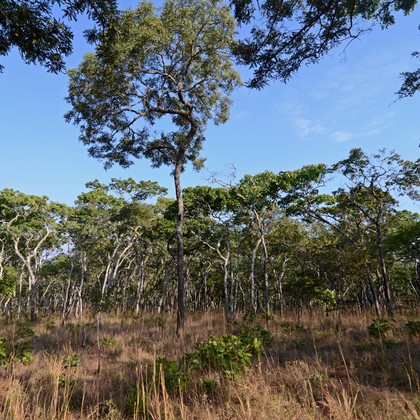
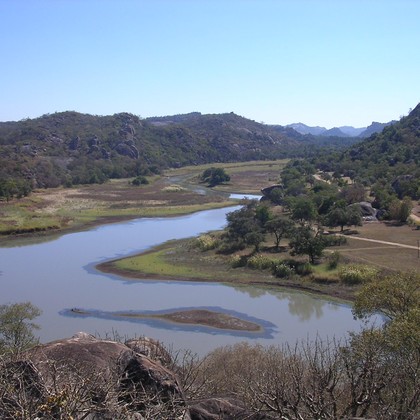
Open and semi-open woodland, especially miombo and mixed broadleaf woodland with a grassy understorey, also woodland edges, clearings, parks and plantations with trees. It forages on the ground for insects and flies into a tree when disturbed, where it walks along the branches.
Where the bird is most at home, classified by the vegetation units of southern Africa.
Range and movements
A scarce but regular summer visitor to the north of the region: Zambia, Malawi, Angola, Zimbabwe, northern Mozambique, the Caprivi Strip and northern Botswana. Further south, in Limpopo, Mpumalanga and KwaZulu-Natal, it is rare. It breeds from Europe to central Siberia and winters in sub-Saharan Africa and India.
- Summer visitor (c. Oct–Mar)
- Passage (Mar–Apr, Oct–Nov)
- dark = core range, pale = thinly spread
How and when to look
Search miombo and other open woodland in Zambia, Malawi and Zimbabwe from November to March. Look for a pipit that flies up from the grass to a branch and gives the hoarse speez there. In the south of the region a calling bird is the key evidence: the Bushveld Pipit sounds thinner and is often mistaken for a Tree Pipit there.
Conservation status
Not threatened. In parts of Europe breeding populations have declined sharply through changes in forestry and farming; the range nevertheless remains huge.
Scientific name
Anthus trivialis | (Linnaeus, 1758)
Linnaeus described the species in 1758 as Alauda trivialis; because it was later moved to another genus, the author and year stand in brackets. The genus Anthus was introduced in 1805 by Bechstein. Anthus is the Latin word for a small bird of grasslands mentioned by Pliny the Elder. trivialis is Latin for 'common, ordinary', from trivium 'public street'. The specimen the first description was based on came from Sweden.