All species › Passerines › Wagtails and pipits › Yellow-Breasted Pipit
Yellow-Breasted Pipit | Hemimacronyx chloris
Geelborstpieper | Bisbita Pechigualdo
The Yellow-Breasted Pipit is a shy, little-known pipit of the high-altitude grassland of eastern South Africa and Lesotho. In breeding plumage its bright yellow throat and breast make it unmistakable, but most of the time it creeps unseen through dense grass and gives itself away only in its high song flight.

Voice
In song flight the male climbs high and circles for minutes on fast wingbeats above the territory, giving a rapidly repeated, scratchy chip-chip-chip or shilip-shilip, sometimes ending in a longer tsiew. The call on take-off is a soft, sparrow-like tchurp.
No recording with a suitable Creative Commons licence is available for this species yet.
Identification
A compact pipit of 16 to 18 cm with a short tail and a fine bill. The upperparts are strikingly scaled: each feather has a dark centre and a broad pale fringe, giving the back a neat, scaly pattern. In breeding plumage (roughly October to March) throat, breast and belly are bright yellow, without breast band or necklace; the female is slightly paler and sometimes shows fine streaks on the breast. In non-breeding plumage the underparts are pale buff with yellow only on the belly and undertail coverts, and the bird is best known by the scaly back and, in flight, by the yellow underwing. The outer tail feathers are pale buff.
Confusion species
A young Cape Longclaw (Macronyx capensis) is also yellowish without a clear necklace, but is larger, with a heavier bill, a very long hind claw and white tail corners. Yellow-Throated Longclaw (Macronyx croceus) has a black necklace and a streaked, not scaled, back. In non-breeding plumage the species resembles other pipits such as African Pipit (Anthus cinnamomeus), but that is slimmer and longer-tailed, with a streaked breast and white outer tail feathers. Short-Tailed Pipit (Anthus brachyurus), an irregular visitor to the same grassland, is smaller, darker and heavily streaked.
Habitat
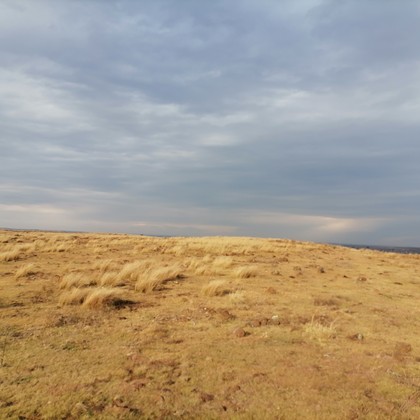
Short to medium, dense and undisturbed grassland with good basal cover, in summer mainly above 1800 m on high plains, plateaus and mountain slopes. In winter part of the population moves to lower grassland in the midlands and on the edges of the Highveld. It forages for insects, creeping hidden in the grass. It avoids heavily grazed, annually burnt and bush-encroached grassland.
Where the bird is most at home, classified by the vegetation units of southern Africa.

Range and movements
Endemic to eastern South Africa and Lesotho: the Mpumalanga escarpment and the highlands around Wakkerstroom and Dullstroom, the Drakensberg and midlands of KwaZulu-Natal, the eastern Free State, the north-eastern Eastern Cape and the highlands of Lesotho. In winter lower down in the same provinces. The species occurs nowhere outside this region.
- Resident
- Summer visitor (c. Oct–Mar)
- dark = core range, pale = thinly spread
How and when to look
Look for the species in summer, from November to February, on still mornings on the grassland plateaus around Wakkerstroom, where it is best known. Listen for the repeated chip-chip high in the sky and follow the bird until it drops; on the ground it often sits motionless and can be found with patience and a telescope. A local guide will know the current territories.
Conservation status
Vulnerable. The world population is small and declining, mainly through loss and degradation of high-altitude grassland to timber plantations, agriculture, mining, overgrazing and unfavourable burning regimes. Important populations lie in the protected grasslands around Wakkerstroom and in the Drakensberg.
Scientific name
Hemimacronyx chloris | (Lichtenstein, 1842)
Lichtenstein described the species in 1842 as Anthus chloris; because it was later moved to another genus, the author and year stand in brackets. The genus Hemimacronyx was introduced in 1922 by Roberts. Hemimacronyx combines the Greek hēmi-, 'half, small', with Macronyx, the longclaw genus — a 'half-longclaw', for its intermediate position between pipits and longclaws. chloris is the Greek khlōris, 'greenfinch' (from khlōros, 'yellow-green') — for the yellow underparts. The specimen the first description was based on came from eastern Cape, South Africa.