All species › Waders, gulls and terns › Skuas › Long-Tailed Jaeger
Long-Tailed Jaeger | Stercorarius longicaudus
Kleinste jager | Págalo Rabero
The Long-Tailed Jaeger is the slimmest of the jaegers, with a buoyant, tern-like flight and, in adults, greatly elongated central tail feathers. Off southern Africa it is a bird of the open ocean that is rarely seen from land.
Voice
Silent at sea.
Recording: Stanislas Wroza — CC BY-NC-SA 4.0 · converted to mono · xeno-canto
Identification
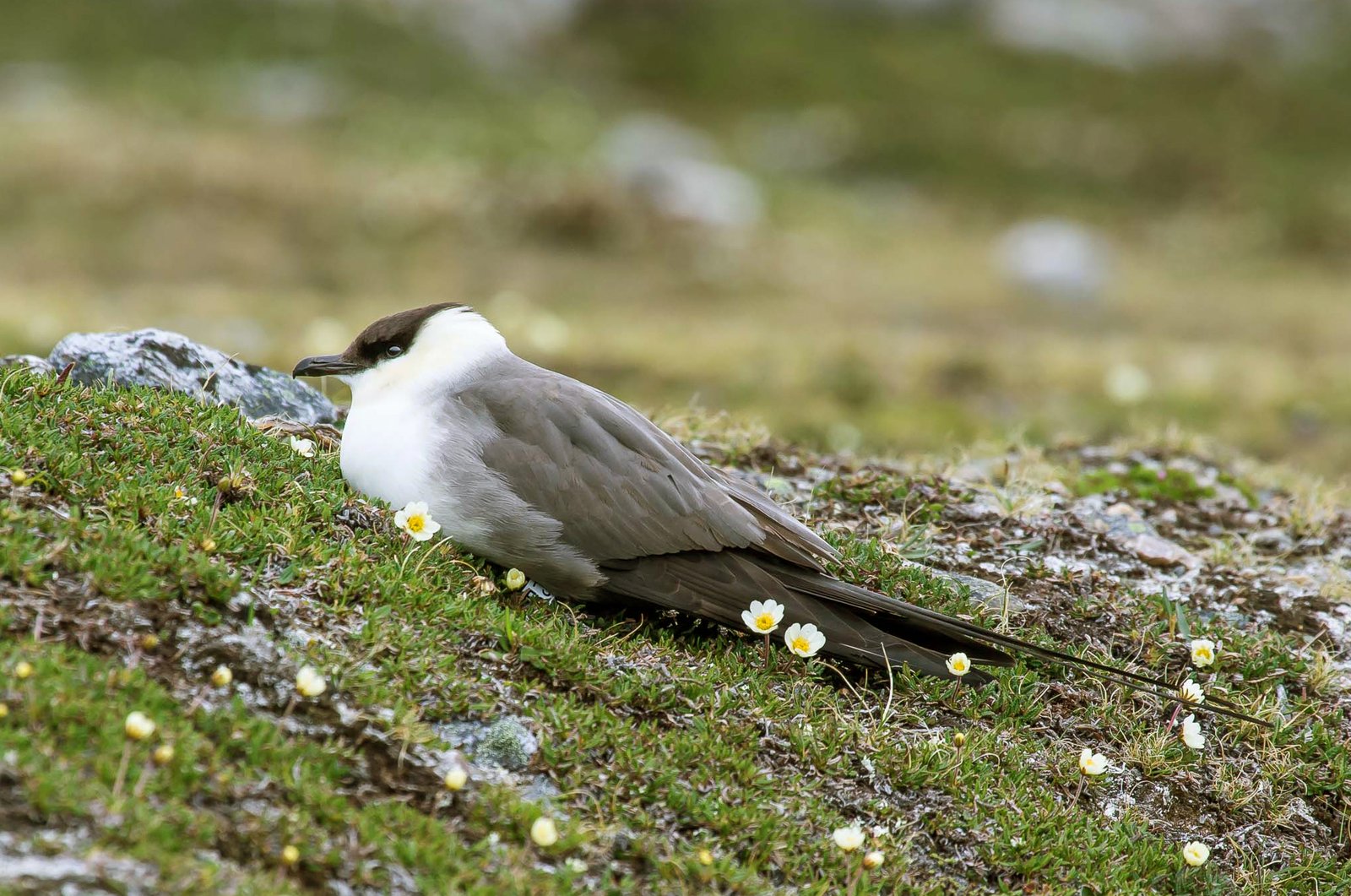
48–53 cm, including the long tail streamers of adults; the body is smaller than that of Parasitic Jaeger. Adults are cool grey above, with contrasting blackish flight feathers, a sharply defined black cap, yellowish cheeks and a white breast that becomes greyer towards the belly, without a breast band. The white wing flash is limited to the shafts of the two outer primaries. Juveniles are cold grey-brown to almost black, often pale-headed, with sharply black-and-white barred under- and uppertail coverts and short, blunt tail tips. During the northern winter the tail streamers are often worn or in moult.
Confusion species
Parasitic Jaeger Stercorarius parasiticus is bulkier and browner, with a larger white wing flash, often a breast band in pale adults and short, pointed tail tips; juveniles are warmer rusty brown. Pomarine Jaeger Stercorarius pomarinus is much heavier, with a broad chest, heavy bill and slow wingbeats.
Habitat
The open ocean, mainly over and beyond the edge of the continental shelf, often tens to hundreds of kilometres offshore. It eats fish and offal and steals from terns less than other jaegers; it sometimes follows trawlers. It rests on the water, sometimes in small groups.
Where the bird is most at home, classified by the vegetation units of southern Africa.

Range and movements
At sea off the whole coast of the region, most often off Namibia and the west and south coasts of South Africa, less so off Angola and in the Mozambique Channel. Only exceptionally seen from land, usually after strong onshore winds. It breeds right around the Arctic on high-Arctic tundra; most birds winter in the South Atlantic, including the Benguela Current.
- Passage (Mar–Apr, Oct–Nov)
- dark = core range, pale = thinly spread
How and when to look
Take a pelagic trip from Cape Town or Simon's Town to the trawlers at the shelf edge, preferably between November and March. On juveniles look for the sharply barred undertail and the very small white wing flash; on adults the cool grey mantle and long tail streamers are decisive.
Conservation status
Not threatened; the world population is large and fluctuates with lemming cycles in the breeding areas, where hardly any young are raised in poor years.
Scientific name
Stercorarius longicaudus | Vieillot, 1819
Vieillot described the species in 1819 and placed it straight away in the genus where it still stands. The genus Stercorarius was introduced in 1760 by Brisson. Stercorarius is Latin for 'of dung', from stercus 'dung': the food disgorged by seabirds when pursued by skuas was once taken for excrement. longicaudus is Latin, from longus 'long' and cauda 'tail', after the long central tail feathers of the adult. The specimen the first description was based on came from northern Europe.