All species › Passerines › Weavers › Long-Tailed Widowbird
Long-Tailed Widowbird | Euplectes progne
Hanenstaartwidavink | Obispo Colilargo
The Long-Tailed Widowbird is the most celebrated bird of the highveld: the breeding male trails a black tail almost half a metre long as it flutters slowly over the grassland. It is a classic example of sexual selection, as females prefer males with the longest tails.

Voice
A scratchy, sizzling zzit-zzit-zzit and a hoarse chirping from the male, from a grass tuft or in flight. In flocks a dry chik-chik contact call.
Recording: Lars Lachmann — CC BY-NC-SA 4.0 · converted to mono · xeno-canto
Identification
Female about 15–16 cm; breeding male about 19–21 cm without the tail, 55–71 cm with it, the central tail feathers reaching about 50 cm. The breeding male is wholly deep black with a broad tail of long, softly arched feathers, an orange-red shoulder patch bordered below by a broad white to pale buff band, and a bluish-white bill. The female is buff-brown with heavy dark streaking above, a pale supercilium, a finely streaked breast and a short pointed tail. The non-breeding male resembles the female but is much larger, with blacker wings, and keeps the red-and-white shoulder. Juveniles resemble the female.
Confusion species
The Red-Collared Widowbird (Euplectes ardens) has a much shorter, narrow tail, red on the throat and no red shoulder. The Fan-Tailed Widowbird (Euplectes axillaris) is smaller and short-tailed, with a red shoulder lacking the white band. The White-Winged Widowbird (Euplectes albonotatus) has a yellow shoulder, a white wing patch and a shorter tail. Females and non-breeding males are larger and bulkier than those of the other widowbirds and bishops; in winter flocks the red-and-white shoulders of the males give the species away.
Habitat
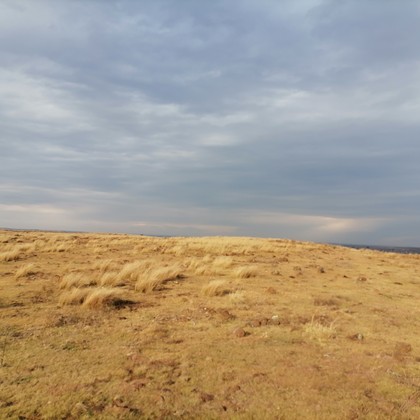
Open, moist to drier high-altitude grassland, vleis and grassland around dams and marshes, up into the Drakensberg. In summer the male defends a territory in tall grass in which several females nest; the nest is a ball of grass low in a tuft. In winter it forms flocks on stubble, maize fields and burns. It eats mainly grass seeds.
Where the bird is most at home, classified by the vegetation units of southern Africa.


Range and movements
In the region mainly on the highveld and in the eastern grasslands of South Africa: Gauteng, Mpumalanga, Free State, North West, inland KwaZulu-Natal and the Eastern Cape, and in Lesotho and western Eswatini; a few records in south-eastern Botswana. A separate population lives on the grasslands of the central Angolan plateau and in western and northern Zambia. Beyond the region only in southern DR Congo and the highlands of Kenya.
- Resident
- Summer visitor (c. Oct–Mar)
- Passage (Mar–Apr, Oct–Nov)
- dark = core range, pale = thinly spread
How and when to look
From December to February on the highveld and in the Drakensberg, for example along farm roads around Wakkerstroom, Dullstroom and in Golden Gate: males fly low over their territory on slow wingbeats, the tail hanging down and folded into a vertical keel. In rain and strong wind they can barely fly and sit low in the grass.
Conservation status
Not threatened, but declining locally in South Africa through conversion of natural grassland to cropland, forestry and mining, and through too-frequent burning and overgrazing. Where natural grassland survives, the species is common.
Scientific name
Euplectes progne | (Boddaert, 1783)
Boddaert described the species in 1783 as Emberiza progne; because it was later moved to another genus, the author and year stand in brackets. The genus Euplectes was introduced in 1829 by Swainson. Euplectes joins Greek eu 'fine, good' to New Latin plectes 'weaver'. progne refers to Procne (Prokne), the Athenian princess of Greek myth who was turned into a swallow — possibly for the long tail. The specimen the first description was based on came from Cape of Good Hope.