All species › Kingfishers, bee-eaters and rollers › Kingfishers › Malachite Kingfisher
Malachite Kingfisher | Corythornis cristatus
Malachietijsvogel | Martín Pescador Malaquita
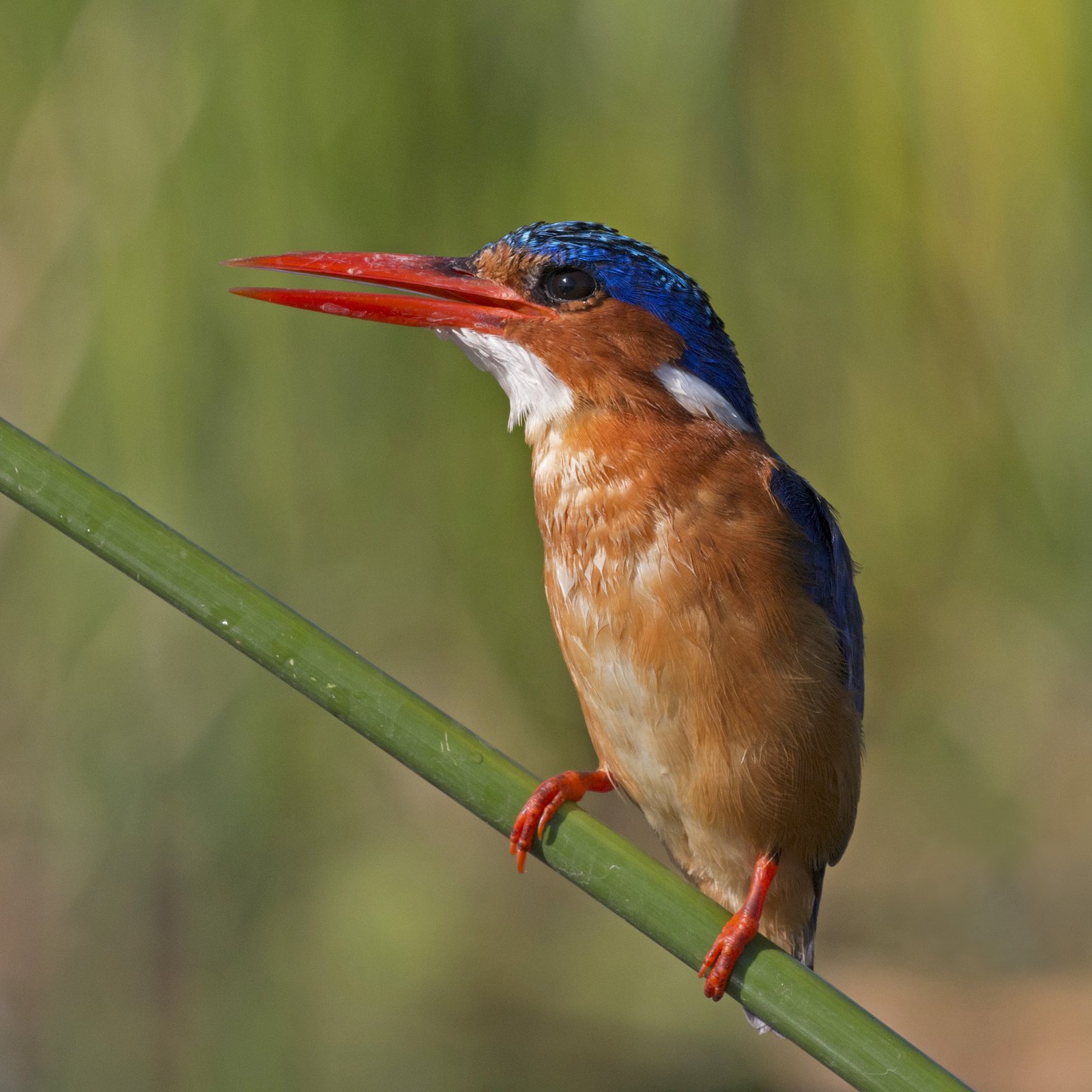
The Malachite Kingfisher is the small, jewel-like kingfisher of reedbeds and water margins: ultramarine above, warm rufous below, with a bright red bill and a crest barred turquoise and black. It is strictly tied to water and fishes from low perches just above the surface.
Voice
A high, sharp tsip or tseek, mostly given in fast flight low over the water; in territorial encounters a squeaky twitter, tsi-tsi-tsi-tsiwi, sometimes with head-bobbing and a raised crest.
Recording: Bernard BOUSQUET — CC BY-NC-SA 4.0 · converted to mono · xeno-canto
Identification
About 14 cm. The upperparts are deep ultramarine blue, the crown and crest turquoise with fine black bars; the crest reaches the eye and can be raised like a comb. The cheeks and underparts are rufous-orange, the throat white, and there is a white patch on the side of the neck. Bill and legs are bright red. The sexes are alike. Juveniles are duller, with a blackish bill and a darker, less glossy back; the bill turns red over a few months.
Confusion species
African Pygmy Kingfisher (Ispidina picta) is slightly smaller, lacks the barred crest, has a violet ear patch and a blue crown that does not reach the eye, and lives mainly in woodland far from water. White-Bellied Kingfisher (Corythornis leucogaster), in northern Angola, has a white central belly and keeps to forest streams. Half-Collared Kingfisher (Alcedo semitorquata) is larger, with a black bill and pale underparts.
Habitat
Margins of rivers, streams, dams, lakes, marshes and quiet estuaries with reeds, papyrus or overhanging vegetation. It perches low on a reed stem or twig, dives at an angle into shallow water and takes small fish, tadpoles, aquatic insects and crustaceans. It excavates a nest tunnel in a steep sand or earth bank, often a low river bank or even the side of a dug pit.
Where the bird is most at home, classified by the vegetation units of southern Africa.

Range and movements
Over much of the region wherever suitable water occurs: throughout South Africa except the driest parts of the Northern Cape and the Karoo, in Lesotho, Eswatini, Zimbabwe, Mozambique, Malawi, Zambia, northern and eastern Botswana (Okavango and Chobe), northern Namibia and almost all of Angola. In the dry western half of the region only along permanent rivers and dams. Beyond the region across most of sub-Saharan Africa.
- Resident
- Summer visitor (c. Oct–Mar)
- Winter visitor (c. Apr–Sep)
- Passage (Mar–Apr, Oct–Nov)
- dark = core range, pale = thinly spread
How and when to look
Walk slowly along a reed fringe and watch for a small spark of blue shooting away low over the water; the bird usually lands a little further on on a reed stem and often returns to the same perch. In the south of the region birds wander to open water in winter; in dry years they vanish from dams that dry out.
Conservation status
Not threatened and common throughout the region. Locally it suffers from the draining of wetlands, the loss of reed-fringed banks and water pollution, but new dams and reservoirs have extended its habitat elsewhere.
Scientific name
Corythornis cristatus | (Pallas, 1764)
Pallas described the species in 1764 as Alcedo cristata; because it was later moved to another genus, the author and year stand in brackets. The genus Corythornis was introduced in 1848 by Kaup. Corythornis comes from the Greek korys, genitive korythos, 'helmet', and ornis, 'bird' — for the barred crest on the crown of Malachite Kingfisher. cristatus is Latin for 'crested', from crista, 'crest' — for the black-and-turquoise barred crest. The specimen the first description was based on came from Cape of Good Hope.