All species › Kingfishers, bee-eaters and rollers › Kingfishers › White-Bellied Kingfisher
White-Bellied Kingfisher | Corythornis leucogaster
Witbuikijsvogel | Martín Pescador Ventriblanco
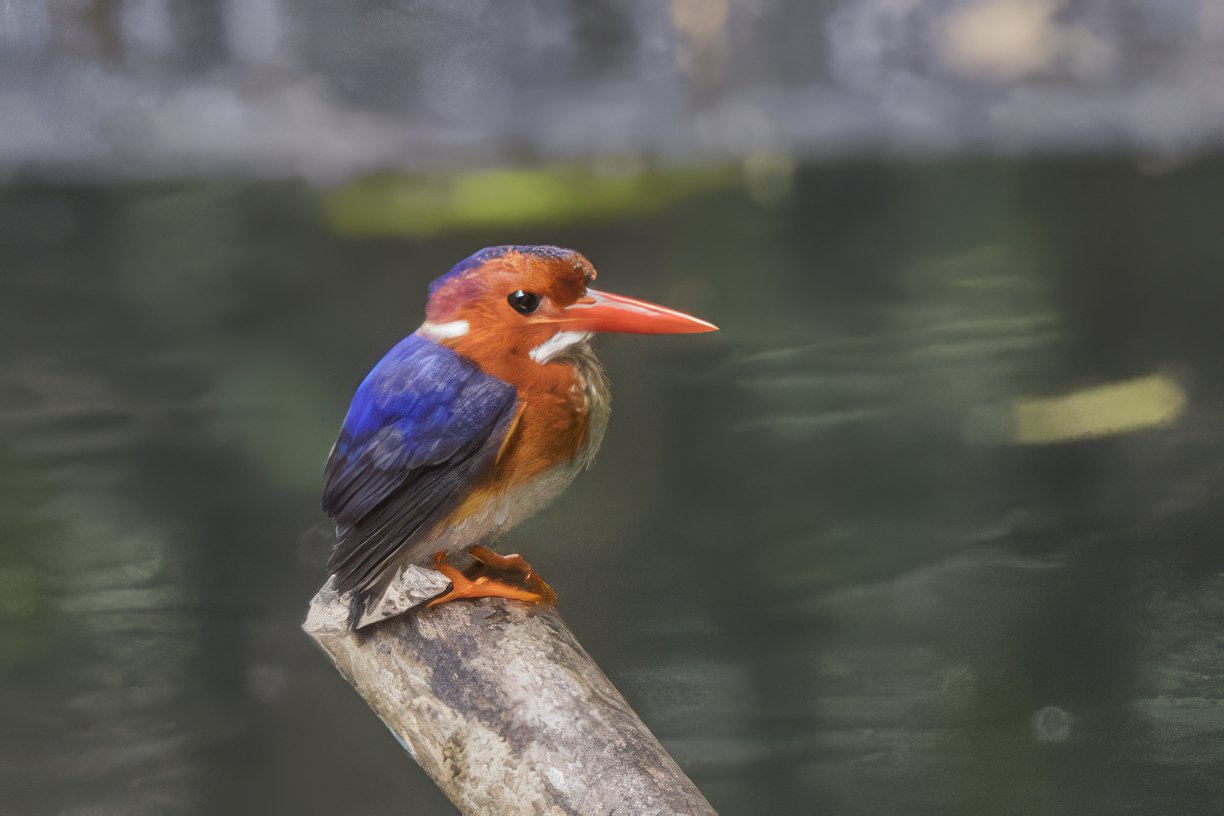
The White-Bellied Kingfisher is a small, dark blue kingfisher of rainforest streams and pools, with a red bill and a striking white stripe down the centre of the underparts. In the region it occurs only in northern Angola and north-western Zambia, at the southern edge of the Congo Basin.
Voice
A high tsip or tseep, often in flight low over the water, sometimes repeated in a rapid series.
Recording: Bram Piot — CC BY-NC-SA 4.0 · converted to mono · xeno-canto
Identification
About 13 cm, with a long red bill and red legs. The crown is dark blue-black with fine pale blue barring and forms a small crest. The upperparts are deep ultramarine, with a brighter blue stripe down the back and rump. The cheeks are rufous, with a white neck patch. Throat and centre of breast and belly are white, the breast sides and flanks rufous; the white central stripe is the best feature. The sexes are alike. Juveniles are duller, with a blackish bill.
Confusion species
Malachite Kingfisher (Corythornis cristatus) has a brighter turquoise crest, paler blue upperparts and wholly rufous underparts without a white central stripe. Shining-Blue Kingfisher (Alcedo quadribrachys) is larger, with a black bill and uniformly rufous underparts. African Pygmy Kingfisher (Ispidina picta) has a violet ear patch and usually sits far from water.
Habitat
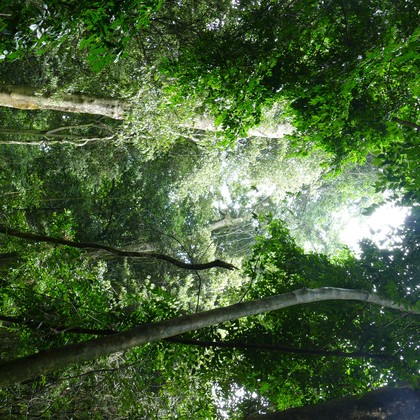
Small, shaded forest streams, pools and swampy patches in lowland rainforest, gallery forest and swamp forest; also in dense vegetation away from water. It perches low on a branch or root over the water and catches small fish, tadpoles, aquatic insects and also insects on the ground. It nests in a burrow in a bank or in the root plate of a fallen tree.
Where the bird is most at home, classified by the vegetation units of southern Africa.

Range and movements
In the region only at the southern edge of the Congo Basin: in northern Angola (Cabinda, Uíge, Cuanza Norte, Lunda Norte) and in north-western Zambia in the gallery forests of the Mwinilunga district. Beyond the region in rainforest from Guinea and Mali east to Uganda, including Bioko.
How and when to look
In north-western Zambia best searched for along the shaded streams in the gallery forests around the source of the Zambezi. Stand still by a forest stream and watch for a small dark blue bird skimming low and fast over the water; in the half-light the white belly is often the first thing noticed.
Conservation status
Not threatened and widespread over a large range. In the region local and rare; the gallery forests of north-western Zambia and northern Angola are under pressure from logging, agriculture and fires.
Scientific name
Corythornis leucogaster | (Fraser, 1843)
Fraser described the species in 1843 as Halcyon leucogaster; because it was later moved to another genus, the author and year stand in brackets. The genus Corythornis was introduced in 1848 by Kaup. Corythornis comes from the Greek korys, genitive korythos, 'helmet', and ornis, 'bird' — for the barred crest on the crown of Malachite Kingfisher. leucogaster is Greek, from leukos, 'white', and gastēr, 'belly' — for the white centre of the belly. The specimen the first description was based on came from Malabo (Clarence), Bioko, Equatorial Guinea.