All species › Passerines › Batises and wattle-eyes › Margaret's Batis
Margaret's Batis | Batis margaritae
Boultons vliegenvanger | Batis de Boulton
Margaret's Batis is a batis of the central plateau of Angola and north-western Zambia, an area visited by few birders. It stands out among the batises in that the female also has a black breast band, and in its red eye.

Voice
A series of clear, even whistles, tyoo-tyoo-tyoo, often repeated at length, and hard, rapid chik-chik clicks. It makes a whirring wing noise in flight.
No recording with a suitable Creative Commons licence is available for this species yet.
Identification
11–12 cm. The male has a dark grey crown and back, a broad black mask, a white supercilium, black wings with a white wing stripe and a black tail with white outer edges. The underparts are white with a broad black breast band. The female is similarly patterned, but the breast band is narrower and sometimes brownish-black; the chestnut throat spot or breast band of other batises is lacking. The eye is red. Juveniles are browner above, with a pale, rusty-mottled breast.
Confusion species
Chinspot Batis Batis molitor has a yellow eye; the female has a chestnut chin spot and breast band. Angola Batis Batis minulla is smaller, with a yellow eye, and the female has a rufous breast band. Pale Batis Batis soror is smaller and paler, with a yellow eye. Black-Throated Wattle-Eye Platysteira peltata has a red wattle above the eye and a glossy black back.
Habitat
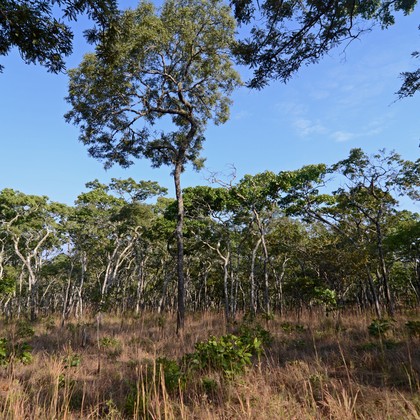
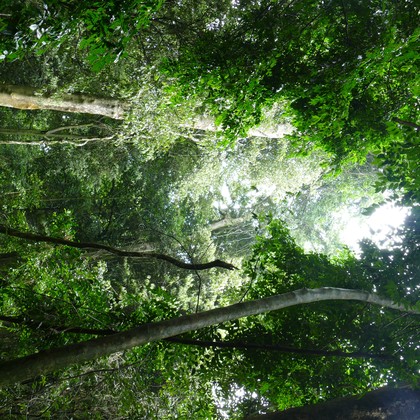
Dry evergreen forest, especially Cryptosepalum or mavunda forest on Kalahari sand, and the edges of dense miombo woodland and gallery forest. It forages in the middle and upper strata, often in mixed flocks, catching insects in short sallies.
Where the bird is most at home, classified by the vegetation units of southern Africa.
Range and movements
Within the region on the central plateau of Angola, from Huambo and Bié east through Moxico, and in north-western Zambia, including the West Lunga and around Mwinilunga and Solwezi. Beyond the region only in adjacent south-eastern Democratic Republic of the Congo.
- Resident
- dark = core range, pale = thinly spread
How and when to look
Year-round. West Lunga National Park and the dry forests between Solwezi and Mwinilunga in Zambia are the most accessible sites. Search mixed flocks in dense forest and listen for the steady whistled series; the red eye and the black breast band in both sexes confirm the species.
Conservation status
Not threatened, but with a fairly small range. The dry evergreen forest on which it depends is locally cleared for farming and timber, including around mining areas in north-western Zambia.
Scientific name
Batis margaritae | Boulton, 1934
Boulton described the species in 1934 and placed it straight away in the genus where it still stands. The genus Batis was introduced in 1833 by Boie. Batis is a Greek word for an unidentified worm-eating bird mentioned by Aristotle; Boie applied the name to these small African flycatchers in 1833. margaritae honours the American historian and novelist Margaret Leech (1893–1974); the species was described in 1934 by the American ornithologist Rudyerd Boulton. The specimen the first description was based on came from Mount Moco, Angola.