All species › Parrots › Parrots › Meyer's Parrot
Meyer's Parrot | Poicephalus meyeri
Meyers papegaai | Lorito de Meyer
Meyer's Parrot is a small brown parrot with yellow shoulders and a blue-green belly, the commonest parrot of the dry woodland of northern southern Africa. Pairs and small flocks give themselves away by their high calls and fast, direct flight.

Voice
A high chee-chee and a screeching kree-kree-kree, often in flight; when perched also a series of sharp, metallic notes and softer chattering. Flocks are noisiest on taking off and at waterholes.
Recording: GABRIEL LEITE — CC BY-NC-SA 4.0 · converted to mono · xeno-canto
Identification
About 22 cm, with a short tail and a large head. The head, throat, breast, back and wings are greyish brown. A yellow band across the crown is present in many birds but varies greatly and is often absent altogether. The bend of the wing, the lesser coverts along the leading edge and the underwing coverts are bright yellow, conspicuous in flight. The belly, flanks and rump are blue-green to turquoise. The bill is dark grey, the iris orange-red. The sexes are alike; juveniles are duller, with little or no yellow and a dark iris. The flight is fast and direct, on rapid shallow beats.
Confusion species
Rüppell's Parrot (Poicephalus rueppellii) of Namibia and south-western Angola has a greyer head without yellow on the crown and yellow thighs, and the female has a bright blue back, rump and belly; hybrids occur in northern Namibia. Brown-Headed Parrot (Poicephalus cryptoxanthus) is largely green with a brown head, a pale yellow iris and no yellow on the shoulders. Red-Fronted Parrot is green with an orange-red forehead and lives in rainforest.
Habitat
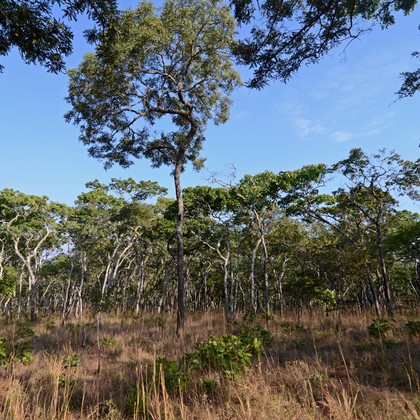
Dry to semi-humid woodland: mopane, miombo, mixed woodland and acacia savanna, especially with tall trees along rivers and around pans. It eats seeds, fruit, nuts and flowers, and sometimes raids maize and sunflower fields. It drinks daily, often in the late morning. It nests in tree holes, often old woodpecker holes.
Where the bird is most at home, classified by the vegetation units of southern Africa.


Range and movements
The north of the region: northern and north-eastern Namibia including the Caprivi Strip, northern and eastern Botswana including the Okavango Delta and Chobe, almost all of Zimbabwe except the high east, Zambia, western Mozambique, the far north of South Africa along the Limpopo, and the interior of Angola; scarce in Malawi. Beyond the region across the savanna belt of East and Central Africa, from Tanzania and Congo to Chad, Sudan and Ethiopia.
- Resident
- Summer visitor (c. Oct–Mar)
- Winter visitor (c. Apr–Sep)
- Passage (Mar–Apr, Oct–Nov)
- dark = core range, pale = thinly spread
How and when to look
In the Okavango Delta, Chobe, Hwange and Mana Pools the species is common; watch for pairs flying fast over the woodland with high calls. Waterholes in the late morning give the best chance of good views of perched birds, when the yellow shoulders and blue-green belly show well. In northern Namibia check any yellow on the crown and the belly colour because of hybrids with Rüppell's Parrot.
Conservation status
Not threatened and common over a large range. Locally it is trapped for the cage-bird trade and persecuted as a crop pest, and the felling of old trees with holes limits nest sites. There is no evidence of a steep decline.
Scientific name
Poicephalus meyeri | (Cretzschmar, 1827)
Cretzschmar described the species in 1827 as Psittacus Meyeri; because it was later moved to another genus, the author and year stand in brackets. The genus Poicephalus was introduced in 1837 by Swainson. Poicephalus comes from the Greek poikilos, 'mottled, variegated', and kephale, 'head' — for the strongly contrasting head pattern of these parrots. meyeri honours the German physician and naturalist Bernhard Meyer (1767–1836). The specimen the first description was based on came from Kordofan, Sudan.