All species › Parrots › Parrots › Red-Fronted Parrot
Red-Fronted Parrot | Poicephalus gulielmi
Congopapegaai | Lorito Frentirrojo
The Red-Fronted Parrot is a green, short-tailed parrot of the Central African rainforest, with an orange-red forehead. Within the area of this guide it occurs only in northern Angola, where it is often seen in pairs flying high over the forest.

Voice
A high kwee-kwee and a sharp chee-weet, mainly in flight; when perched also soft creaking and whistled notes. Pairs and flocks call often and loudly on taking off.
Recording: isaac kilusu — CC BY-NC-SA 4.0 · converted to mono · xeno-canto
Identification
About 28 cm, stocky, with a large head and a short, square tail. The body is green, most yellow-green on the rump and belly; the feathers of the back and mantle are black with green edges, giving a scaled pattern. The forehead and forecrown are orange-red, as are the thighs and the bend of the wing in most birds. The flight feathers and tail are dark. The upper mandible is pale horn with a dark tip, the lower mandible dark; the iris is orange-red. The sexes are alike. Juveniles lack the orange-red on head and wing and have a dark iris. The flight is fast, on rapid deep beats, and the loud calls give the bird away.
Confusion species
Grey Parrot (Psittacus erithacus) is larger and wholly grey with a red tail. Meyer's Parrot (Poicephalus meyeri) is smaller and brown with yellow shoulders and a blue-green belly, and lives in dry woodland, not rainforest. Cape Parrot is most similar to Red-Fronted Parrot but occurs far outside its range, in the mist forests of South Africa.
Habitat
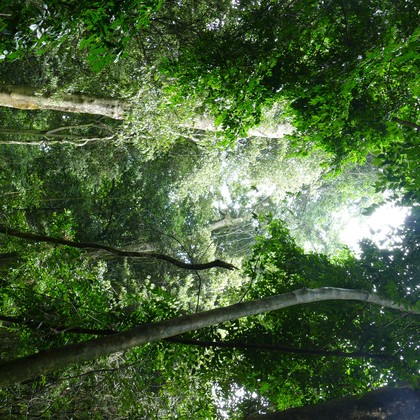
Humid lowland and montane rainforest, gallery forest and forest edges with tall trees. It eats seeds and fruit of forest trees, including figs and the cones of Podocarpus in montane forest. It lives in pairs and small flocks that gather at productive trees, and nests in holes high in old trees.
Where the bird is most at home, classified by the vegetation units of southern Africa.

Range and movements
Within the region only in northern Angola: in the Maiombe forests of Cabinda and locally in the forests of the northern provinces. Beyond the region from Ivory Coast and Ghana through Cameroon, Gabon and both Congos to the Central African Republic, with isolated populations in the montane forests of Kenya and northern Tanzania.
- Resident
- dark = core range, pale = thinly spread
How and when to look
In Cabinda listen in the early morning for high calls above the forest and follow pairs crossing fast and high between the trees. Perched birds are hard to find in the canopy; clearings with views over the treetops and fruiting trees at forest edges give the best chance.
Conservation status
Not threatened on the global list, but declining locally through forest loss and trapping for the cage-bird trade. In Angola the species is scarce and little studied; the loss of lowland forest in the north is the main threat.
Scientific name
Poicephalus gulielmi | (Jardine, 1849)
Jardine described the species in 1849 as Pionus gulielmi; because it was later moved to another genus, the author and year stand in brackets. The genus Poicephalus was introduced in 1837 by Swainson. Poicephalus comes from the Greek poikilos, 'mottled, variegated', and kephale, 'head' — for the strongly contrasting head pattern of these parrots. gulielmi is Latin for 'William's': Sir William Jardine named it after his son William, who brought the first specimen back from the Congo. The specimen the first description was based on came from Congo (not specified).