All species › Parrots › Parrots › Cape Parrot
Cape Parrot | Poicephalus robustus
Kaapse papegaai | Lorito del Cabo
The Cape Parrot is a heavily built, short-tailed parrot with a disproportionately large bill, tied to Afromontane mistbelt forest with yellowwood trees. It is the only parrot endemic to South Africa, and the world population is estimated at between one and two thousand birds.
Voice
Loud, harsh and nasal calls: a high tzek-tzek and a screeching krzzik, and in flight a piercing tweet-tweet. Flocks are noisiest leaving the roost at first light, the calls carrying across a whole valley.
Recording: Rick Nuttall — CC BY-NC-SA 4.0 · shortened to the first 60 s, mono · xeno-canto
Identification
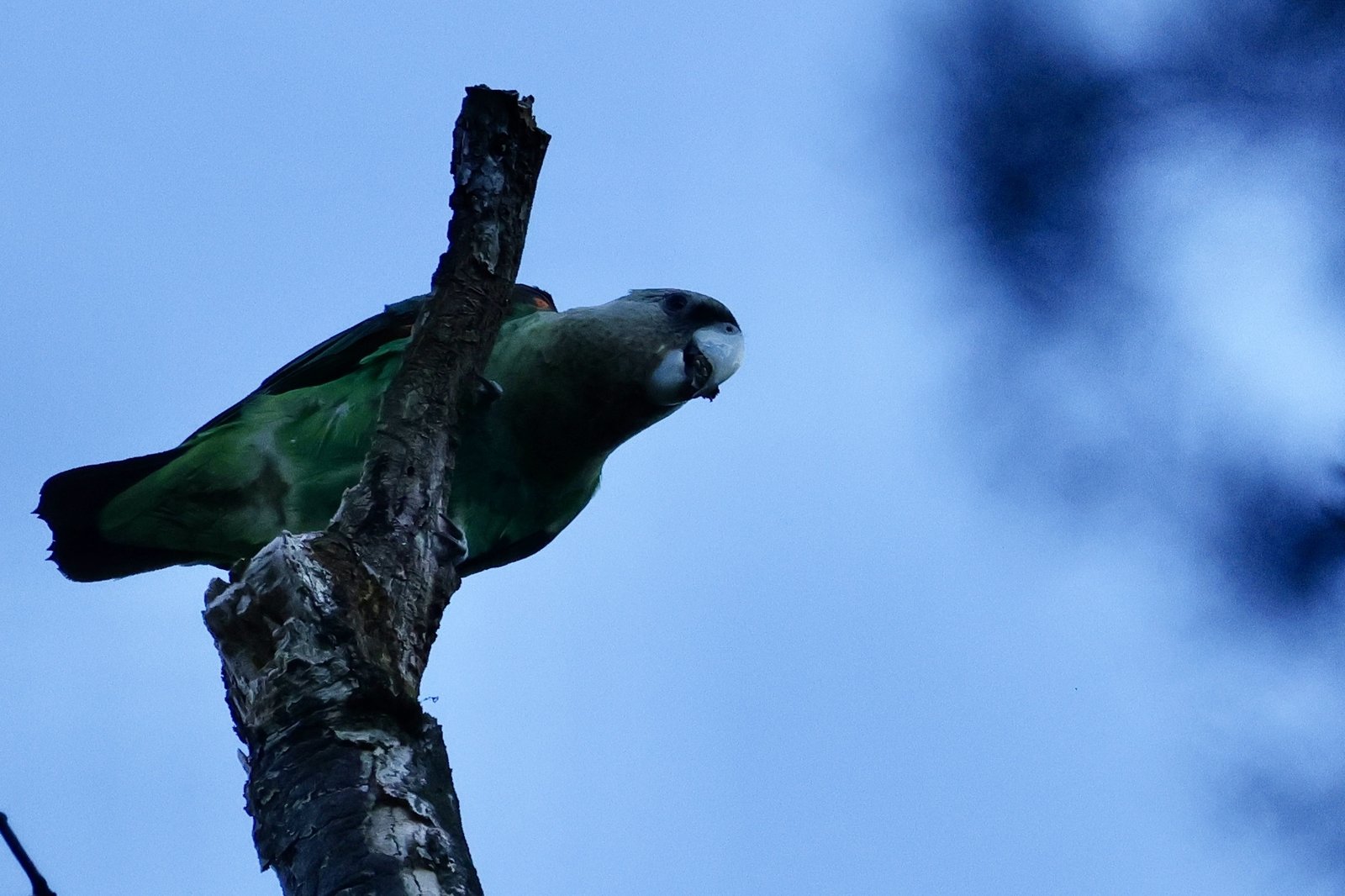
Solidly built, 30 to 35 cm long, with a thick pale horn-coloured bill that is larger in proportion to the body than in any other African parrot. The body is olive-green and the head golden-brown to olive-brown, clearly paler than the rest. Both sexes have orange-red thighs and an orange-red patch at the bend of the wing. The female additionally has an orange-red band across the forehead, which the male usually lacks. Juveniles resemble the female. Flight is fast and direct on rapid shallow beats, accompanied by loud calls.
Confusion species
Grey-headed (Brown-necked) Parrot (Poicephalus fuscicollis suahelicus) of Limpopo, Zimbabwe, Mozambique, Zambia and Malawi is larger, with a silvery-grey head and neck and an even heavier bill; it lives in low-lying mopane and miombo woodland and does not overlap with the Cape Parrot's mistbelt forest. Meyer's Parrot is much smaller, brown with yellow shoulders and a blue-green rump. Rüppell's Parrot of Namibia is brown with a blue belly.
Habitat
Afromontane mistbelt forest with yellowwood trees (Podocarpus and Afrocarpus), whose fruit kernels it chops out. When the yellowwood crop fails it turns to pecan and almond orchards, exotic trees in villages, and wild figs along forest edges.
Where the bird is most at home, classified by the vegetation units of southern Africa.

Range and movements
Endemic, with a highly fragmented range in South Africa: the Eastern Cape forests around the Amathole mountains and the former Transkei, the KwaZulu-Natal mistbelt belt, and a small isolated population in Limpopo around Magoebaskloof and the Woodbush forest. It is absent from the rest of southern Africa and occurs nowhere else in the world.
- Resident
- Summer visitor (c. Oct–Mar)
- Winter visitor (c. Apr–Sep)
- Passage (Mar–Apr, Oct–Nov)
- dark = core range, pale = thinly spread
How and when to look
Stand at a vantage point above a forest patch at first light and listen for the calls of small flocks commuting between roost forest and feeding trees; the same movement happens in the last hour before sunset. Hogsback and Magoebaskloof are the most accessible sites. A national count is held each May, when sightings are best documented.
Conservation status
Vulnerable globally and assessed as Endangered nationally in South Africa. Felling of large yellowwoods in the nineteenth and twentieth centuries removed both food and nest cavities, and the remaining forest lies in small, widely separated fragments. Psittacine beak and feather disease, capture for the cage-bird trade and the loss of old cavity trees add to this. Nest-box schemes, forest restoration and an annual census are under way.
Scientific name
Poicephalus robustus | (Gmelin, 1788)
Gmelin described the species in 1788 as Psittacus robustus; because it was later moved to another genus, the author and year stand in brackets. The genus Poicephalus was introduced in 1837 by Swainson. Poicephalus comes from the Greek poikilos, 'mottled, variegated', and kephale, 'head' — for the strongly contrasting head pattern of these parrots. robustus is Latin for 'sturdy, strongly built', for this parrot's relatively heavy build within its genus. The specimen the first description was based on came from South Africa.