All species › Falcons › Falcons › Lanner Falcon
Lanner Falcon | Falco biarmicus
Lannervalk | Halcón Borní
The Lanner Falcon is the most widespread large falcon in southern Africa, a slim, long-tailed hunter of open country, mountains and towns. The rufous crown makes the adult easy to recognise, even at a distance.

Voice
A harsh, rapid kre-kre-kre-kre or kak-kak-kak, mainly around the nest and in alarm, and a whining, plaintive weeeeh from begging young and from the female.
Recording: Stanislas Wroza — CC BY-NC-SA 4.0 · converted to mono · xeno-canto
Identification
About 42 cm, the female clearly larger than the male. The upperparts are blue-grey with fine dark barring, the crown and nape rufous, the forehead cream. A thin black moustachial stripe and a narrow dark eye-stripe frame the pale cheek. The underparts are cream with a pinkish tinge and almost unmarked in adult southern African birds; only the flanks sometimes show a few spots. The cere, eye-ring and legs are yellow. Juveniles are brown above, with a paler rufous crown and heavily dark-brown-streaked underparts. In flight the wings look broader and blunter and the tail longer than in Peregrine Falcon; the wingbeats are slower and looser.
Confusion species
Peregrine Falcon (Falco peregrinus) is more compact and shorter-tailed, with a dark head, a broad black moustachial stripe and barred underparts. Juvenile Peregrines lack the rufous crown. Red-Necked Falcon (Falco chicquera) also has a rufous head but is much smaller, with finely barred underparts and a tail with a broad black terminal band. Taita Falcon is smaller and stocky with rufous underparts.
Habitat
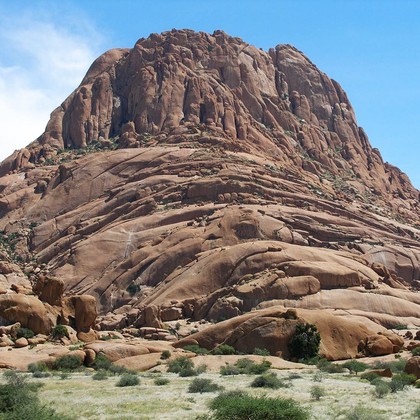
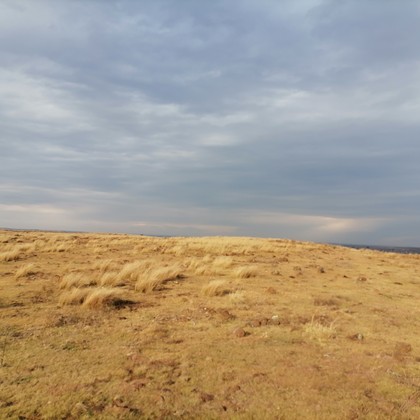
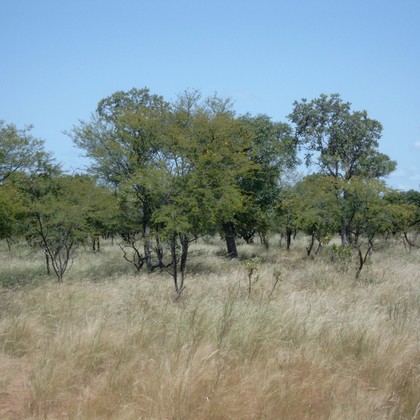
Very broad: open grassland, Karoo and semi-desert, mountains with cliffs, open savanna, farmland and towns. It hunts mainly birds up to the size of a francolin, often by flying low over the ground to surprise prey, but also from a stoop; at times together with its mate. It also takes rodents, reptiles and insects. It nests on cliffs, in old stick nests of crows and raptors, and on pylons and buildings.
Where the bird is most at home, classified by the vegetation units of southern Africa.
Range and movements
Distributed across virtually the whole region and the commonest large falcon, from the Cape to Angola, Zambia and Malawi; most numerous in open dry country in Namibia, Botswana and the interior of South Africa, scarcer in densely wooded areas and on the humid coastal plain of Mozambique. Beyond the region it occurs across almost all of Africa outside the rainforest, around the Mediterranean and in the Middle East.
- Resident
- Summer visitor (c. Oct–Mar)
- Winter visitor (c. Apr–Sep)
- Passage (Mar–Apr, Oct–Nov)
- dark = core range, pale = thinly spread
How and when to look
Look at the tops of pylons along highveld and Karoo roads, and along cliffs in mountainous country. At waterholes in the Kalahari and Etosha Lanners often hunt the doves and sandgrouse that come to drink; wait there in the morning. Breeds from July to October.
Conservation status
Not threatened and common over most of its range. In the north of its global range, around the Mediterranean, the species is scarcer and declining. In southern Africa electrocution on pylons, pesticide poisoning and the taking of young for falconry are local threats; the species benefits from pylons as nest sites in treeless country.
Scientific name
Falco biarmicus | Temminck, 1825
Temminck described the species in 1825 and placed it straight away in the genus where it still stands. The genus Falco was introduced in 1758 by Linnaeus. Falco is the Latin word for 'falcon', possibly related to falx, 'sickle', for the curved shape of the claws or wings. biarmicus is not certainly explained; it has been read as 'bearded', but probably goes back to Bjarmaland, a district in northern Russia, in latinised form. The specimen the first description was based on came from the Cape of Good Hope.