All species › Falcons › Falcons › Peregrine Falcon
Peregrine Falcon | Falco peregrinus
Slechtvalk | Halcón Peregrino
The Peregrine Falcon is the most powerful falcon in the region, a compact, deep-chested hunter that strikes birds out of the air in a steep stoop. In southern Africa the small dark subspecies minor breeds on cliffs and tall buildings; in the southern summer it is joined by the larger, paler Palearctic subspecies calidus.

Voice
A harsh repeated kek-kek-kek-kek or rek-rek-rek at the nest and when disturbed, and a whining weee-chew between the pair. Largely silent outside the breeding season.
Recording: Frantz Barrault — CC BY-NC-SA 4.0 · converted to mono · xeno-canto
Identification
About 34 to 38 cm in resident birds, females clearly larger than males; calidus is larger. Adults are slate-grey above with a blackish head and a broad, sharply defined black moustachial stripe that merges with the crown into a hood. The throat and upper breast are white to cream, the rest of the underparts finely barred black. The cere, eye-ring and legs are yellow. The wings are broad-based and pointed, the tail rather short. Juveniles are dark brown above and heavily streaked below. Calidus is paler grey, with a narrower moustachial stripe, more white on the cheeks and paler underparts.
Confusion species
Lanner Falcon (Falco biarmicus) is slimmer, with a longer tail and broader, blunter wings, a rufous crown, a thin moustachial stripe and unmarked pinkish-cream underparts; its flight is looser. Taita Falcon (Falco fasciinucha) is much smaller, with rufous underparts and rufous nape patches. African Hobby is smaller and slimmer, with rufous underparts. Juvenile Peregrines resemble juvenile Lanners but have a dark, not rufous, crown, a broader moustachial stripe and a more compact outline.
Habitat
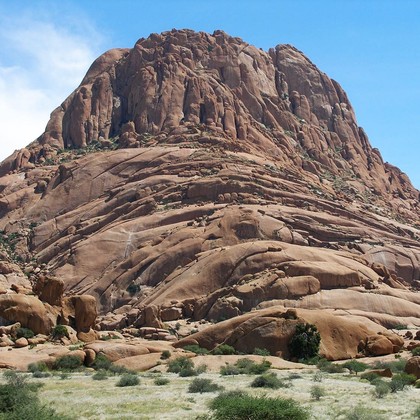
Breeds on ledges of high cliffs in mountains, river gorges and sea cliffs, and increasingly on tall buildings, church towers and industrial sites in cities. It hunts from high flight or a lookout for medium-sized birds such as pigeons, ducks, waders and starlings, which are struck in a stoop with closed wings. The Palearctic birds spend the summer on coasts, at large wetlands and in cities, where waders and pigeons are plentiful.
Where the bird is most at home, classified by the vegetation units of southern Africa.


Range and movements
Scarce but distributed across almost the whole region, tied to cliffs and buildings: from the Cape mountains and coast through the Drakensberg, the Magaliesberg and the gorges of Limpopo to Zimbabwe, Zambia, Malawi, Mozambique and Namibia; largely absent as a breeder from the flat interior of Botswana and the Kalahari. Cape Town, Johannesburg and other cities hold pairs breeding on buildings. Worldwide on every continent except Antarctica.
- Resident
- Summer visitor (c. Oct–Mar)
- Winter visitor (c. Apr–Sep)
- Passage (Mar–Apr, Oct–Nov)
- dark = core range, pale = thinly spread
How and when to look
Check high cliffs in gorges and the upper ledges of towers and chimneys in cities; a breeding pair often returns to the same ledge year after year. In the southern summer coastal lagoons and large wetlands with many waders are good places for the migrants. Breeds mainly from July to October, earlier than most other raptors.
Conservation status
Not threatened on the global list. The species declined steeply worldwide in the twentieth century through DDT and other pesticides and recovered after these were banned. In southern Africa the resident population is small but stable; disturbance at breeding cliffs, poisoning through prey and the taking of young for falconry are local threats. Colonisation of cities has helped the species.
Scientific name
Falco peregrinus | Tunstall, 1771
Tunstall described the species in 1771 and placed it straight away in the genus where it still stands. The genus Falco was introduced in 1758 by Linnaeus. Falco is the Latin word for 'falcon', possibly related to falx, 'sickle', for the curved shape of the claws or wings. peregrinus is Latin for 'wanderer, one from abroad'; young birds were taken on migration for falconry rather than from the nest. The specimen the first description was based on came from Northamptonshire, England.