All species › Falcons › Falcons › Taita Falcon
Taita Falcon | Falco fasciinucha
Taitavalk | Halcón Taita
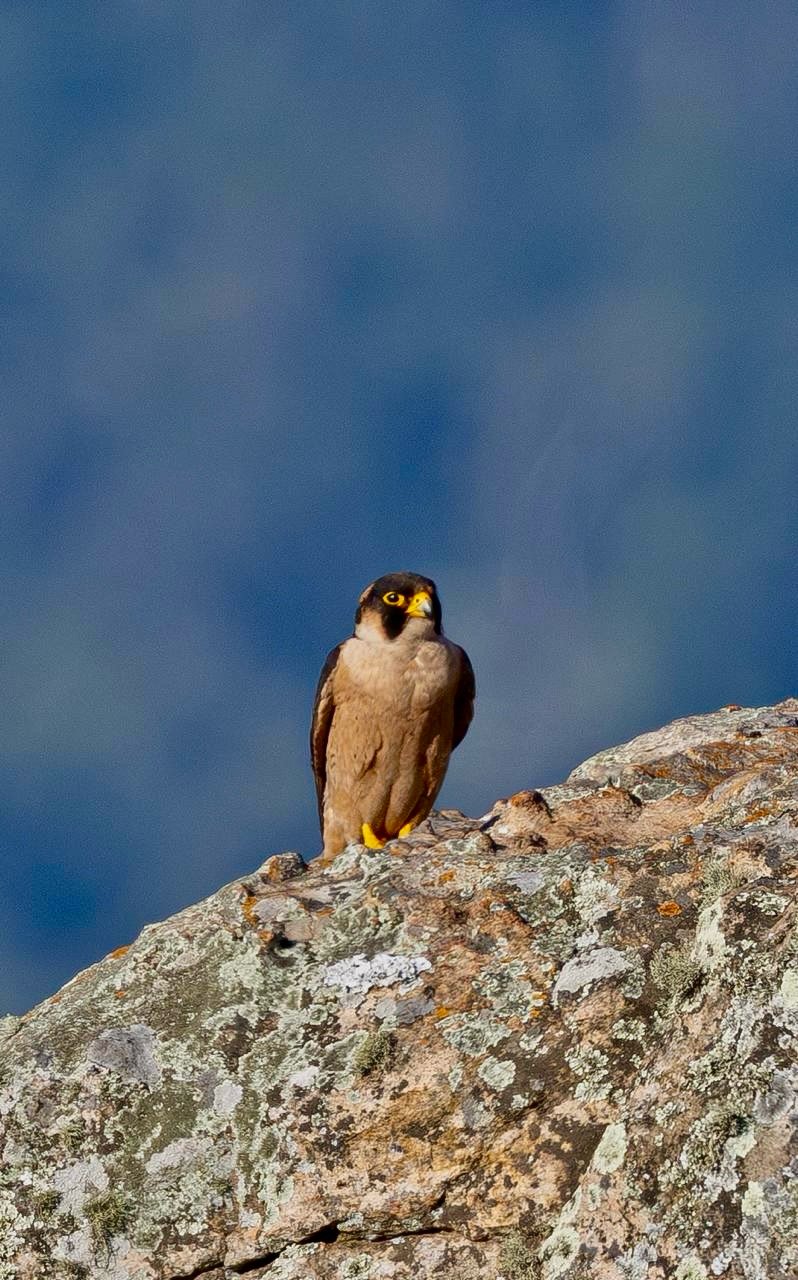
The Taita Falcon is a small, stocky falcon with a large head, broad shoulders and a short tail, tied to steep gorges and cliffs. It is one of the rarest and least known falcons in Africa; in southern Africa only a handful of pairs breed.
Voice
A high kree-kree-kree-kree and a fast, sharp chatter kek-kek-kek, higher and thinner than in Peregrine Falcon. Heard mainly around the nest and during display; outside the breeding season the bird is silent.
Recording: David C. Moyer — CC BY-NC-SA 4.0 · converted to mono · xeno-canto
Identification
About 28 cm and strikingly compact, the wingtips reaching almost to the tail tip at rest. The upperparts are dark slate-grey, the crown and moustachial stripe blackish. On the nape are two rufous patches separated by a dark central stripe, the best feature of the species. The throat and cheeks are white, the rest of the underparts warm rufous with a few fine dark streaks. The cere, eye-ring and legs are yellow. The female is clearly larger than the male. Juveniles are browner above and more heavily streaked below. The flight is fast and powerful, on stiff rapid beats, suggesting a small Peregrine Falcon rather than a hobby.
Confusion species
African Hobby (Falco cuvierii) also has rufous underparts but is slimmer and longer-winged, with a rufous rather than white throat and no rufous nape patches. Peregrine Falcon (Falco peregrinus) is larger, with barred rather than rufous underparts and no nape patches. Eurasian Hobby (Falco subbuteo), a summer visitor, has white, heavily streaked underparts with rufous confined to the thighs and undertail coverts. Red-Necked Falcon has a wholly rufous crown and pale, finely barred underparts. Shape, white throat and nape patches together settle it.
Habitat
Deep river gorges and sheer cliffs with ledges and potholes, usually with open woodland or riverine forest nearby. It hunts from a high lookout or in high flight over the gorge and takes small birds in the air after a fast stoop, especially swifts, bee-eaters, doves and starlings. It nests in a pothole or on a sheltered ledge in the cliff, without nest material.
Where the bird is most at home, classified by the vegetation units of southern Africa.


Range and movements
Very local. The best-known stronghold is the Batoka Gorge below the Victoria Falls on the Zimbabwe–Zambia border; a few further pairs occur elsewhere along the Zambezi and in eastern Zimbabwe, with scattered records in Malawi and Mozambique. In South Africa a small population breeds in the gorges of the northern Drakensberg escarpment in Limpopo and Mpumalanga, including the Blyde River Canyon. Beyond the region it is patchily distributed in East Africa, from Ethiopia and South Sudan through Kenya to Tanzania.
- Resident
- Summer visitor (c. Oct–Mar)
- Passage (Mar–Apr, Oct–Nov)
- dark = core range, pale = thinly spread
How and when to look
The Batoka Gorge below the Victoria Falls gives the best chance: from the rim, scan the cliffs and the airspace above the gorge in the early morning and late afternoon, when the birds hunt swifts. Look for a small, very compact falcon shooting through the gorge at high speed. It breeds from August to November, when pairs are most active and most vocal.
Conservation status
Vulnerable on the global list, with a small and highly fragmented population of probably several hundred to just over a thousand birds. The causes of its scarcity are not entirely clear; competition with and predation by Peregrine and Lanner Falcons, disturbance at breeding cliffs, egg theft by collectors and pesticide use have all been suggested. In South Africa the species is regarded as Endangered.
Scientific name
Falco fasciinucha | Reichenow & Neumann, 1895
Reichenow & Neumann described the species in 1895 and placed it straight away in the genus where it still stands. The genus Falco was introduced in 1758 by Linnaeus. Falco is the Latin word for 'falcon', possibly related to falx, 'sickle', for the curved shape of the claws or wings. fasciinucha is New Latin for 'band-naped', from fascia, 'band', and nucha, 'nape' — for the rufous nape patches. The specimen the first description was based on came from Taita, Kenya.