All species › Falcons › Falcons › Red-Necked Falcon
Red-Necked Falcon | Falco chicquera
Roodkopsmelleken | Alcotán Turumti
The Red-Necked Falcon is a fast, compact bird-hunter of dry savannas and palm country, with a chestnut crown and nape that set it apart from every other falcon in the region. Some authors treat the African population as a species separate from the Indian one.

Voice
A high, rapid kee-kee-kee-kee and, around the nest, a high, plaintive chip.
Recording: Julien Birard — CC BY-NC-SA 4.0 · shortened to the first 60 s, mono · xeno-canto
Identification
About 32 cm; the female is clearly larger than the male. The crown and nape are warm chestnut, with a narrow black moustache and a black eye-stripe against white cheeks and throat. The upperparts are pale blue-grey finely barred black, the tail grey with narrow bars and a broad black terminal band. A rufous band crosses the upper breast; the rest of the underparts are white with fine black barring. Cere, eye-ring and legs are yellow. The juvenile has a dark brown head and rufous-tinged, barred underparts.
Confusion species
Lanner Falcon (Falco biarmicus) also has a rufous crown, but is much larger, with unbarred, pale pinkish-buff underparts and a darker, brownish-grey back. Taita Falcon (Falco fasciinucha) is stockier, with a dark crown, only rufous nape patches and rufous underparts. Pygmy Falcon (Polihierax semitorquatus) is far smaller and lacks a moustache.
Habitat
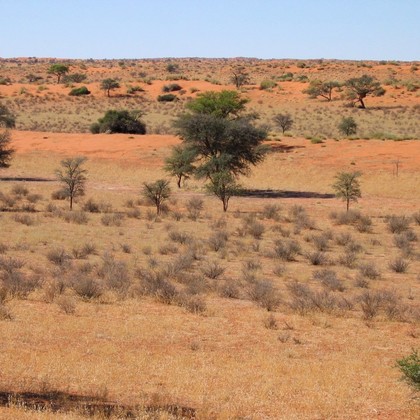
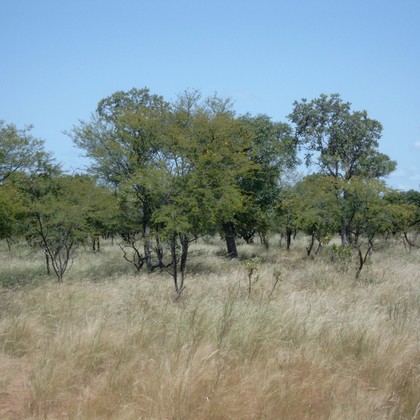
Dry open savanna and Kalahari thornveld with scattered camelthorns, palm savanna (Borassus and Hyphaene) along rivers and pans, and mopane. It hunts in fast, low flight, often with pairs cooperating, for small birds such as Red-Billed Queleas, sparrows, doves and sandgrouse, especially at waterholes. It nests in the crown of a palm or in an old crow nest in a camelthorn.
Where the bird is most at home, classified by the vegetation units of southern Africa.

Range and movements
In the region in Namibia, Botswana, northern South Africa (Northern Cape, North West and Limpopo), western and northern Zimbabwe, Zambia and southern Angola; scarce and local in Mozambique and Malawi. Elsewhere scattered across the dry savannas of sub-Saharan Africa and, in the broad sense of the species, in India.
- Resident
- Summer visitor (c. Oct–Mar)
- Winter visitor (c. Apr–Sep)
- Passage (Mar–Apr, Oct–Nov)
- dark = core range, pale = thinly spread
How and when to look
In the Kalahari (for example Kgalagadi) or on the Etosha plains, wait at a waterhole where large flocks of Red-Billed Queleas and doves come to drink; pairs of Red-Necked Falcons often hunt there in the early morning. In the north, search among Hyphaene palms.
Conservation status
Near Threatened for the species as a whole, including the Indian population, because of declines in parts of its range. In southern Africa rather scarce but locally stable; the felling of palms and large camelthorns and the poisoning of queleas may have an effect.
Scientific name
Falco chicquera | Daudin, 1800
Daudin described the species in 1800 and placed it straight away in the genus where it still stands. The genus Falco was introduced in 1758 by Linnaeus. Falco is the Latin word for 'falcon', possibly related to falx, 'sickle', for the curved shape of the claws or wings. chicquera goes back to Levaillant's 'Le Chicquera', after a local name he was given for this falcon at Chandernagore (Bengal); the name probably referred to the shikra. The specimen the first description was based on came from Bengal, India.