All species › Woodpeckers and allies › African barbets › Miombo Pied Barbet
Miombo Pied Barbet | Tricholaema frontata
Miombabaardvogel | Barbudo del Miombo
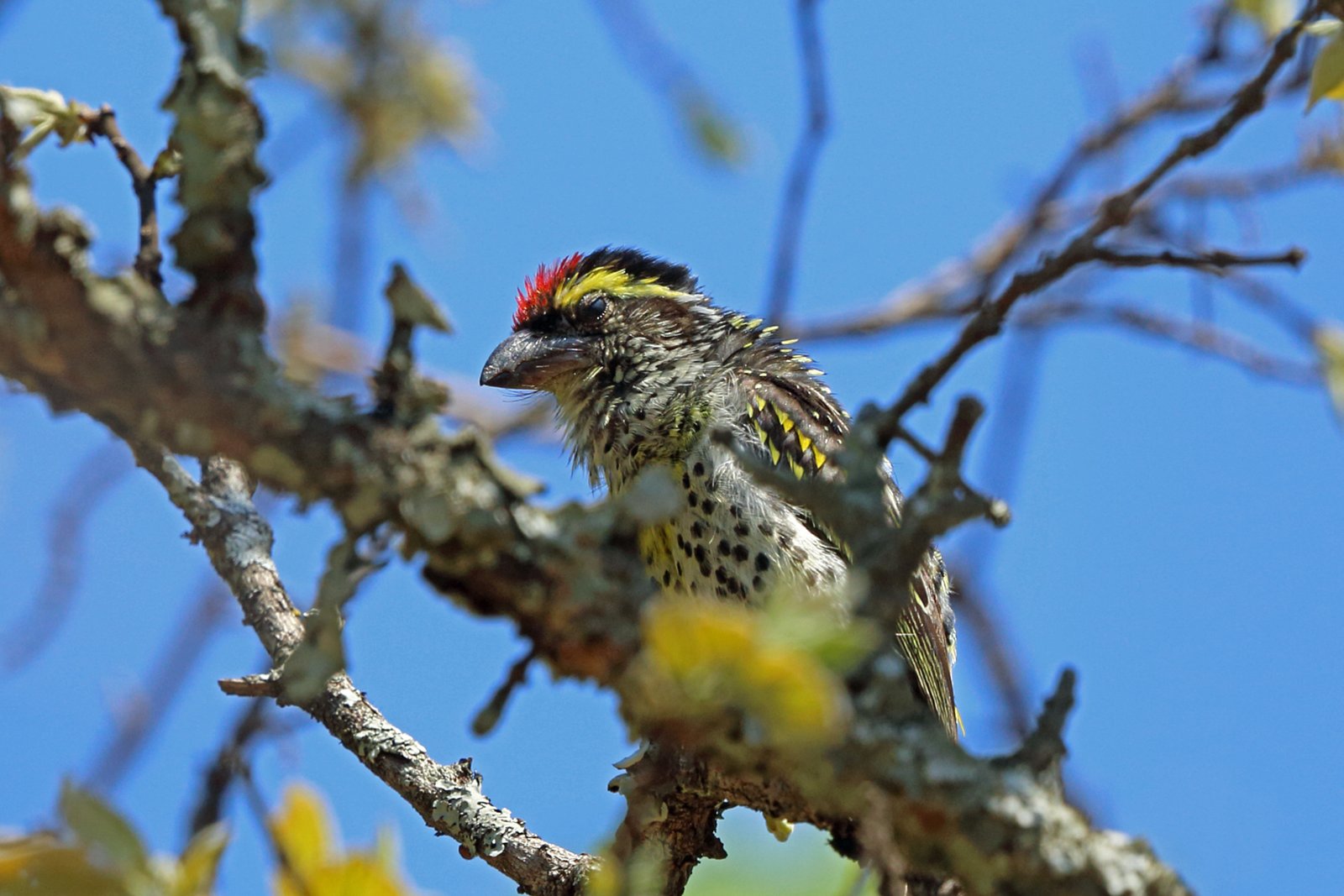
The Miombo Pied Barbet is the northern counterpart of the Acacia Pied Barbet: a black-and-white barbet with a red forehead spot that lives almost exclusively in the miombo woodland of south-central Africa. Outside this woodland type it is rarely seen.
Voice
A series of hollow, even hoots, hoop-hoop-hoop-hoop, and nasal nyah notes, also a dry rattle, ddddt. When calling, the male puffs out his throat and swings his head from side to side.
Recording: Dries Van de Loock — CC BY-NC-SA 4.0 · converted to mono · xeno-canto
Identification
About 15–16 cm, with a stout black bill. Head black with a red spot on the forehead, a yellow supercilium turning white behind the eye and a white stripe below the eye. The throat is white with brown-black speckles, without a solid black bib. Upperparts black with yellow drop-shaped spots and a whitish-scaled nape; wing coverts tipped yellow. Underparts pale yellow to whitish with dark spots on the breast and flanks. The sexes are alike; juveniles lack the red forehead spot.
Confusion species
Acacia Pied Barbet (Tricholaema leucomelas) has a solid black throat patch, an unspotted white belly and lives in dry thornveld; the two species barely overlap. White-Eared Barbet (Stactolaema leucotis) and Whyte's Barbet (Stactolaema whytii) are browner and lack the red forehead and yellow supercilium. Crested Barbet (Trachyphonus vaillantii) is larger, crested and has a yellow-and-red speckled face.
Habitat
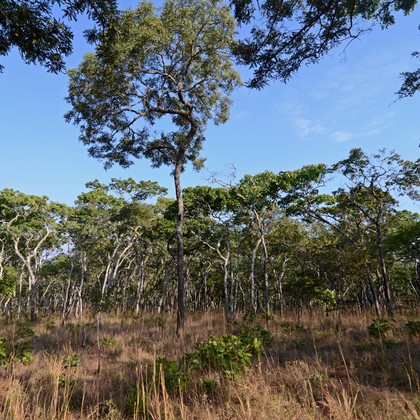
Mainly closed and semi-open miombo dominated by Brachystegia and Julbernardia, also degraded miombo and grassland with patches of trees. It eats fruit, especially figs and mistletoe berries, supplemented with insects. It nests in a self-excavated hole in a dead branch.
Where the bird is most at home, classified by the vegetation units of southern Africa.
Range and movements
The north of the region: the central plateau of Angola, much of Zambia and western Malawi. Beyond the region only in southern DR Congo and south-western Tanzania, so the species is virtually confined to the miombo belt.
- Resident
- Summer visitor (c. Oct–Mar)
- Passage (Mar–Apr, Oct–Nov)
- dark = core range, pale = thinly spread
How and when to look
In miombo, look for mixed foraging flocks and fruiting figs and mistletoes, and follow the hollow hooting series. The bird often sits inconspicuously in the canopy; a soft imitation of the call sometimes draws it to a visible branch.
Conservation status
Not threatened and fairly common within its miombo range. Large-scale clearance of miombo for charcoal and agriculture is the main long-term threat.
Scientific name
Tricholaema frontata | (Cabanis, 1881)
Cabanis described the species in 1881 as Pogonorhynchus frontatus; because it was later moved to another genus, the author and year stand in brackets. The genus Tricholaema was introduced in 1855 by Verreaux & Verreaux. Tricholaema comes from the Greek thrix (trichos), 'hair', and laimos, 'throat' — for the bristly hair-like feathers around the throat and bill base. frontata is Latin for 'with a (distinctive) forehead' — for the red-and-yellow-marked forehead. The specimen the first description was based on came from Angola (not further specified).