All species › Woodpeckers and allies › African barbets › Moustached Tinkerbird
Moustached Tinkerbird | Pogoniulus leucomystax
Witsnorketellapper | Barbudito Bigotudo
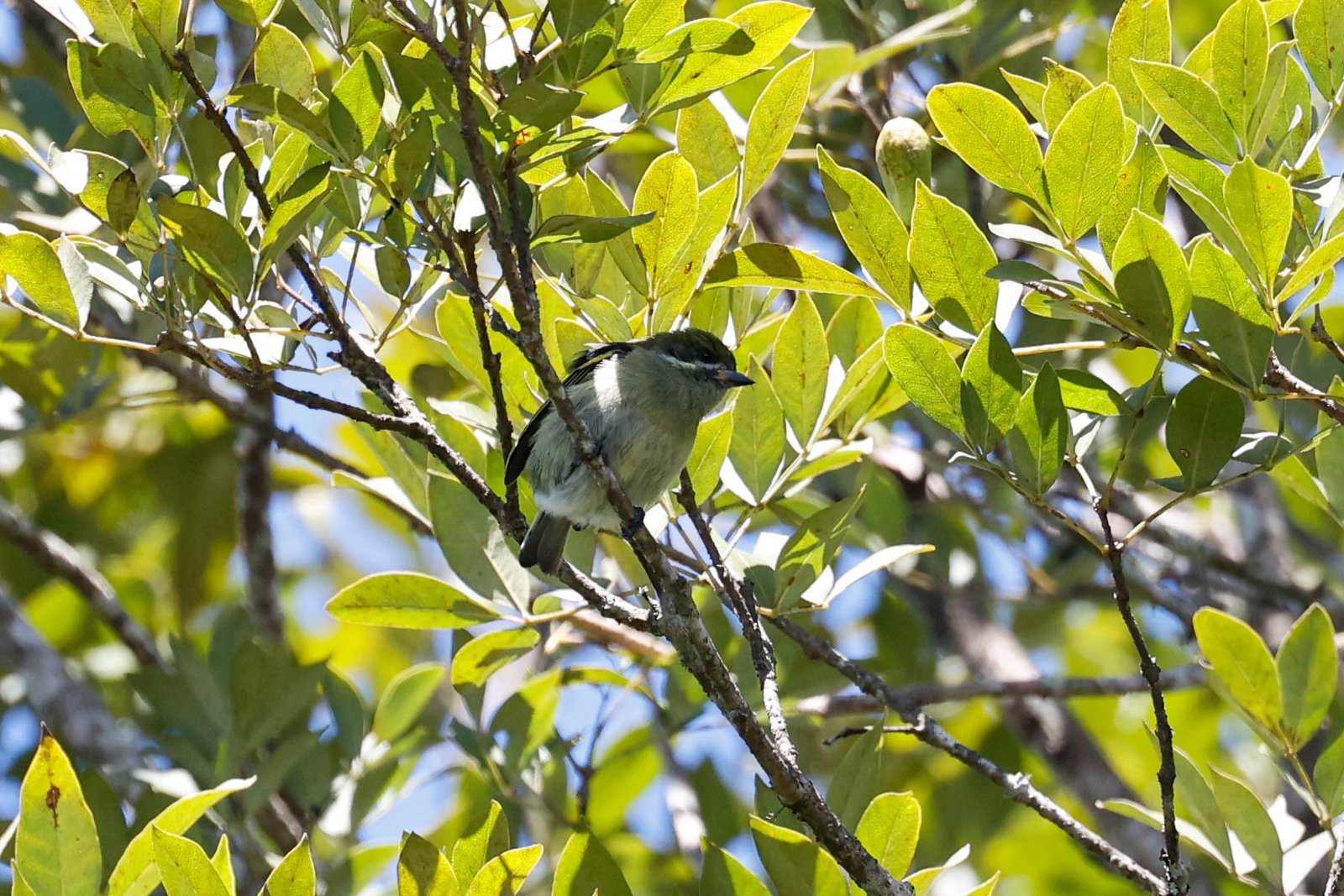
The Moustached Tinkerbird is a small olive-green tinkerbird of East African montane forest, identified by a sharp white stripe from the bill corner along the side of the neck. Within the region it is confined to the highlands of northern Malawi and adjacent north-eastern Zambia.
Voice
A trilled series that starts slowly and accelerates, pi-pi-pi-pi-i-i-i-i-i, plus rhythmic series of short notes separated by pauses. Nestlings give a regular ti-ti-ti-ti.
Recording: Rolf A. de By — CC BY-NC-SA 4.0 · shortened to the first 60 s, mono · xeno-canto
Identification
About 9–10 cm. The upperparts are dark olive-green with a yellow to golden-yellow rump, the wings blackish with yellowish edges to the inner feathers and the tail black with greenish-yellow fringes. Striking is the white moustachial stripe that runs from the bill corner below the eye along the side of the neck. The throat is greyish, the underparts pale olive-grey, slightly paler on the belly. The bill is two-toned: paler base, dark tip. The sexes are alike; juveniles are duller, with a less crisp moustachial stripe.
Confusion species
Yellow-Rumped Tinkerbird (Pogoniulus bilineatus), which may share the same forests, has a glossy black head and back with two white face stripes, not one. Green Tinkerbird (Pogoniulus simplex) lacks the white moustachial stripe and lives in the lowlands. The combination of an olive-green back and a single white moustachial stripe is diagnostic.
Habitat
Afromontane forest, forest edges and clearings, highland riparian forest and adjacent dense scrub, usually above 1,500 m. It forages in the canopy and mid-storey for berries, especially of mistletoes, and insects. It excavates a nest cavity in a dead branch.
Where the bird is most at home, classified by the vegetation units of southern Africa.

Range and movements
Within the region in the montane forests of northern Malawi, including the Nyika Plateau, the Misuku Hills and the Viphya Plateau, and in north-eastern Zambia on the Zambian side of the Nyika Plateau and in the Mafinga Hills. Beyond the region in the mountains of Tanzania, Kenya and Uganda.
- Resident
- Summer visitor (c. Oct–Mar)
- Passage (Mar–Apr, Oct–Nov)
- dark = core range, pale = thinly spread
How and when to look
Search forest edges on the Nyika Plateau, where the bird regularly forages in mistletoes. The accelerating trill gives it away; then wait for it to show on the outer branches. Morning light shows the white moustachial stripe best.
Conservation status
Not threatened. Within the region confined to small, fragmented montane forests, so the population is small. Logging and fire at forest edges threaten habitat locally; most of it lies within protected areas.
Scientific name
Pogoniulus leucomystax | (Sharpe, 1892)
Sharpe described the species in 1892 as Barbatula leucomystax; because it was later moved to another genus, the author and year stand in brackets. The genus Pogoniulus was introduced in 1842 by De Lafresnaye. Pogoniulus is a diminutive of Pogonias, from the Greek pōgōnias, 'bearded' — thus 'little barbet', fitting for these smallest barbets. leucomystax comes from the Greek leukos, 'white', and mystax, 'moustache' — for the white moustachial stripe. The specimen the first description was based on came from Sotik, Kenya.