All species › Passerines › Starlings › Narrow-Tailed Starling
Narrow-Tailed Starling | Poeoptera lugubris
Spitsstaartspreeuw | Estornino Rabilargo
Narrow-Tailed Starling is a small, slender, dark-glossed starling with a long, narrow, pointed tail, which lives in flocks in the canopy of the Central African rainforest. Within the region it occurs only in the forests of northern Angola.

Voice
A thin, high, metallic twitter, cheep or tsweet, repeated constantly by groups in flight and in the canopy; also a soft, chattering song.
Recording: Albert Vrielink — CC BY-NC-SA 4.0 · converted to mono · xeno-canto
Identification
20–24 cm, much of it tail; the male's tail is long, narrow and strongly graduated, the female's shorter. The male is wholly black with a dark purplish-blue gloss; the female is greyer and duller, with rufous primaries that show mainly in flight. Both sexes have a pale yellow eye. Juveniles are duller, with a darker eye. It flies fast and direct, in tight groups that cross above the canopy with high twittering.
Confusion species
Chestnut-Winged Starling Onychognathus fulgidus is much larger, with a red eye and rufous wings in both sexes. Splendid Starling Lamprotornis splendidus is larger and stockier, with a broader, shorter tail and a much stronger green-blue gloss. Velvet-Mantled Drongo Dicrurus modestus has a forked tail and a red eye and hunts from a fixed perch. In flight and from below, the silhouette with the long, pointed tail is diagnostic.
Habitat
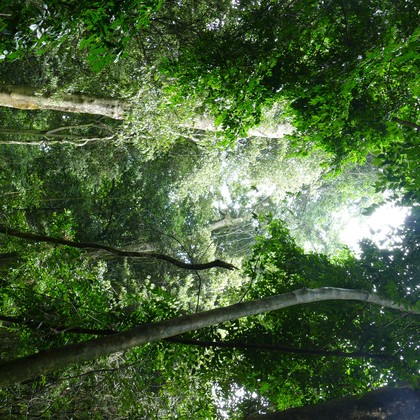
The canopy and edges of humid lowland and escarpment forest, secondary forest, clearings with tall dead trees and old coffee plantations under shade trees. It eats mainly fruit, such as figs, and insects. It breeds colonially in holes in tall dead trees, often in old barbet or woodpecker holes.
Where the bird is most at home, classified by the vegetation units of southern Africa.
Range and movements
Within the region only in northern Angola: Uíge, Cuanza Norte, Bengo and Malanje. Beyond the region from Sierra Leone and Guinea through the Guinean forest belt and the Congo Basin to western Uganda, western Kenya and north-western Tanzania.
- Resident
- dark = core range, pale = thinly spread
How and when to look
Year-round. Damengola Forest near Quitexe in Uíge and the forests around Canzele in Cuanza Norte are good sites. Scan tall dead trees at forest edges: groups breed and rest there, and the high twittering gives them away before the silhouette does.
Conservation status
Not threatened and fairly common in the Central African forest. In Angola it is confined to the shrinking forest of the north-west.
Scientific name
Poeoptera lugubris | Bonaparte, 1854
Bonaparte described the species in 1854 and placed it straight away in the genus where it still stands. He introduced the genus Poeoptera in that same work. Poeoptera comes from the Greek phaios, 'grey', and -pteros, 'winged' — thus 'grey-wing'. lugubris is Latin for 'mournful' — for the dark, sombre plumage. The specimen the first description was based on came from no locality given; later taken to be Gabon.