All species › Tubenoses › Petrels and shearwaters › Northern Giant Petrel
Northern Giant Petrel | Macronectes halli
Noordelijke reuzenstormvogel | Abanto Marino Subantártico
The Northern Giant Petrel is the twin species of the Southern Giant Petrel: just as large, just as voracious, and only recognised as a separate species in the 1960s. It breeds farther north, on subantarctic islands, and earlier in the season.
Voice
As Southern Giant Petrel: usually silent at sea, at food a harsh braying croak and gurgling threat sounds. At the colony cackling calls.
Recording: Hichem MACHOUK — CC BY-NC-SA 4.0 · converted to mono · xeno-canto
Identification
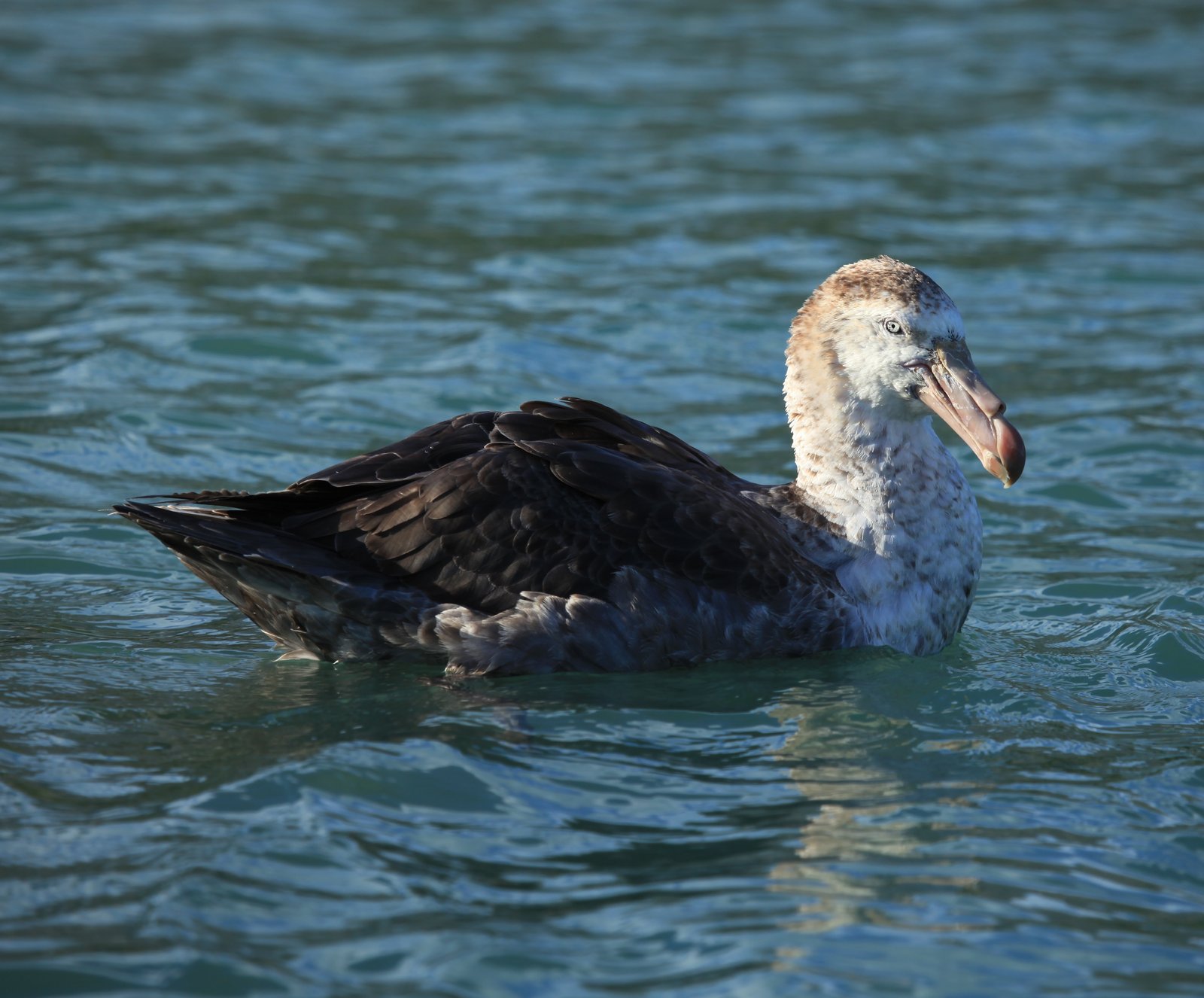
80–90 cm, wingspan up to 2 m; males are markedly heavier than females. Adults are grey-brown with a slightly paler, mottled face and a dark crown, lacking the sharply defined pale head and breast of the southern species. The heavy horn-coloured bill has a reddish-brown to pinkish-brown tip; the eye of adults is often pale. There is no white morph. Juveniles are uniform blackish-brown with a dark bill tip that only later turns reddish-brown. Flight as in Southern Giant Petrel: stiff, with humped back and long glides.
Confusion species
The Southern Giant Petrel (Macronectes giganteus) has a pale green bill tip and, in adults, a paler, more sharply defined head and breast; an all-white bird is always a Southern. Young birds of both species are often inseparable without a good view of the bill tip. White-Chinned Petrel Procellaria aequinoctialis and Sooty Albatross Phoebetria fusca are slimmer and lack the heavy pale bill.
Habitat
Open ocean, the continental shelf and inshore waters, also harbours; it comes ashore at seal and penguin colonies to scavenge and follows fishing vessels. It breeds dispersed, often solitarily, in sheltered, vegetated ground on subantarctic islands.
Where the bird is most at home, classified by the vegetation units of southern Africa.
Range and movements
Breeds on Marion and Prince Edward Islands. Off the mainland mainly from May to October; off the Western Cape in winter usually commoner than Southern Giant Petrel. Young birds wander along the west coast to Namibia and Angola and along the east coast to KwaZulu-Natal and Mozambique. It also breeds on South Georgia, Crozet, Kerguelen, Macquarie, and the Chatham, Antipodes, Auckland and Campbell Islands, ranging over the southern oceans between about 30° and 60°S.
- Resident
- Winter visitor (c. Apr–Sep)
- dark = core range, pale = thinly spread
How and when to look
On winter pelagic trips out of Cape Town usually the commoner giant petrel behind the trawlers. Look for the reddish-brown bill tip, preferably when the bird is sitting on the water. Also visible from shore at Cape Point and in harbours such as Hout Bay and Kalk Bay.
Conservation status
Not threatened, after an earlier listing as Near Threatened. Populations have been stable or slightly increasing in recent decades. Bycatch in longline fisheries and changes in seal and penguin food sources are the main concerns; introduced predators have been removed from breeding islands.
Scientific name
Macronectes halli | Mathews, 1912
Mathews described the species in 1912 and placed it straight away in the genus where it still stands. The genus Macronectes was introduced in 1905 by Richmond. Macronectes comes from the Greek makros, 'great', and nēktēs, 'swimmer' — 'great swimmer', for these huge petrels. halli honours the Australian ornithologist Robert Hall (1867–1949), who described the breeding birds of the Kerguelen Islands. The specimen the first description was based on came from Kerguelen Islands.