All species › Waterfowl › Ducks and geese › Northern Pintail
Northern Pintail | Anas acuta
Pijlstaart | Ánade Rabudo
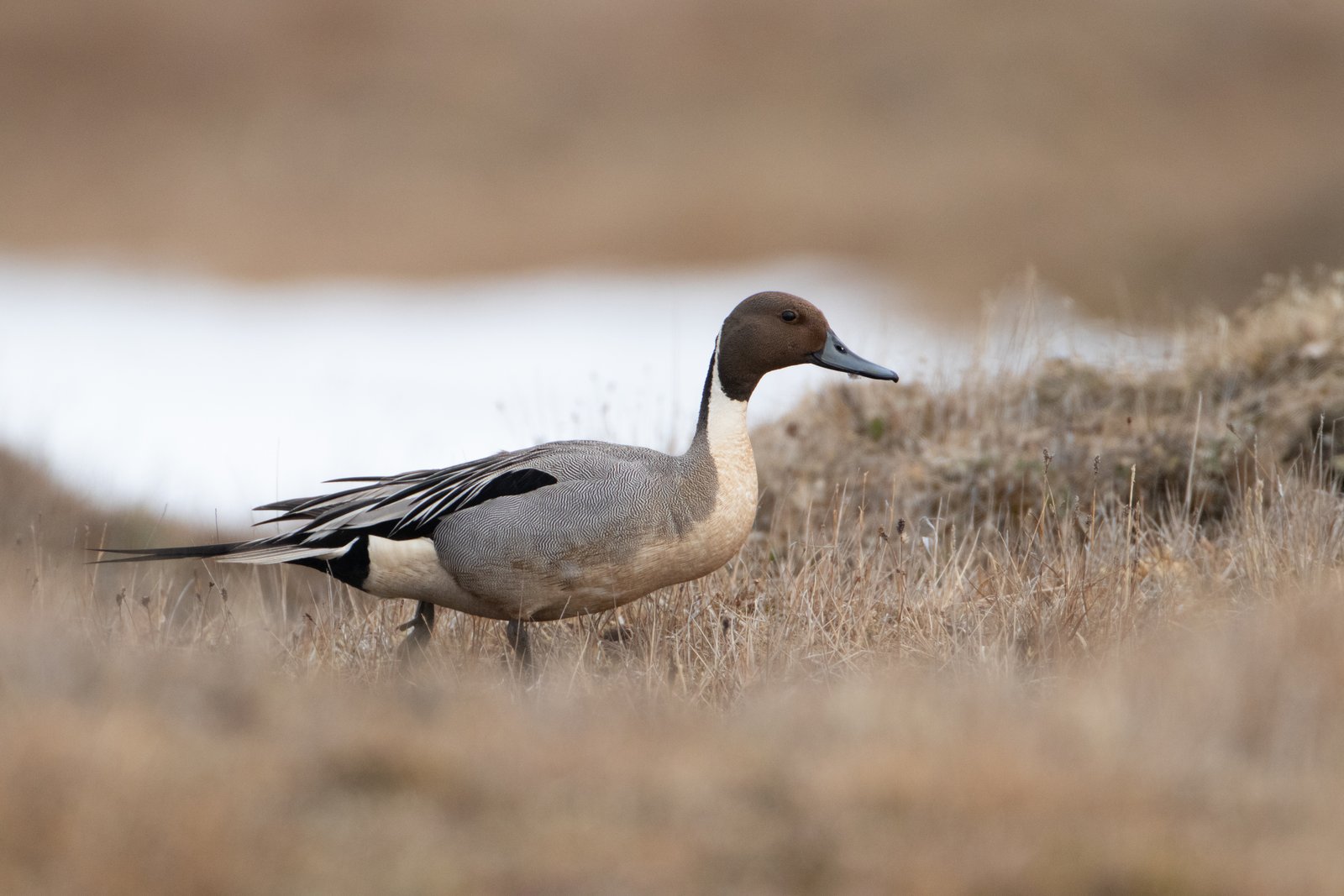
The Northern Pintail is a slender, long-necked dabbling duck from northern Eurasia that winters in small numbers south to the north of the region. The male stands out by its chocolate-brown head, the white stripe up the side of the neck and the long, pointed central tail feathers.
Click a thumbnail to switch the photo above.
Voice
Almost silent in winter. The male gives a soft, whistled prruup, the female a low, hoarse quack, kwuk.
Recording: Stanislas Wroza — CC BY-NC-SA 4.0 · converted to mono · xeno-canto
Identification
51–66 cm including the male's tail feathers, the male being up to 10 cm longer than the female. The breeding male has a chocolate-brown head and hindneck, a white breast running up the neck side as a narrow stripe, finely grey-vermiculated flanks and back, a creamy-yellow patch in front of the black undertail-coverts and elongated black central tail feathers. In eclipse plumage, which can last into the northern winter, it resembles the female but is greyer with a longer tail. The female is warm grey-brown with dark scaling, a plain light brown head, a pointed tail and a grey bill. In flight it shows long, narrow wings, a brownish-green speculum with a white trailing edge and a long neck.
Confusion species
Red-Billed Teal Anas erythrorhyncha has a similarly slender shape, but a red bill and a dark cap above pale cheeks. Female Mallard Anas platyrhynchos is stockier, with an orange-and-black bill and a blue speculum bordered white. Yellow-Billed Duck Anas undulata has a yellow bill. Female Garganey Spatula querquedula are much smaller, with a striped head.
Habitat
Large shallow freshwater lakes, floodplains, marshes and sewage ponds with open water. It feeds by dabbling and upending with the neck deep underwater, on seeds, roots of aquatic plants and invertebrates. In Africa it associates with other ducks, especially Red-Billed Teals and Garganeys.
Where the bird is most at home, classified by the vegetation units of southern Africa.

Range and movements
A scarce to rare winter visitor to the north of the region, mainly Zambia and Malawi; further south a vagrant with scattered records from Zimbabwe, Botswana, Namibia and South Africa. It breeds across northern Europe, Asia and North America and winters south to the Sahel and East Africa, with the largest African concentrations in West Africa and around Lake Chad.
How and when to look
In summer, check flocks of Red-Billed Teals and Garganeys on large floodplains, such as the Kafue Flats and Liuwa Plain in Zambia. A long-necked duck with a grey bill that upends for noticeably long spells is worth a second look. A confirmed sighting in the south should be reported to the regional rarities committee.
Conservation status
Not globally threatened, although numbers are declining in parts of Europe and North America through loss of breeding habitat and hunting. For the region it is a peripheral species; the numbers that reach this far south depend on conditions in the Sahel.
Scientific name
Anas acuta | Linnaeus, 1758
Linnaeus described the species in 1758 and placed it straight away in the genus where it still stands. He introduced the genus Anas in that same work. Anas is the Latin word for 'duck'. acuta is Latin for 'pointed', from acuere 'to sharpen', after the long pointed tail feathers of the male. The specimen the first description was based on came from Sweden.