All species › Passerines › White-eyes › Northern Yellow White-Eye
Northern Yellow White-Eye | Zosterops senegalensis
Noordelijke Afrikaanse brilvogel | Anteojitos Senegalés
The Northern Yellow White-Eye is a small, bright yellow white-eye found from West Africa to Ethiopia and Tanzania, reaching the region only in northern and central Angola. Since the split of the former ‘African Yellow White-eye’ its southern counterpart has been a separate species, so older records from the rest of the region belong to the Southern Yellow White-Eye.
Voice
The contact call is a soft, plaintive tsiu or twee, repeated constantly by members of a party. The song, mainly in the early morning, is a fast, sweet, rippling series of high whistles and chirps.
Recording: Paweł Szymański — CC BY-NC-SA 4.0 · shortened to the first 60 s, mono · xeno-canto
Identification
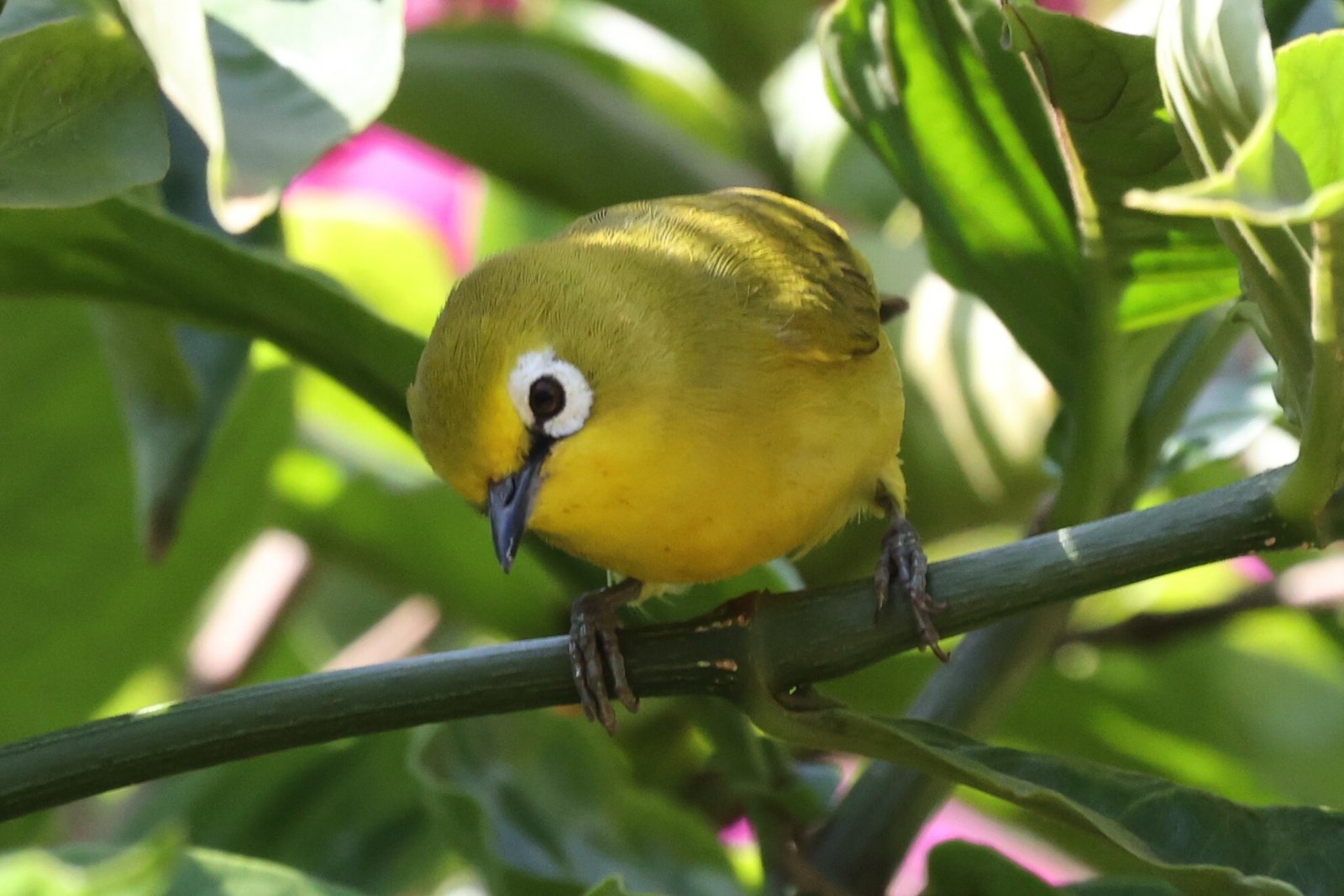
10–11 cm, small and compact. The upperparts are yellowish green, the forehead and lores bright yellow. Around the eye is a clear white ring, broken at the front by a narrow black line before the eye. The underparts are wholly bright lemon-yellow, without grey or buff flanks. The bill is thin, pointed and dark, the legs blue-grey. The sexes are alike; juveniles are duller, with a narrower eye-ring. The Angolan forms are slightly darker green above than the East African ones. It moves through the foliage in small, noisy parties, hanging tit-like from twigs.
Confusion species
Southern Yellow White-Eye Zosterops anderssoni is barely separable in the field and occurs in southern and eastern Angola; range is the main feature, although that species is slightly paler yellow-green above. African Yellow Warbler Iduna natalensis is larger, lacks the white eye-ring and lives low in rank vegetation near water. Green-Capped Eremomela Eremomela scotops has a grey throat, no white eye-ring and a green crown, and forages in the same canopies.
Habitat
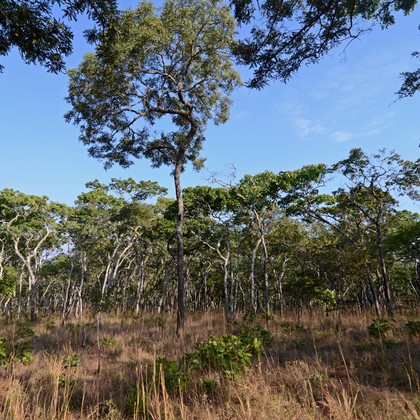
Miombo and other open broadleaved woodland, forest edges, gallery forest along rivers and scrubby savanna; also gardens and orchards. It forages in the canopy for small insects, nectar and soft fruit, often in mixed parties with other small passerines.
Where the bird is most at home, classified by the vegetation units of southern Africa.

Range and movements
Within the region only in Angola: in the north-east (Lunda), in the north-west (Cuanza Norte and Cuanza Sul) and in the central highlands from Malanje to the Bié Plateau; the exact boundary with Southern Yellow White-Eye is unclear. Beyond the region it ranges from Senegal and Sierra Leone east to Eritrea and Ethiopia, and south through Uganda and Kenya to northern Tanzania and southern DR Congo.
- Resident
- dark = core range, pale = thinly spread
How and when to look
All year; search forest edges and gallery forest in northern and central Angola for parties of small yellow birds and listen for the soft, plaintive tsiu. Identify the species by locality; a photograph of the upper- and underside helps with doubtful birds in the contact zone.
Conservation status
Not threatened. Common and widespread over a large range and tolerant of disturbed woodland, gardens and plantations. The Angolan forms are treated by some authors as a separate species, Angola White-eye; their status is still little studied.
Scientific name
Zosterops senegalensis | Bonaparte, 1850
Bonaparte described the species in 1850 and placed it straight away in the genus where it still stands. The genus Zosterops was introduced in 1827 by Vigors & Horsfield. Zosterops comes from the Greek zōstēr, 'belt, girdle', and ōps, 'eye' — for the white eye-ring shown by most white-eyes. senegalensis is Latin for 'of Senegal', where the species was first collected. The specimen the first description was based on came from Senegal.