All species › Kingfishers, bee-eaters and rollers › Bee-eaters › Olive Bee-Eater
Olive Bee-Eater | Merops superciliosus
Madagaskarbijeneter | Abejaruco Malgache
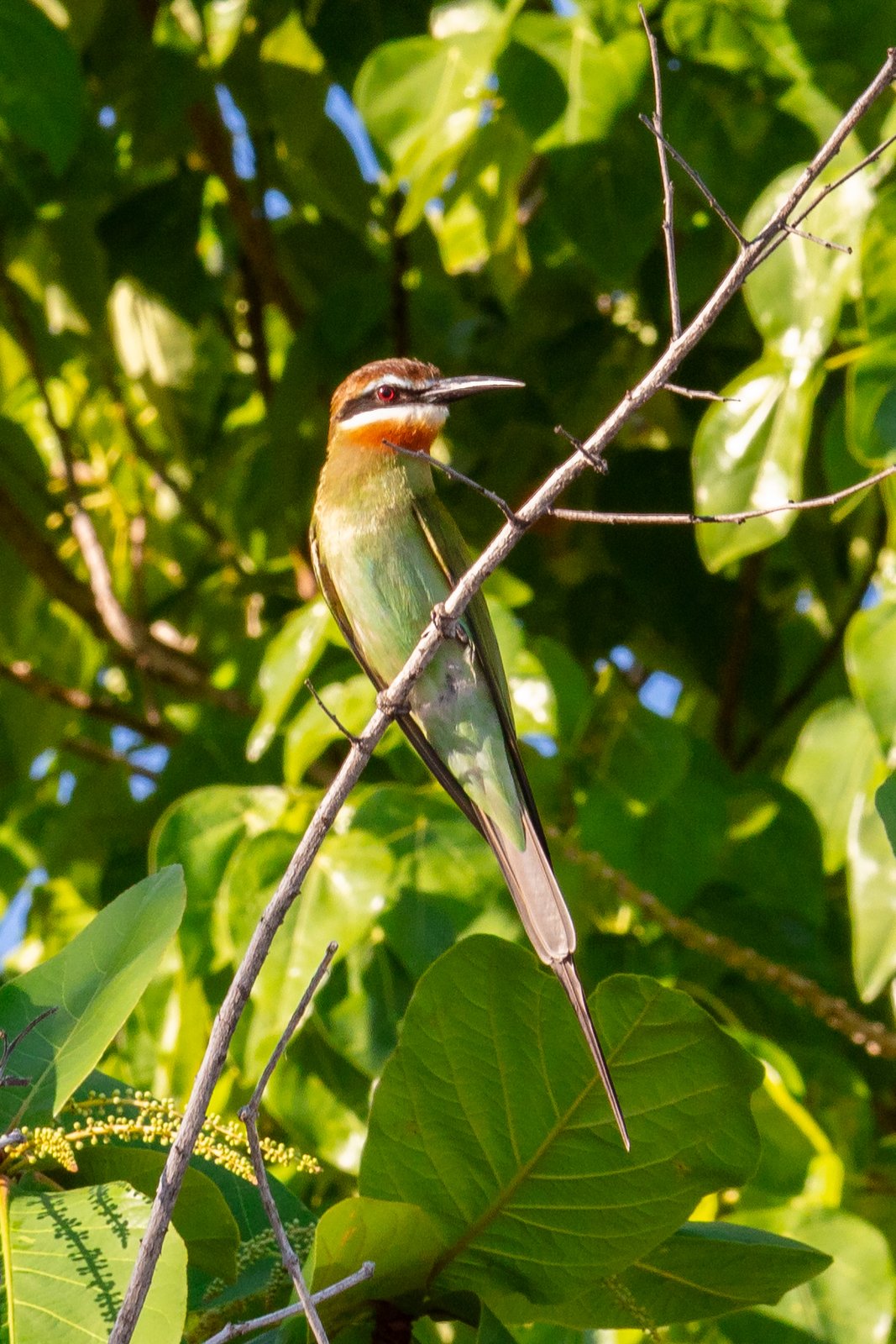
The Olive Bee-Eater is a large, olive-green bee-eater with a brown crown, a rufous throat and long streamers that breeds in the region mainly along large rivers, lakes and coastal plains. Besides Madagascar it also occurs on the African mainland; in the region it is locally common but closely tied to water.
Voice
A rolling, liquid prrrip or tirrrup, lower and less clear than that of European Bee-Eater; flocks call a lot in flight and around the colony.
Recording: Rolf A. de By — CC BY-NC-SA 4.0 · converted to mono · xeno-canto
Identification
The body is 22–24 cm, with elongated central tail feathers projecting 5–7 cm. Crown and nape are olive-brown to dark olive-green, the forehead and a narrow supercilium whitish. Below the black mask runs a white to pale blue cheek stripe. The chin is pale yellowish white, the throat rufous. Upperparts and breast are olive-green, without the bright grass-green tone of related species; the belly is paler, greenish blue. In flight the underwings are rufous with a dark trailing edge. The sexes are alike; juveniles are duller, with a pale throat and no streamers.
Confusion species
Most similar is Blue-Cheeked Bee-Eater (Merops persicus), which has a green rather than brown crown, a blue-and-white supercilium and cheek stripe, a yellow-brown chin and a fresher, grass-green colour; this Palearctic winter visitor is also often found near water. European Bee-Eater (Merops apiaster) has a yellow throat and chestnut upperparts. Swallow-Tailed Bee-Eater (Merops hirundineus) is much smaller, with a forked blue tail and a yellow throat.
Habitat
Open riverine woodland, banks of large rivers and lakes, coastal plains with mangroves, swamp forest and floodplains; seldom far from water. Breeds in colonies in sandy banks, sandbars and sometimes flat sandy ground, where burrows up to two metres long are dug. It hunts from a bare branch or wire and on the wing for dragonflies, bees, wasps and other flying insects.
Where the bird is most at home, classified by the vegetation units of southern Africa.


Range and movements
Local in the north and east of the region: along the coast and the large rivers of Mozambique (including the Zambezi and Save), at Lake Malawi and the Shire, in the Zambezi valley in north-western Zimbabwe and in Zambia, in Angola along the coast and on the plateau, and in north-western Namibia along the Kunene. A vagrant further south, as far as KwaZulu-Natal. Beyond the region in East and Central Africa from Somalia and Kenya to DR Congo, and on Madagascar and the Comoros.
- Resident
- Summer visitor (c. Oct–Mar)
- Winter visitor (c. Apr–Sep)
- Passage (Mar–Apr, Oct–Nov)
- dark = core range, pale = thinly spread
How and when to look
Best found at colonies along sandy riverbanks and on sandbars, from September to December, or resting on dead branches over the water along the Zambezi and at Lake Malawi. With green bee-eaters always compare the colour of the crown and cheek stripe: a brown cap and a white rather than blue cheek stripe point to this species.
Conservation status
Not threatened and common in parts of its range. In the region it is locally distributed and dependent on sandy banks for breeding; flooding of banks by dams and sand mining can threaten colonies.
Scientific name
Merops superciliosus | Linnaeus, 1766
Linnaeus described the species in 1766 and placed it straight away in the genus where it still stands. The genus Merops was introduced in 1758 by Linnaeus. Merops is Greek and means 'bee-eater'. superciliosus is Latin for 'eyebrowed' — for the white stripe above the black eye mask. The specimen the first description was based on came from Madagascar.