All species › Kingfishers, bee-eaters and rollers › Bee-eaters › European Bee-Eater
European Bee-Eater | Merops apiaster
Bijeneter | Abejaruco Europeo
The European Bee-Eater is a colourful, slender bee-eater with a yellow throat and a chestnut crown and mantle that migrates in large numbers from Europe and western Asia to the region. Uniquely, a separate population also breeds in the south of the region, in the austral summer. Flocks are often heard before they are seen.

Voice
A liquid, rolling prruup or kruuk, often repeated in series; flocks high in the sky are recognised mainly by this soft, melodious chorus, even when the birds themselves are barely visible.
Recording: Stanislas Wroza — CC BY-NC-SA 4.0 · shortened to the first 60 s, mono · xeno-canto
Identification
About 27 cm including the short, pointed streamers of 1–2 cm. Forehead white, merging into green; crown, nape and mantle chestnut, in the male continuing into a golden-yellow band across the scapulars and back that shows as a pale V in flight. Broad black mask; the throat is bright yellow, bordered below by a narrow black band. Breast and belly are turquoise-blue, the wings green and rufous with a black trailing edge. The female has a greener back and scapulars. Juveniles are duller and greener, with a pale throat and no streamers. In flight the translucent rufous wings with a dark trailing edge are distinctive.
Confusion species
The yellow throat and brown upperparts rule out any other large bee-eater. Blue-Cheeked Bee-Eater (Merops persicus) and Olive Bee-Eater (Merops superciliosus) are wholly green with a rufous throat and longer streamers. White-Fronted Bee-Eater (Merops bullockoides) has a red throat and white cap. Juvenile Southern Carmine Bee-Eaters (Merops nubicoides) lack the yellow in the throat.
Habitat
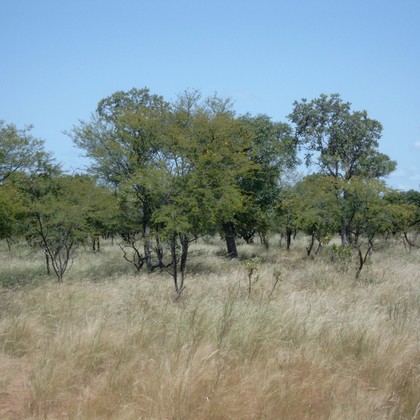
Open savanna, thornveld, farmland and Karoo scrub with scattered trees, wires or fences as lookouts, often near riverbeds and dams. Breeding birds dig burrows in sandy walls of riverbanks, dongas, gravel and sand pits, and sometimes in flat ground. It hunts on the wing, often high, for bees, wasps, dragonflies and other flying insects, and disarms stinging prey by beating and rubbing it against a branch.
Where the bird is most at home, classified by the vegetation units of southern Africa.


Range and movements
Palearctic birds pass through the whole region and winter mainly in Botswana, Zimbabwe, Zambia, Malawi, Mozambique, Namibia and northern and eastern South Africa; in Angola mainly on passage. A breeding population occurs in southern Namibia and South Africa (Northern Cape, Western Cape, Eastern Cape, Free State), from September to February. Elsewhere it breeds in southern and eastern Europe, North Africa and western and central Asia; it winters in sub-Saharan Africa.
- Summer visitor (c. Oct–Mar)
- Passage (Mar–Apr, Oct–Nov)
- dark = core range, pale = thinly spread
How and when to look
From October large flocks pass over calling; in overcast weather they hunt low over fields and water. The breeding birds in the Karoo and Western Cape are best found at sandy banks of dry riverbeds, where the burrows are in the wall. With flocks resting on wires, look for the differences between males, females and juveniles.
Conservation status
Not threatened and widespread. Beekeepers sometimes persecute the species at hives. Breeding sites are lost locally when sandy banks are stabilised or excavated; insecticides reduce the supply of prey.
Scientific name
Merops apiaster | Linnaeus, 1758
Linnaeus described the species in 1758 and placed it straight away in the genus where it still stands. He introduced the genus Merops in that same work. Merops is Greek and means 'bee-eater'. apiaster says the same in Latin, from apis 'bee'; the name thus means 'bee-eater' twice. The specimen the first description was based on came from southern Europe.