All species › Kingfishers, bee-eaters and rollers › Bee-eaters › Southern Carmine Bee-Eater
Southern Carmine Bee-Eater | Merops nubicoides
Zuidelijke karmijnrode bijeneter | Abejaruco Carmesí Sureño
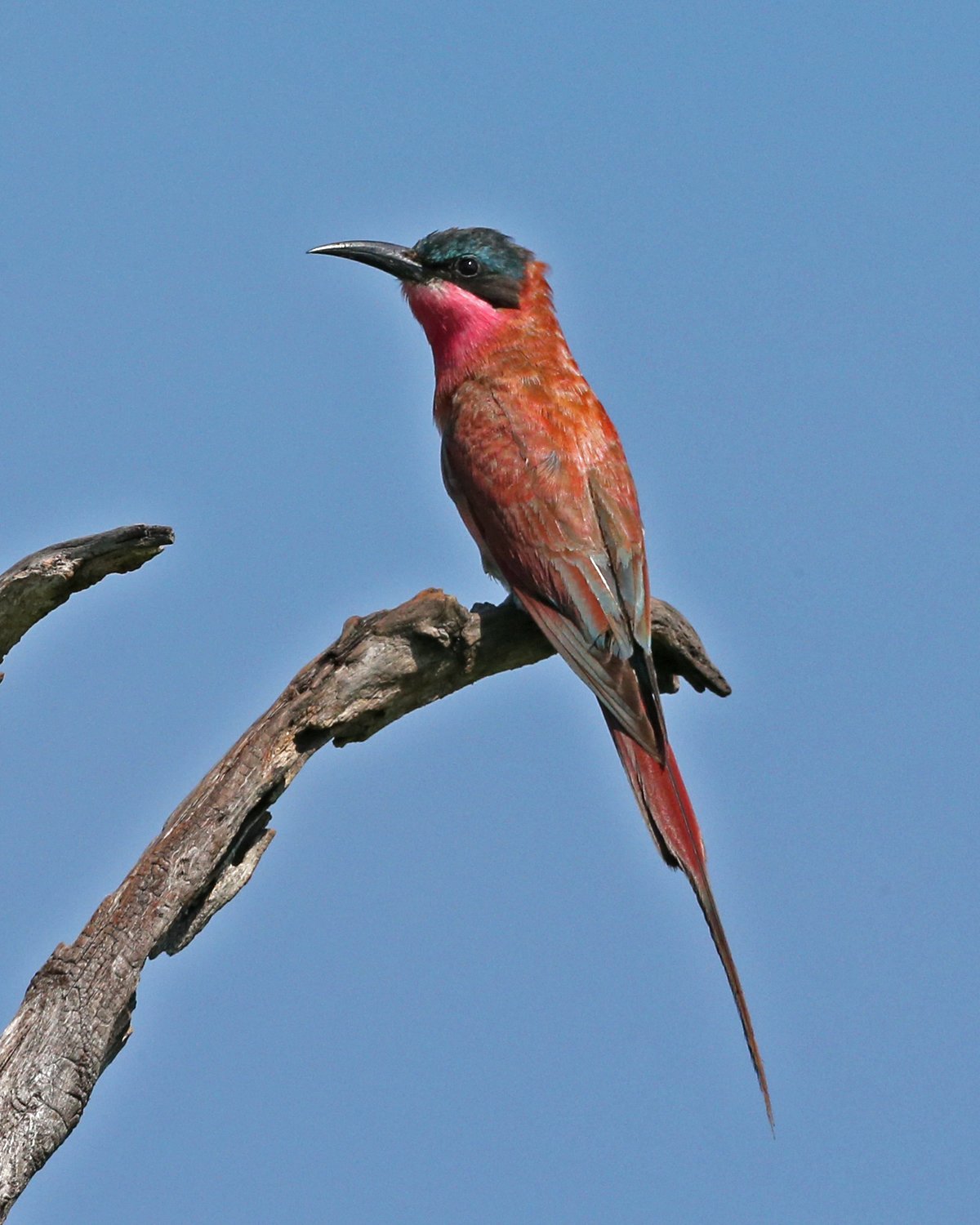
The Southern Carmine Bee-Eater is the largest and most colourful bee-eater of the region: a carmine bird with a blue crown and long streamers, breeding in colonies of hundreds to thousands of pairs in steep riverbanks. After breeding it wanders south across the savanna, where it readily follows grazing animals, bustards and bush fires to catch flushed insects.
Voice
A deep, hoarse terk or trrik, often repeated as terk-terk-terk. A colony can be heard from afar as a continuous raw chatter; foraging groups also call a lot in flight.
Recording: African Bioacoustics Community — CC BY-NC-SA 4.0 · converted to mono · xeno-canto
Identification
The body is 24–27 cm, with greatly elongated central tail feathers projecting up to 12 cm. Crown and forehead are turquoise-blue, with a broad black mask below. Throat, cheeks, breast and mantle are deep carmine-pink, the wings and tail a darker rose-red; rump and under- and uppertail coverts are pale blue. The long, decurved bill is black. The sexes are alike. Juveniles are duller and browner, with a pinkish-brown throat, pale scaling on the upperparts and no streamers. In flight the red with the blue rump and the long pointed tail stand out, even against a bright sky.
Confusion species
Not to be confused with any other species in the region: no other bee-eater is so red. Northern Carmine Bee-eater (Merops nubicus) has a blue-green rather than pink throat and does not occur regularly in the region. Juveniles without streamers may suggest European Bee-Eater (Merops apiaster) in poor light, but lack the yellow throat and golden-brown mantle.
Habitat
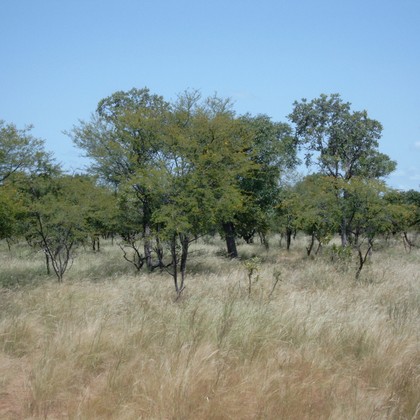
Breeds in steep sandy banks of large rivers, sandbars and sometimes flat sandy ground, in burrows one and a half to two metres deep. Outside the breeding season open savanna, mopane woodland, grassland, floodplains and farmland, often near water. It hunts from a perch or on the wing for large flying insects, especially grasshoppers, bees, wasps and beetles. It likes to ride on the backs of Kori Bustards, ostriches or cattle, and gathers at bush fires.
Where the bird is most at home, classified by the vegetation units of southern Africa.


Range and movements
Breeds mainly in the north of the region: in the Zambezi valley (Zambia, Zimbabwe, Mozambique), along the Luangwa, Kafue and Shire, in the Caprivi and northern Botswana (Chobe, Okavango) and in Angola. After breeding, from December to March, it moves south to northern Botswana and Namibia, Zimbabwe and north-eastern South Africa (especially Kruger and Limpopo); rare further south. Beyond the region it extends to southern DR Congo and Tanzania, where it spends the winter months.
- Resident
- Summer visitor (c. Oct–Mar)
- Winter visitor (c. Apr–Sep)
- Passage (Mar–Apr, Oct–Nov)
- dark = core range, pale = thinly spread
How and when to look
The spectacle of a breeding colony is a highlight of any trip to the Zambezi, Luangwa or Chobe in September–November; from a boat the birds can be seen at close range as they fly in and out of their burrows. Outside the breeding season it pays to check Kori Bustards in grassland: a red bird on a bustard's back is almost certainly this species. Smoke from a bush fire often attracts dozens of bee-eaters.
Conservation status
Not threatened and locally abundant, but heavily dependent on a limited number of large colonies. These are vulnerable to flooding by dams, sand mining, bank erosion and disturbance by tourists and people hunting the birds. Locust control with insecticides can reduce the food supply locally.
Scientific name
Merops nubicoides | des Murs & Pucheran, 1846
Des Murs & Pucheran described the species in 1846 and placed it straight away in the genus where it still stands. The genus Merops was introduced in 1758 by Linnaeus. Merops is Greek and means 'bee-eater'. nubicoides means 'resembling nubicus', the Northern Carmine Bee-eater, of which this species is the southern counterpart. The specimen the first description was based on came from Ouri River, former Transvaal (South Africa).